Totality Lasts 2 Minutes on the Ground Wednesday
NASA Is Chasing the Shadow at 460 MPH to Stretch It to Three.
A WB-57 jet at 50,000 feet will run down the Moon's shadow with four cameras shooting 20 frames a second, while roughly 86 balloons go up over Iceland and Spain.
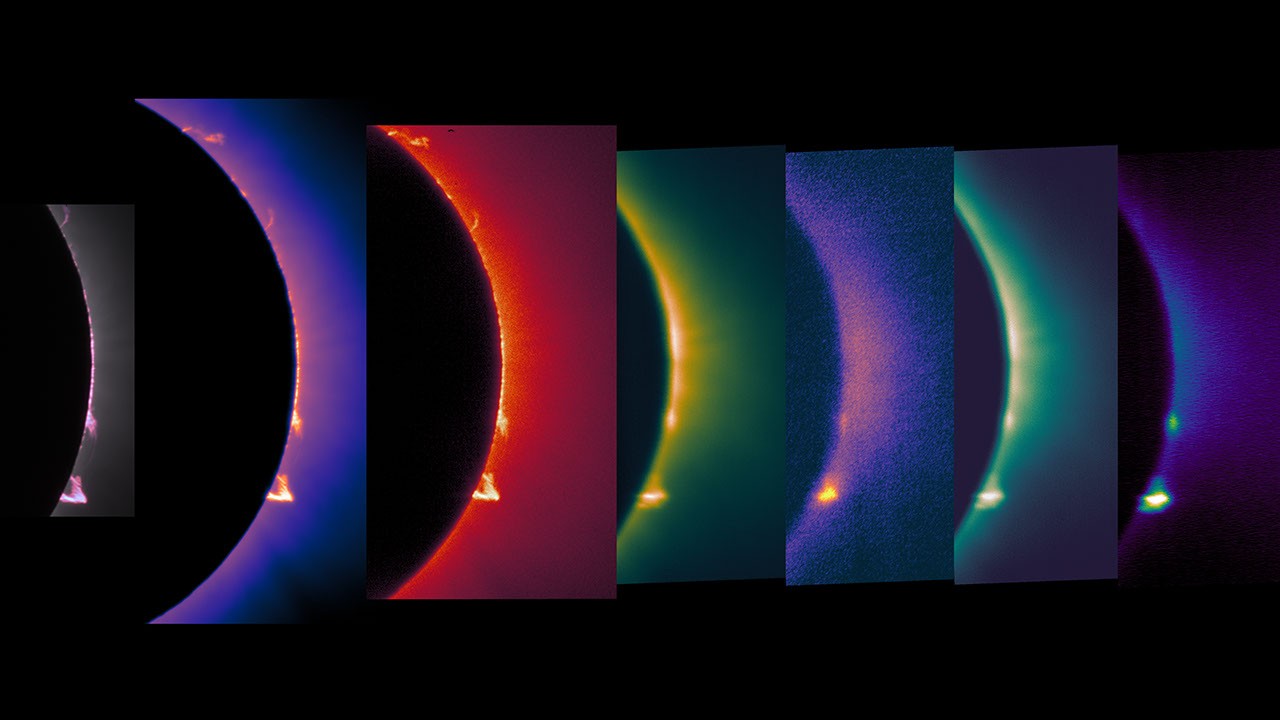
The total solar eclipse crossing Greenland, Iceland, Spain and Portugal on Wednesday will hand scientists the one thing they cannot manufacture: a clear view of the Sun's outer atmosphere with the Sun's own disk blocked out. The problem is that it hands it over for barely two minutes. Along the track the maximum is 2 minutes and 18 seconds, and observers in northern Spain get roughly 1 minute 40 seconds.
NASA's answer is to stop standing still. A WB-57 high-altitude research jet will fly at 50,000 feet carrying the SCIFLI Airborne Multispectral Imager, a suite of four cameras that shoot at least 20 images per second in visible and infrared light. By chasing the Moon's shadow at 460 mph, the aircraft stretches its own totality to nearly three minutes — and it does so above almost all of the atmosphere and any weather that might close in over the ground stations. The experiment is led by Amir Caspi of the Southwest Research Institute in Boulder, Colorado, with support from NASA's Heliophysics Low Cost Access to Space program.
The target is the corona, the Sun's outer atmosphere, which reaches close to a million degrees while the visible surface below it sits at roughly 5,500 degrees Celsius. Why the outer layer is hundreds of times hotter than the surface it sits on remains one of the genuinely open problems in solar physics. Caspi's cameras are aimed at how prominences form, how the corona is heated, and how coronal material connects to the solar wind that eventually washes over Earth.
A second campaign goes up on balloons. Over Iceland, two university teams will launch roughly 80 balloons across a 26-hour window — from 18 hours before totality to 8 hours after — to measure what happens to the atmospheric boundary layer when the Sun switches off at high latitude in August. That effort is led by Matthew Bernards of the University of Idaho. Over Spain, three more teams will fly six balloons carrying 360-degree cameras to image the shadow from altitude and instruments to track ozone levels through totality. The balloon work sits under the NASA-supported Nationwide Eclipse Ballooning Project, directed by Angela Des Jardins of Montana State University.
The European side is running its own comparison. The European Space Agency's Solar Orbiter is collecting data on the solar atmosphere and wind from close range, and Proba-3 — three spacecraft flying in formation to manufacture artificial eclipses on demand — provides a check against the real thing. Researchers have also published advance simulations predicting what the corona should look like on Wednesday, so that the images coming back can be scored against the models rather than merely admired.
That is the quiet purpose of a modern eclipse campaign. The spectacle is two minutes long. The value is in whether the forecasts of the Sun's magnetic environment — the same models used to predict the space weather that disrupts satellites and power grids — turn out to have been right.