Levitated Micromagnet Spins 2.3 Million Times a Second, a Record, in Dark Matter Search
A 30-micrometer magnet floating in a superconducting trap reached 138 million revolutions per minute and set preliminary limits on axion-like dark matter.

Physicists have levitated and spun a microscopic magnet faster than any levitated magnet before it, and used it to start a search for dark matter. The work, published in Science Advances (DOI 10.1126/sciadv.aee6434), reports the first experiments with a levitated spinning micromagnet.
Tiny levitated magnets avoid contact friction, which makes them useful for detecting extremely weak forces and magnetic fields. Cooling them to extreme cold reduces unwanted motion that can bury faint signals. Spinning magnets are even more sensitive, but levitated micromagnet experiments had mostly studied back-and-forth motion rather than continuous rotation. Earlier spinning-magnet experiments stayed at the macroscopic scale, with magnets about half a millimeter across.
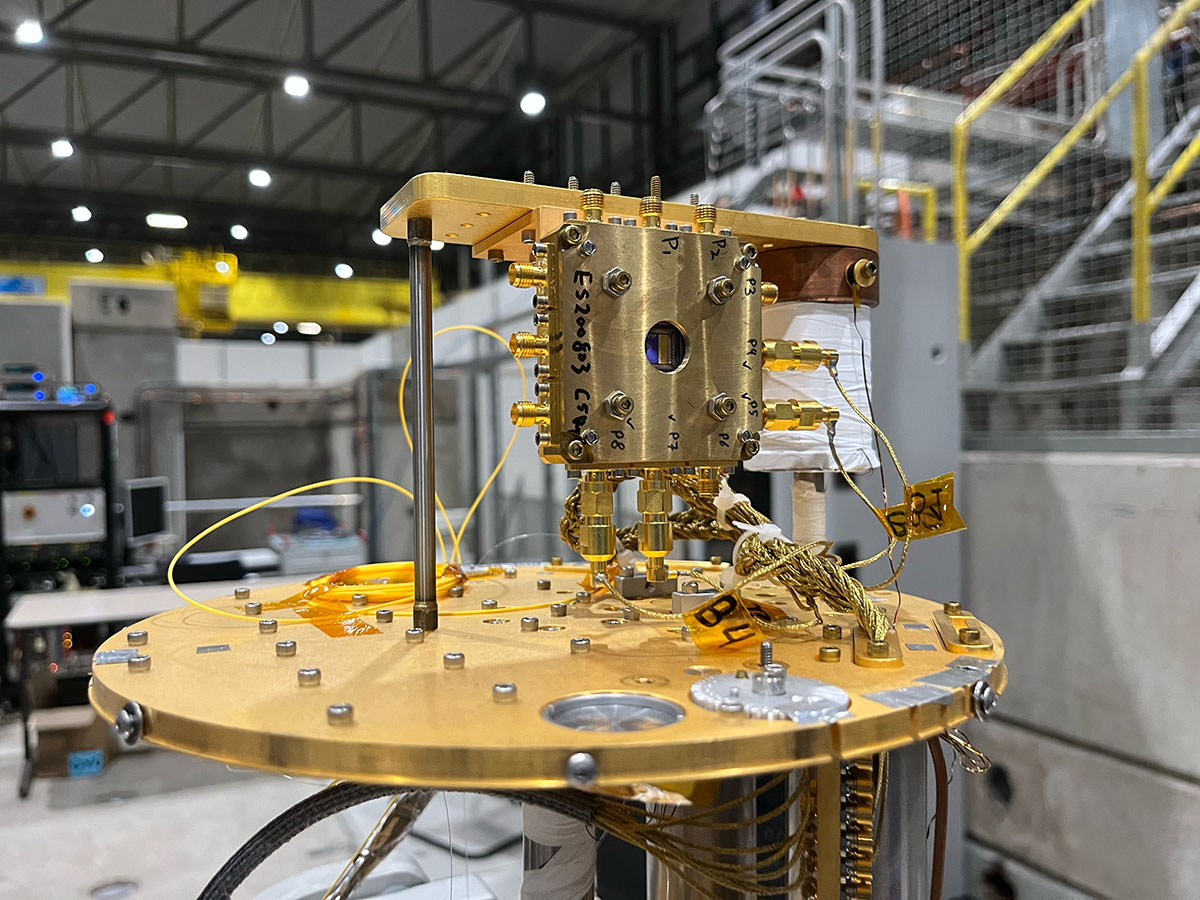
The team levitated magnetic spheres with a radius of about 30 micrometers inside a superconducting lead trap cooled with liquid helium. The superconductor expels magnetic fields through the Meissner effect, which lets the magnet float without active position control. Magnetic coils then accelerated the spheres to 2.3 million revolutions per second, or 138 million revolutions per minute, while an ultrasensitive superconducting detector tracked their rotation and slowdown. The previous record for levitated magnets was 38 million revolutions per minute, set with the half-millimeter magnet.
The experiments ran at about 4.2 kelvin, roughly minus 269 degrees Celsius. The magnet slowed so gradually that its speed decayed with a characteristic time of about 24 days, the lowest damping rate ever measured in a levitated micro- or nanosized object. In a separate, slower experiment, the rotor's magnetic-field sensitivity matched the best previously shown with a nonspinning levitated magnet of similar size.
The team also synchronized a rotor with an oscillating magnetic field so that it could measure tiny twisting disturbances. That allowed a preliminary search for signatures of axion-like dark matter, hypothetical particles that are leading candidates for cold dark matter. The search covered only a very narrow frequency range and found no signal, but it placed limits on how strongly such particles could interact with electrons. The authors write that their upper limit on the axion-electron coupling is "close to the best laboratory-based limits inferred from fifth-force experiments." They stress the "very preliminary nature" of the measurement and say a more thorough, wideband search is left to future work.
The most immediate use is as a pressure sensor. The authors show the spinning rotor can work as a cryogenic pressure gauge at 4.2 kelvin across pressures down to 10 to the minus 8 millibar. The lowest operating temperature previously reported for a spinning rotor gauge was 77 kelvin. Such measurements could help characterize the environments inside quantum technology experiments, where stray gas collisions disturb delicate systems.
Other possible uses include precision rotation sensing, gravity sensors and tests of materials under extreme mechanical stress. The authors add that rotors with elongated shapes, which have a large mass quadrupole moment, could enable measurements such as detecting high-frequency gravitational waves, mechanical tests of spontaneous collapse models, and tests of whether gravity behaves quantum mechanically or classically.