Laser Flashes Line Up Tiny Electric Regions in a Crystal for a Trillionth of a Second
Auburn physicists used short pulses to align 'polar nanoregions' in modified strontium titanate at temperatures where they normally point in random directions.
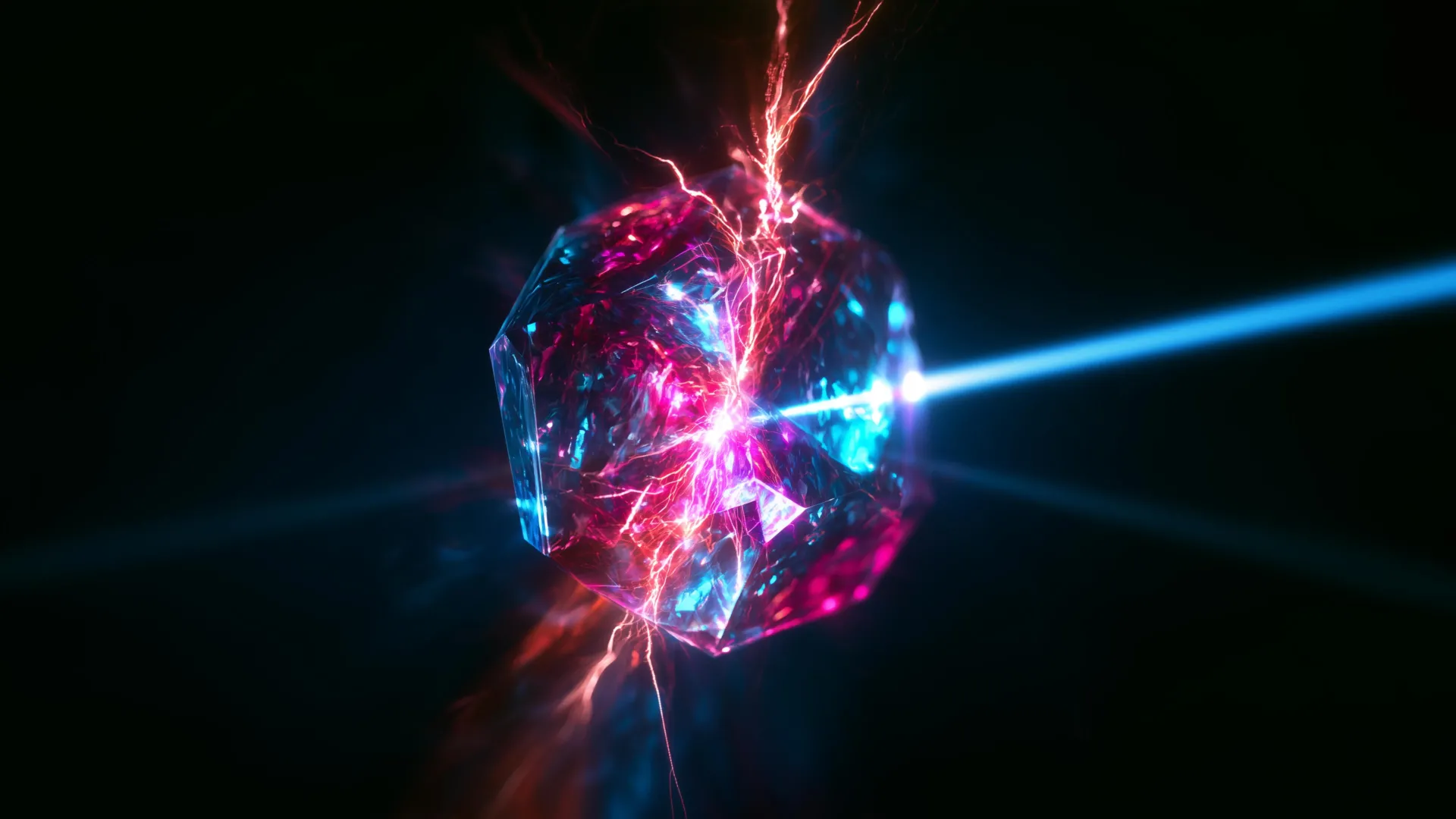
Physicists at Auburn University have used laser pulses to briefly force tiny electrically charged patches inside a crystal into line, in conditions where they would normally point in random directions. The alignment lasts about one picosecond, a trillionth of a second, and the work appears in Physical Review Letters, where editors flagged it as an Editors' Suggestion.
The material is a modified form of strontium titanate, a crystal long used to study quantum behavior. It contains polar nanoregions, tiny zones that each have a positive and a negative electrical side. When the crystal is warm, those regions point in seemingly random directions. When it is cooled, they settle into preferred orientations, which suggests the regions already exist in the warm crystal and cooling simply organizes them.
The team, led by Wencan Jin, the Thomas and Jean Walter Endowed Associate Professor of physics, tested what light could do instead of cold. Short laser pulses temporarily aligned the regions even at higher temperatures, where they would otherwise stay disordered. The paper is titled "Optical Poling of a Quantum Ferroelectric Metal across the Order-Disorder Phase Transition."
Measuring this was hard. The signal is faint and brief, so the group built a highly sensitive optical system that tracks how the crystal changes the light passing through it. Graduate student Mohamed Kandil, a co-lead on the study, spent roughly three years on the experiment, and it became his first published paper. The crystals came from Japan's National Institute of Advanced Industrial Science and Technology.
The collaboration began at the American Physical Society March Meeting in 2023. About a year later, the team had refined its equipment enough to reliably detect weak optical signals. In 2025, Kandil saw the disordered regions line up under laser illumination, which Jin called the breakthrough. "This experiment has truly been Mohamed's odyssey," Jin said, adding that "seeing that signal emerge was a thrilling moment for the team."
The authors are Kandil, Yasuhide Tomioka, Yafei Ren, Ryan Comes, Isao Inoue and Jin.
Practical uses are still a future possibility. The researchers say the approach could eventually support faster ways to process and store information. Just as important for now, it gives physicists a new way to study ultrafast electrical processes in quantum materials, where the speed of the response has been difficult to capture.
The result also supports a broader idea: that disorder in these crystals isn't random noise but a set of pre-formed regions that can be steered, which could guide how future materials are designed.


