They Went Hunting One Exotic Particle at Jefferson Lab and Came Back With Two Nobody Ordered
The GlueX experiment aimed a photon beam at protons to confirm a 20-year-old particle candidate. It missed that target and instead found evidence for two previously unseen structures, one of them at the five-sigma threshold physicists treat as a discovery.
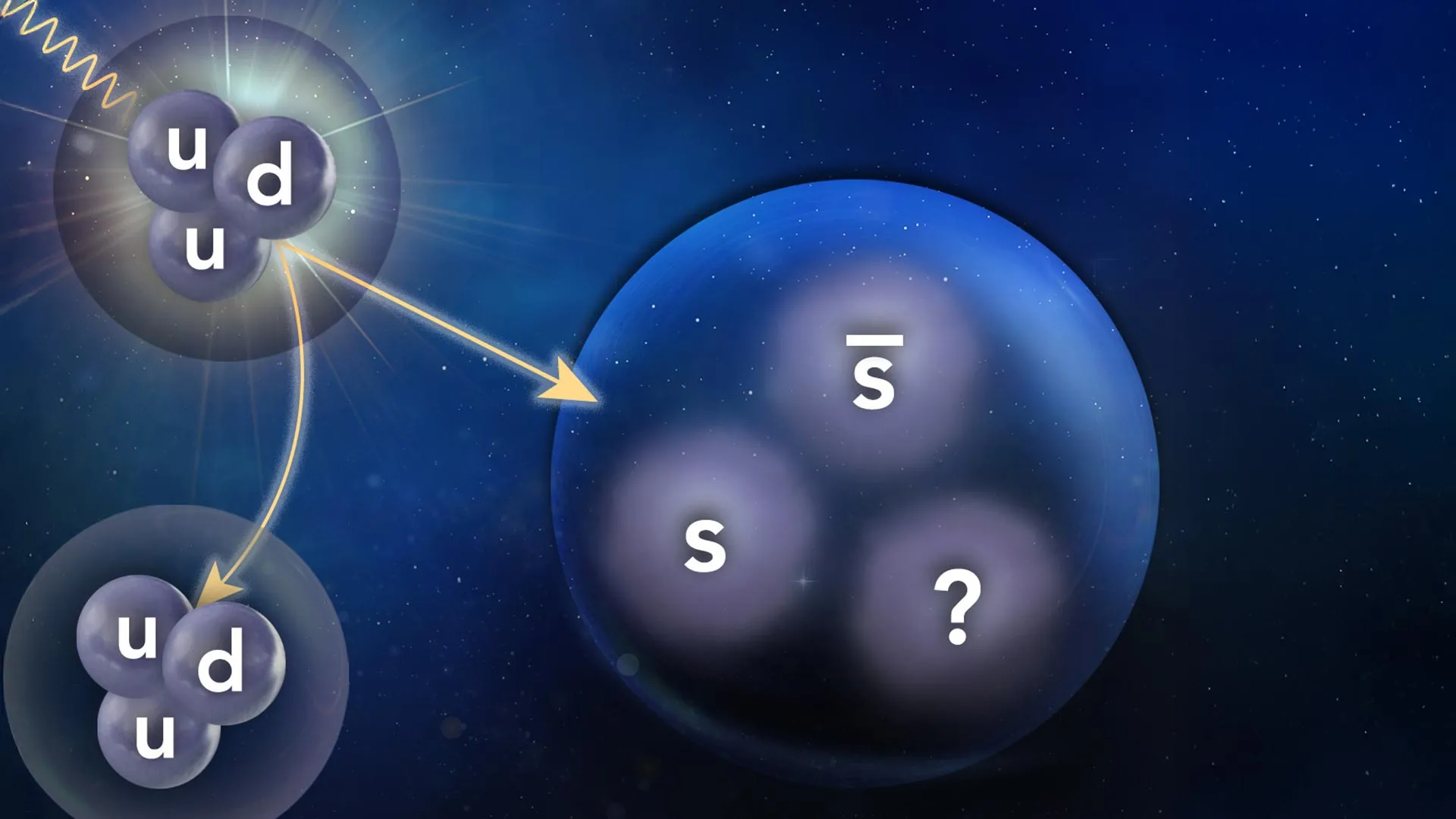
The GlueX Collaboration went looking for Y(2175). It is a particle candidate first reported by the BaBar experiment in 2006, a possible member of the strange menagerie physicists call XYZ states — objects that do not fit the tidy picture of a hadron as either three quarks or a quark paired with an antiquark. Y(2175) had only ever been seen one way, in electron-positron annihilation. GlueX, which runs in Experimental Hall D at the Thomas Jefferson National Accelerator Facility in Virginia, wanted to see whether a photon beam fired at a proton target could produce it too, which would give the field an entirely new handle on these states.
The photon beam did not produce Y(2175). It produced something else. Analyzing the data, the collaboration found evidence for two structures that had not been seen before: one at roughly 2.24 GeV, now labeled Y(2240), and one at roughly 1.82 GeV, labeled X(1830). The results were published in Physical Review Letters, volume 136, issue 25.
The statistics separate the two claims. Y(2240) reached five sigma, the threshold particle physicists treat as discovery — a probability of under one in a million that the bump is a fluctuation in the background. X(1830) came in at three sigma, about 99.7 percent confidence, which is strong enough to report and not strong enough to close the case. "We went searching for a confirmed XYZ candidate with a photon beam but instead found two other structures," said Malte Albrecht, the Jefferson Lab staff scientist who worked on the analysis.
What makes the result useful beyond the two new entries is the production mechanism. If photons striking protons can make objects in this mass range at all, then a large class of exotic-state measurements that were previously restricted to electron-positron colliders becomes available at a fixed-target photon facility, where the experimental handles are different and the backgrounds behave differently. "It really opens the door for a whole new set of hadron spectroscopy measurements," said Justin Stevens, a physics professor at William & Mary and a GlueX spokesperson.
Whether Y(2240) and X(1830) are four-quark bound states, loosely bound molecules of two conventional hadrons, or something more mundane hiding in the data is exactly what the next round of measurements has to settle. Quantum chromodynamics permits configurations well beyond the two textbook ones, and the past two decades have turned up dozens of candidates without a consensus on what most of them are. Frank Nerling, a physicist at the GSI Helmholtz Centre who worked on the study alongside GSI colleague Klaus Goetzen, summarized the state of play with some resignation. "First, a zoo of hadrons was discovered," he said. "Now, we're facing a zoo of exotic states."


