Physicists Found a Droplet That Holds Itself Together Using Nothing But the Pauli Exclusion Principle
A Monash team predicts a self-bound quantum liquid made of bosons and fermions, where the pressure that stops electrons from stacking up exactly cancels the attraction that should collapse it.

A droplet of water holds its shape because its molecules pull on each other and, at short range, shove back. Physicists at Monash University say the same balancing act can be built out of ultracold atoms with no chemistry involved at all — and that the shoving comes from one of the strictest rules in quantum mechanics.
Writing in Physical Review Letters, a team led by PhD candidate Sam Foster, with Associate Professor Jesper Levinsen, Professor Meera Parish and co-author Olivier Bleu, along with collaborators at Heidelberg University, predicts a stable, self-bound "quantum droplet" formed from a mixture of two fundamentally different kinds of particle: bosons, which are happy to pile into the same state, and fermions, which are forbidden from doing so.
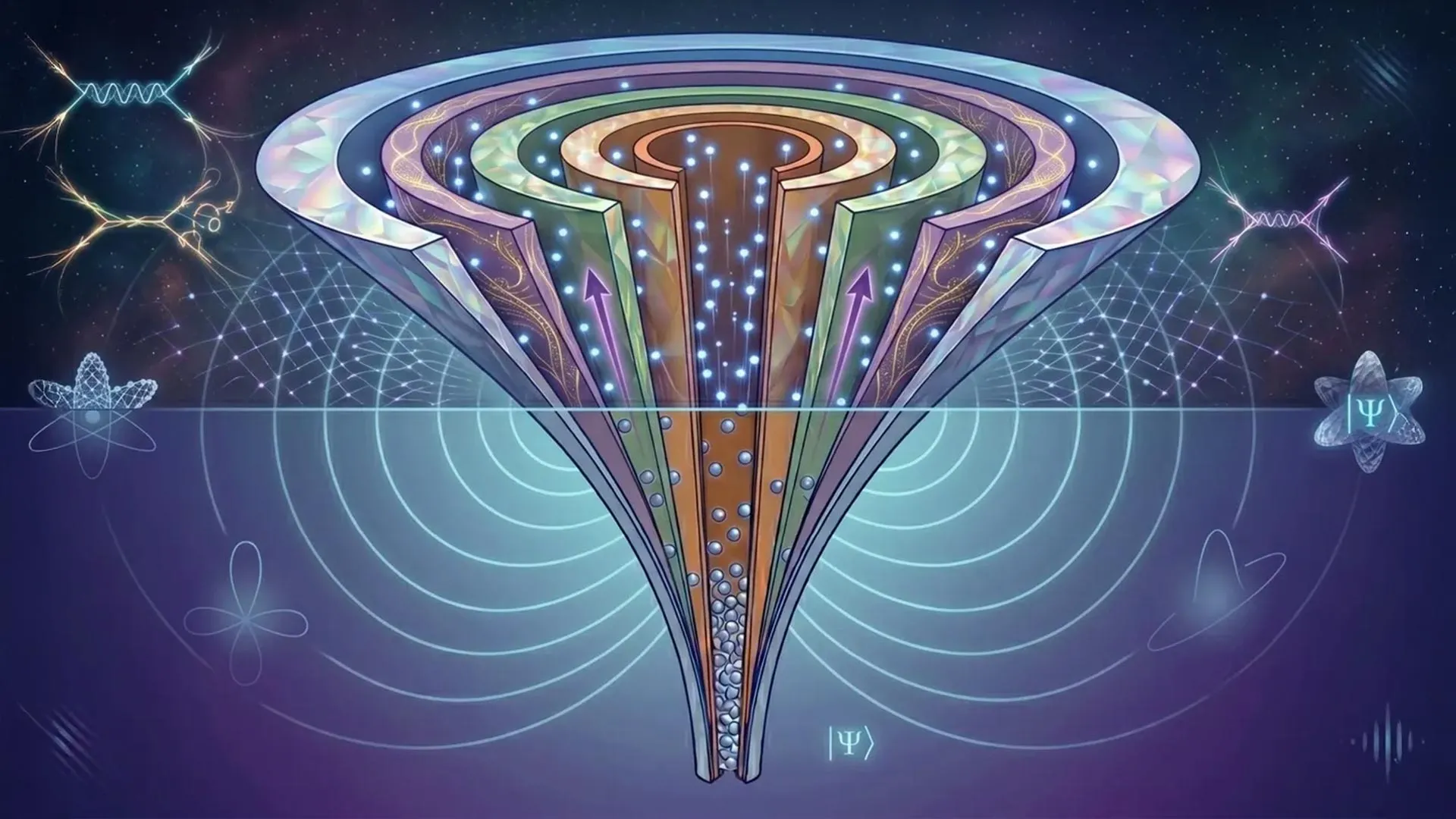
That prohibition is the Pauli exclusion principle, and it has a mechanical consequence. Because no two identical fermions can occupy the same quantum state, squeezing a cloud of them forces particles into higher-energy states, and the cloud pushes back. This is called degeneracy pressure, and it is the same effect that holds up a white dwarf star against its own gravity. In the Monash calculation, the attraction between bosons and fermions in a strongly interacting mixture is precisely counterbalanced by that fermion pressure — so instead of collapsing to a point or dispersing into empty space, the mixture settles at a finite density and simply sits there.
"Quantum systems can behave in ways that seem impossible in our everyday world," Foster said. "We've shown that these two very different types of particles can balance each other perfectly to create a stable droplet."
The result matters because of where it sits on the difficulty curve. Bose-Fermi mixtures have been studied for two decades, but the theory has largely been confined to the weakly interacting regime, where the attraction between species is gentle enough that standard approximations survive. Push into strong interactions and the usual tools break down, which is exactly the region where the interesting physics has been suspected to live. The Monash framework is designed to work there, and it overturns a long-running assumption that strongly interacting mixtures of this kind must simply collapse.
The prediction is not exotic to test. Self-bound droplets have already been produced in purely bosonic mixtures, and the ingredients here — a degenerate Fermi gas overlapping a Bose-Einstein condensate, with the interaction strength tuned by a magnetic field through a Feshbach resonance — are standard equipment in ultracold atom laboratories. The authors argue the droplets should be reachable with existing setups.
If they are, the payoff is a new state of matter that exists in free space rather than inside a trap, and a clean laboratory for the strongly interacting regime. The team suggests such systems may hide considerably more complex quantum phases than anyone has catalogued, with potential downstream uses in quantum computing hardware and precision sensing.