Giant Fire Tornadoes Could Clean Up Oil Spills Faster With Less Pollution
Researchers show that controlled fire whirls consume up to 95% of oil while cutting soot emissions by 40% compared to traditional burning methods.
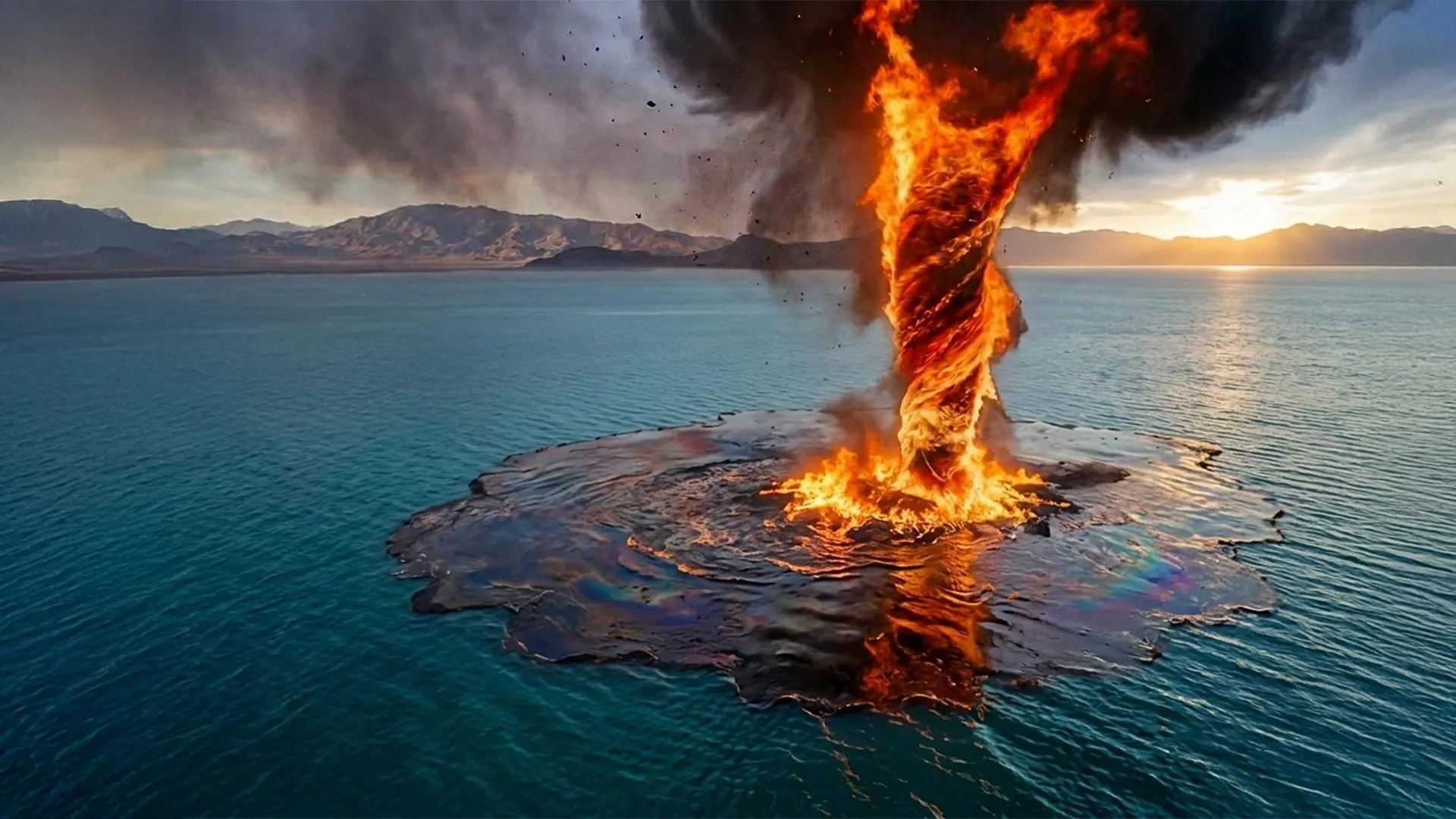
Scientists have demonstrated that controlled fire whirls—spinning columns of flame resembling fire tornadoes—could revolutionize how emergency crews respond to major oil spills at sea. In a first-of-its-kind large-scale study, researchers found that these rotating flames burn oil nearly twice as fast as conventional methods while producing significantly less pollution, potentially transforming oil spill cleanup operations.
The research, led by Dr. Elaine Oran and Dr. Qingsheng Wang of Texas A&M University and Dr. Michael Gollner of the University of California, Berkeley, addresses a critical challenge in marine environmental disasters. When oil spills occur at sea, emergency responders often face the difficult choice between allowing oil to spread toward coastlines or conducting in situ burns that produce thick black smoke and leave behind unburned residue floating on the ocean's surface.
Fire whirls offer a dramatically more effective alternative to traditional burning techniques. The rotating vortex draws in large amounts of oxygen, creating hotter and more efficient flames that consume oil more completely. In laboratory tests supported by the Bureau of Safety and Environmental Enforcement, the fire whirls consumed up to 95% of the oil while reducing soot emissions by approximately 40% compared to conventional burning methods.
"This the first time anyone has conceived using fire whirls for oil spill remediation, and it's really just the beginning," said Professor Oran of Texas A&M's aerospace engineering department. "Our goal is to harness the chaotic nature of fire whirls as a powerful, precise restoration tool, to protect coastlines, marine ecosystems and the environment as a whole." The technique could give cleanup crews critical time advantages, allowing them to eliminate oil before it spreads into sensitive marine habitats.
Speed represents one of the most promising advantages of the fire whirl approach. The faster removal rate could prove crucial in preventing spills from reaching protected coastal regions and sensitive ecosystems. The reduced smoke production also addresses one of the biggest drawbacks of traditional oil burning operations, which generate massive amounts of atmospheric pollution. The research introduces an unconventional but potentially powerful new strategy for dealing with environmental disasters like the 2010 Deepwater Horizon spill, which killed 11 workers and caused widespread damage to ocean ecosystems throughout the Gulf of Mexico.