Galaxies Are Still Spinning the Way Gravity Told Them To 13 Billion Years Ago — and It Shows Up at 7 Sigma
Tidal torque theory says a galaxy's rotation was set before the galaxy existed, by uneven gravity tugging on the clump of matter that became it. A Xiamen University team reconstructed the primordial density field and found the fingerprint intact.

Astronomers have found that the direction galaxies spin today still encodes the pattern of gravitational forces that acted on them before they were galaxies at all — a signal detected at about 7 sigma, a level of statistical confidence that effectively rules out coincidence.
The result, led by Ming-Jie Sheng at Xiamen University and published in Nature Astronomy, is a direct test of tidal torque theory, an idea that has been standard textbook cosmology for decades without ever being confirmed observationally with this kind of force.
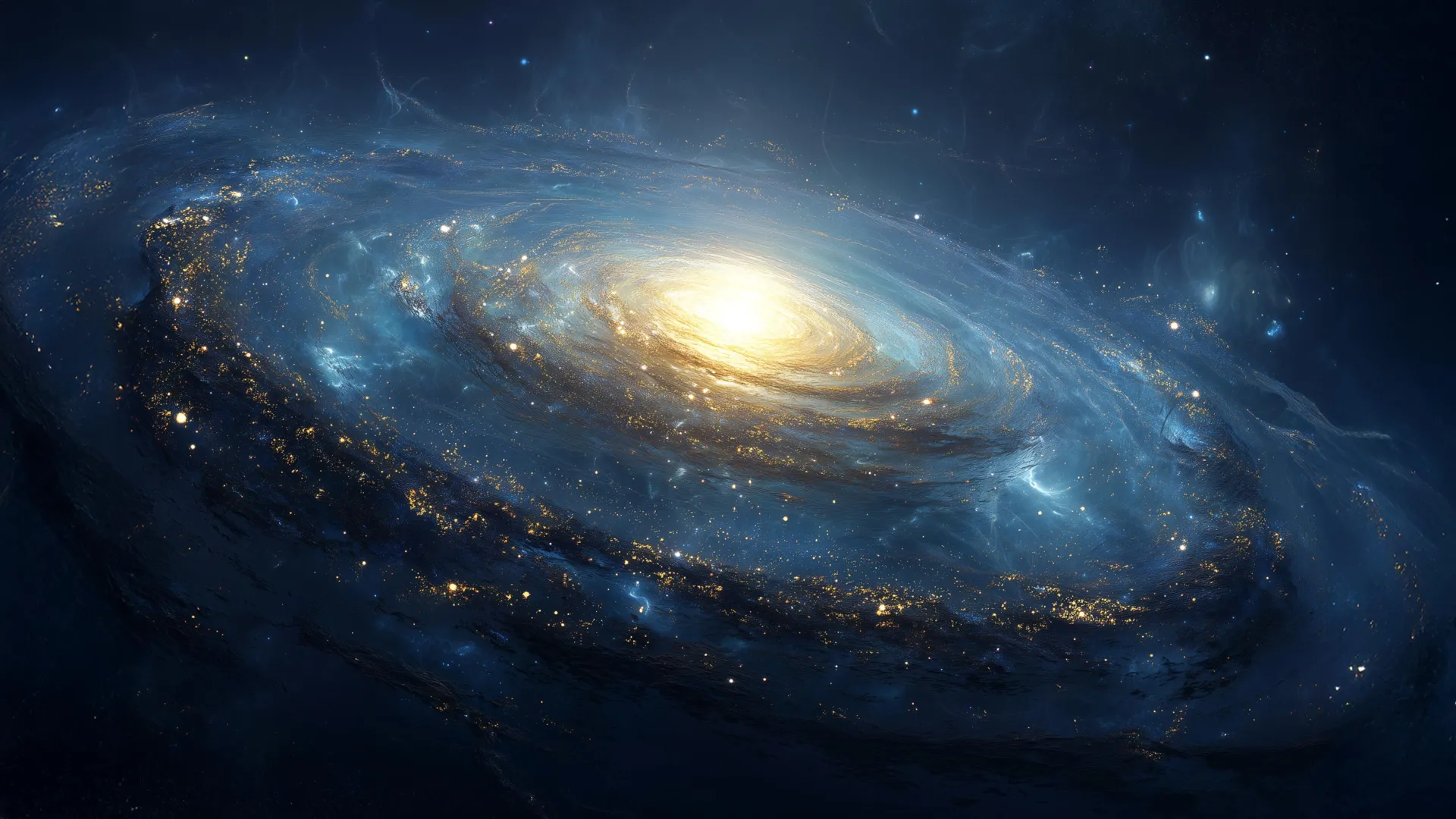
The theory addresses a question that sounds simple and is not: why does anything in the universe spin? The early universe was very nearly smooth, with density varying by roughly one part in 100,000. Those tiny variations grew under gravity into the clumps that became galaxies. But a perfectly spherical clump collapsing symmetrically would have no reason to rotate. Tidal torque theory's answer is that the clumps were not spherical. They were elongated, and the surrounding matter distribution was uneven, so different parts of a proto-galaxy felt gravitational pulls of different strength and direction. That imbalance applied a torque. The clump began to turn, and it kept turning, carrying that angular momentum forward as it collapsed into a galaxy.
If that account is right, a galaxy's spin axis today should still point in a direction predictable from the gravitational field of the primordial universe — the field as it existed before the galaxy formed. That is an extraordinary claim to test, because it requires knowing what the early universe's matter distribution looked like in the specific region that produced a specific galaxy.
The team got at it using the ELUCID project, which reconstructs the primordial density field of the nearby universe by running the observed present-day positions of galaxies backward through a model of gravitational evolution. From that reconstructed early field, they calculated the tidal torques that should have been applied to each region, and therefore which way each resulting galaxy ought to be spinning. Then they compared those predictions with measured angular momentum vectors derived from the observed motions of gas and stars in real galaxies.
The correlation was strongest in the gas component of central massive elliptical galaxies, where the alignment between predicted and observed spin directions reached roughly 7 sigma. That the signal survives at all in ellipticals is notable, because massive ellipticals are precisely the galaxies with the most violent histories — built through repeated mergers, the kind of chaotic assembly that should scramble any memory of initial conditions. The gas evidently retains the imprint even when the stellar component has been thoroughly stirred.
The practical payoff extends past confirming a theory. If galaxy spins are a readable record of the primordial tidal field, they become a new observational handle on the early universe's contents. The authors point specifically at neutrino mass: neutrinos, being light and fast-moving, smooth out gravitational structure on small scales in a way that depends on how heavy they are, and that smoothing would alter the tidal pattern galaxies inherited. Reading spins may offer a route to measuring properties that are otherwise inaccessible.