Undergraduate Students Build 'Cosmic Radio' to Hunt for Dark Matter Particles
Hamburg university students construct functional axion detector with limited resources, establishing new experimental limits on dark matter properties.
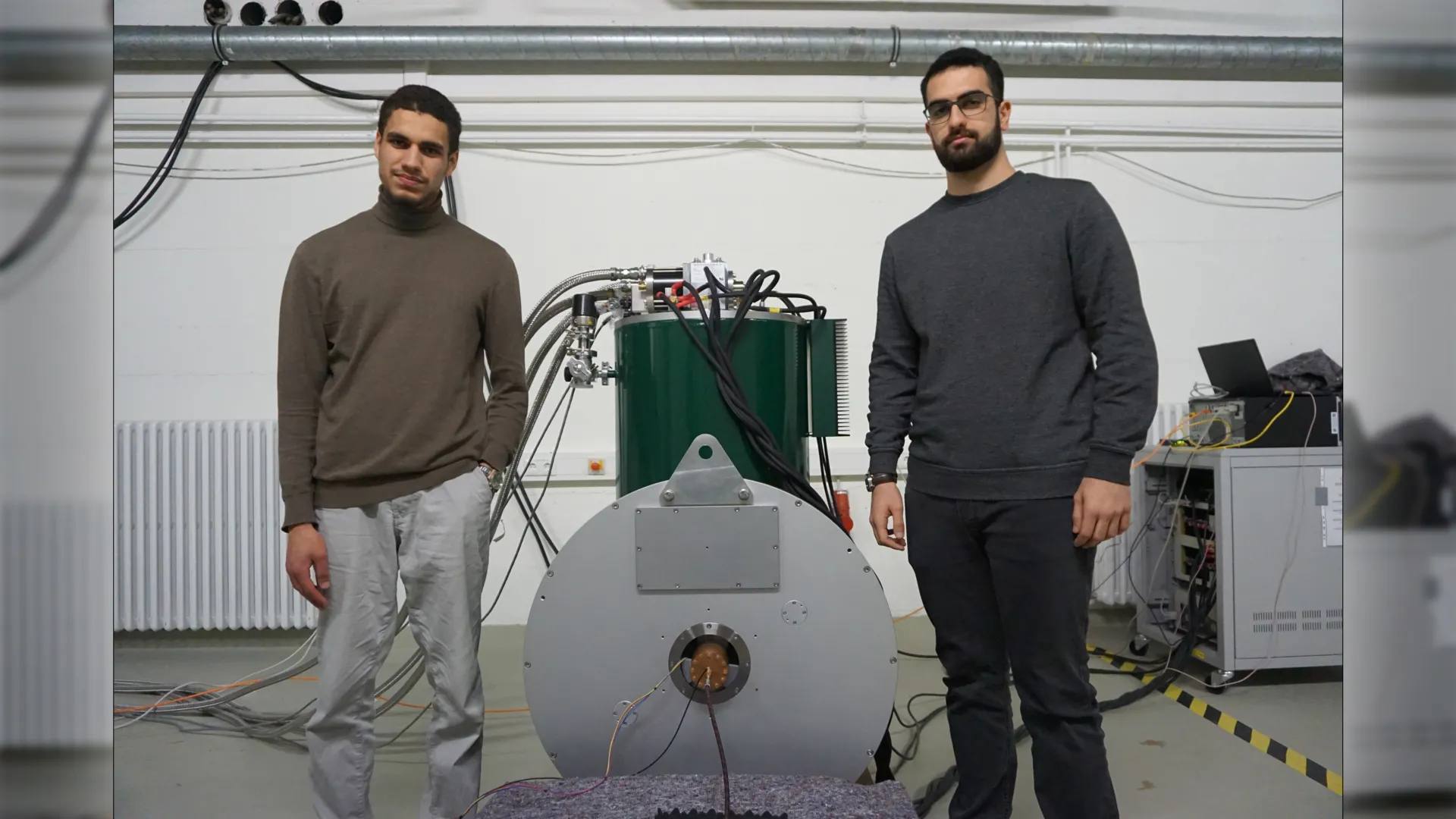
A group of undergraduate students at the University of Hamburg has successfully built and operated their own dark matter detector, demonstrating that meaningful contributions to fundamental physics research don't always require massive international collaborations or enormous budgets. Their project, funded through a student research grant, created a functional cavity detector capable of searching for axions—hypothetical particles that could make up the mysterious dark matter that comprises most of the universe's mass.
The student-led team, including Nabil Salama and first author Agit Akgümüş, designed what they describe as "essentially the simplest version of a cavity detector for dark matter." Their stripped-down experimental setup centered on a resonant cavity made from highly conductive materials, integrated with the necessary electronics, cabling, structural supports, and measurement tools. Despite working with limited resources, they were able to establish new experimental limits on axion properties and publish their results in the Journal of Cosmology and Astroparticle Physics.
"The benefit of working with dark matter, or axions, is that we expect it to be present everywhere in our galaxy," explained Akgümüş, who is pursuing a master's degree in Mathematical Physics. "So essentially, no matter where you perform the experiment, you have some dark matter on your hand you can do experiments with." This ubiquity of dark matter allowed the students to conduct meaningful research without requiring exotic locations or specialized facilities that larger experiments typically need.
The project received crucial support from the University of Hamburg through the Hub for Crossdisciplinary Learning, as well as assistance from the MADMAX dark matter experiment research group. The students also benefited from access to key equipment including a powerful magnet and guidance from experienced researchers in the Quantum Universe Cluster of Excellence. This institutional support proved essential in helping the team navigate the technical challenges of building a functional particle physics detector.
While the student-built detector was less sensitive than larger, more complex experiments and could only search within a limited parameter range, it still produced genuine scientific data that advanced the field's understanding of dark matter. "We reduced very complex experiments to their essential components," noted Salama. "The result is a less sensitive setup, limited to a small search window, but still capable of producing new scientific data." The success demonstrates that creative approaches and dedicated effort can enable meaningful contributions to cutting-edge physics research even with modest resources.