Chinese Physicists Confirm 80-Year-Old Quantum Prediction That Could Let Dark Matter Detectors See Particles They've Always Missed
The first direct measurement of the Migdal effect — a secondary electron signal produced when dark matter nudges an atomic nucleus — validates a key tool for detecting lighter dark matter candidates and immediately upgrades sensitivity projections for every major search experiment.

Chinese physicists have reported the first direct experimental evidence of the Migdal effect — a quantum mechanical phenomenon first predicted in 1939 that could fundamentally transform the search for dark matter by making detectors sensitive to far lighter particles than conventional approaches allow. The finding, published in January 2026 by a team at the China Jinping Underground Laboratory in Sichuan province, confirms a decades-old theoretical prediction that had never been verified in a controlled laboratory environment and opens a new detection window for one of physics' most enduring mysteries.
Dark matter is believed to constitute approximately 85 percent of all matter in the universe — the invisible scaffolding that holds galaxies together and explains why they rotate faster than the visible mass within them should permit. Despite decades of increasingly sensitive experiments, no direct detection has been confirmed. Most searches over the past 30 years targeted weakly interacting massive particles, or WIMPs, which interact with ordinary atomic nuclei at masses roughly comparable to a proton or heavier. But a succession of null results has driven the field toward lighter candidates, and the Migdal effect is one of the most promising theoretical handles for detecting them.
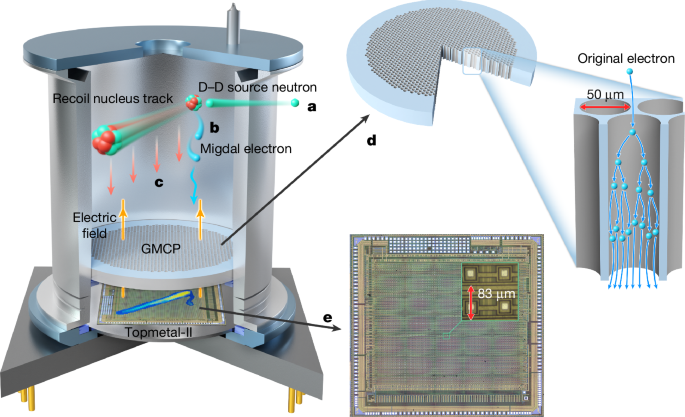
The effect describes a secondary quantum process: when a dark matter particle strikes an atomic nucleus and sets it recoiling, there is a quantum-mechanical probability that the recoiling nucleus drags its electron cloud imperfectly behind it, causing one or more electrons to jump to higher energy states or escape the atom entirely. This secondary electron signal is substantially larger and more easily measured than the tiny nuclear recoil alone, allowing detectors to register collision events that would otherwise fall below their detection threshold. Detecting it experimentally had remained elusive because the effect is rare and because calibrating it requires a precisely characterized source of nuclear recoils at very low energies — a technical challenge that nuclear physics facilities have only recently achieved.
The Chinese team, using a germanium detector at the China Jinping Underground Laboratory — the world's deepest such facility at 2,400 meters of rock overburden — placed the detector in front of a nuclear reactor whose neutron flux was precisely characterized. Neutron-nucleus collisions mimic the nuclear recoils that dark matter candidates would produce, providing a controlled stand-in for dark matter. The team then looked for electron signals correlated with the predicted Migdal rate at multiple neutron energies and observed them at greater than five-sigma statistical confidence — the threshold the physics community recognizes as a discovery. "This detection enables the conversion of faint nuclear recoils into measurable signals, enhancing sensitivity to light dark matter candidates," the authors wrote.
The experimental confirmation has immediate practical consequences for the entire dark matter search community. Major experiments including LUX-ZEPLIN in South Dakota, XENON in Italy, and the newly commissioned SuperCDMS at SNOLAB in Canada have all begun incorporating Migdal-effect analyses into their published searches. For LUX-ZEPLIN, which uses liquid xenon as its detection medium, the Migdal channel could extend sensitivity to dark matter candidates roughly ten times lighter than WIMPs without any hardware changes. For SuperCDMS, which uses germanium and silicon crystals — the same material the Chinese team used — the calibration data provides a direct measurement of the Migdal rate that experimenters need to calculate expected signal counts in their detectors. The Chinese measurement does not itself detect dark matter; it calibrates the tool that future experiments will use to look for it. But physicists say it removes one of the last major obstacles to searches in the sub-GeV mass regime, a region that theoretical models increasingly favor as the most likely hiding place for dark matter if it exists at masses accessible to terrestrial experiments.