Scientists Achieve One-Way Quantum Synchronization That Resists Real-World Interference
RIKEN researchers develop technique combining quantum effects to create robust nonreciprocal synchronization for practical quantum technologies.
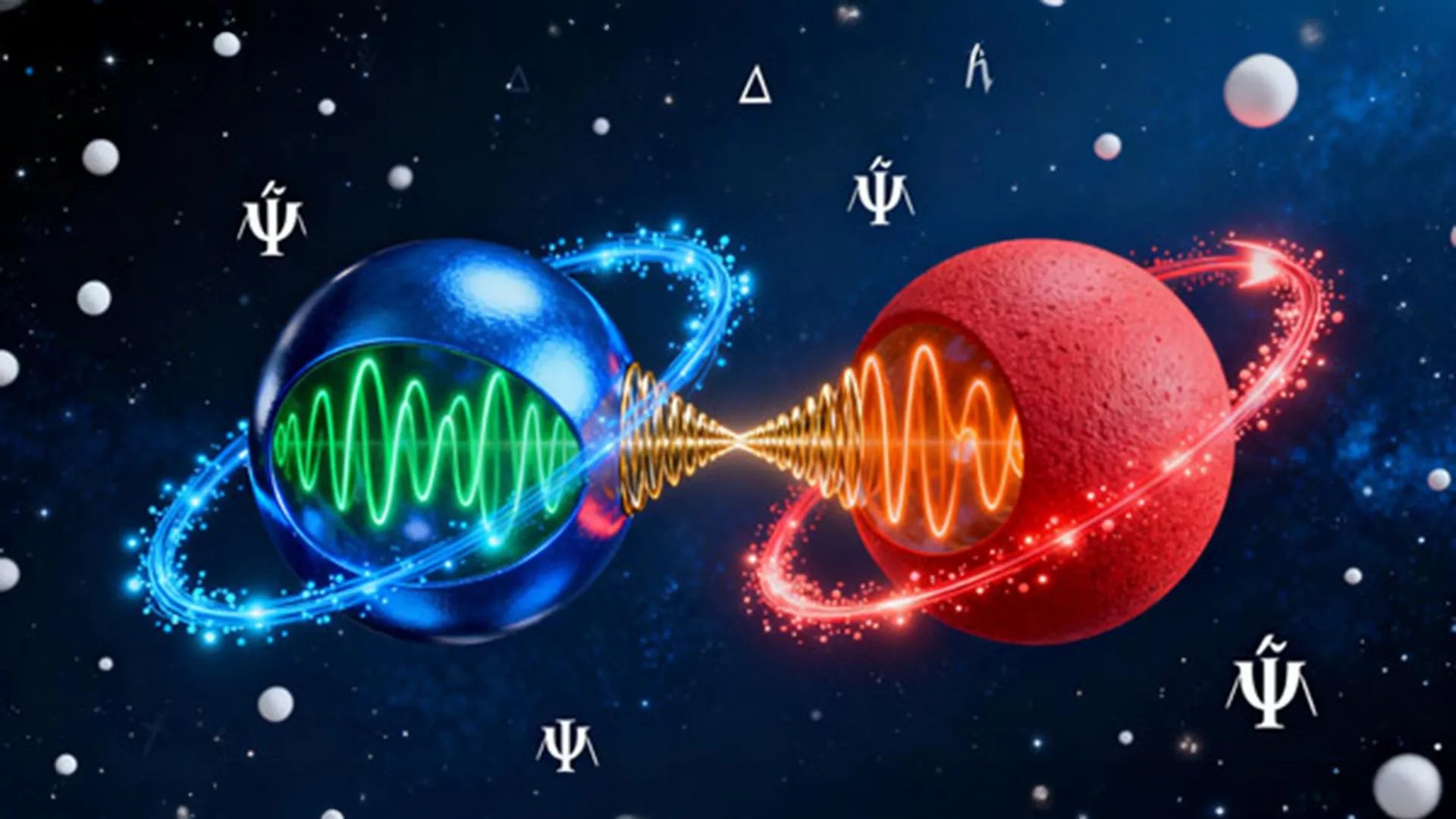
A team of theoretical physicists at RIKEN has proposed a groundbreaking approach to achieve one-way quantum synchronization of phonons, sound particles that could revolutionize quantum computing reliability. The innovative technique stands out because it maintains effectiveness even when faced with significant real-world challenges such as manufacturing imperfections and environmental noise, two major obstacles that have long hindered the practical implementation of quantum technologies. Unlike previous approaches that typically succumb to these limitations, the new method demonstrates surprising resilience that could finally bridge the gap between laboratory quantum experiments and real-world applications.
The research addresses a critical need in quantum technology for nonreciprocal components that function like one-way streets for particles or signals. These devices allow movement in one direction while restricting flow in the opposite direction, similar to how traffic flows on a one-way street. "Nonreciprocal components enable signals to travel along desired paths, whereas they are strongly attenuated in the opposite direction," explains Franco Nori of the RIKEN Center for Quantum Computing. Such directional control finds applications ranging from signal processing to advanced cloaking technologies, making it essential for developing practical quantum systems.
Despite considerable scientific interest, developing a practical method for achieving nonreciprocal quantum synchronization has proven exceptionally difficult. Previous proposals have generally been vulnerable to various limitations that make real-world implementation challenging, particularly when exposed to the inevitable imperfections and environmental disturbances present in any practical system. "Practical quantum technologies face critical challenges from random fabrication imperfections and environmental noise," notes Adam Miranowicz, also of the RIKEN Center for Quantum Computing. "These factors profoundly suppress -- or even completely destroy -- quantum resources in conventional approaches."
The RIKEN team's breakthrough combines two separate quantum effects into a single framework, creating a system where phonons become synchronized when light or magnetic fields are applied from one direction, but synchronization fails when the same influence comes from the opposite direction. This directional sensitivity occurs while maintaining remarkable stability against the types of disruptions that typically destroy quantum effects. "We were thrilled to discover that quantum synchronization persists even in the presence of substantial imperfections and noise," says Deng-Gao Lai, a member of the research team. "Previously, this was thought to be impossible without employing complex protection schemes."
The discovery's implications extend far beyond basic science, potentially enabling the development of quantum computers and other quantum technologies that can operate reliably outside carefully controlled laboratory environments. "This development establishes a new foundation for generating fragile-to-robust nonreciprocal quantum resources with future practical applicability," says Nori. The team's success in creating quantum effects that survive real-world conditions represents a significant step toward making quantum technologies practical for everyday use, bringing closer the day when quantum computers might operate in ordinary offices and homes rather than requiring specialized laboratory conditions.