Quantum Breakthrough Could Revolutionize Teleportation and Computing
Japanese scientists developed the first method to instantly detect quantum "W states," a major milestone that could unlock faster quantum communication and powerful new computing systems.
Scientists in Japan have achieved a groundbreaking quantum physics milestone by developing the first method to instantly detect elusive quantum "W states," potentially revolutionizing quantum teleportation, communication, and computing technologies. The breakthrough, led by researchers from Kyoto University and Hiroshima University, solves a problem that has puzzled quantum physicists for more than 25 years and provides a crucial tool for building the quantum technologies of the future. Unlike previous methods that required exponentially increasing measurements as particle numbers grew, this new technique can identify W states in a single measurement.
Quantum entanglement represents one of the most counterintuitive aspects of quantum mechanics, where particles become so fundamentally connected that measuring one instantly affects the others, regardless of the distance separating them. This phenomenon, which Einstein famously called "spooky action at a distance," forms the foundation for emerging quantum technologies including quantum computers, secure quantum communication networks, and quantum teleportation systems. However, building these technologies requires not just creating entangled states, but also reliably identifying exactly what type of entangled state has been produced.
The challenge of detecting quantum states has been a significant bottleneck in quantum technology development. Traditional quantum tomography methods require an exponentially increasing number of measurements as more particles are added to the system, making them impractical for large-scale quantum systems. While scientists had previously developed single-shot detection methods for Greenberger-Horne-Zeilinger (GHZ) states, the equally important W states had remained beyond reach. W states possess unique properties that make them particularly valuable for certain quantum applications, but their detection required this fundamental breakthrough.
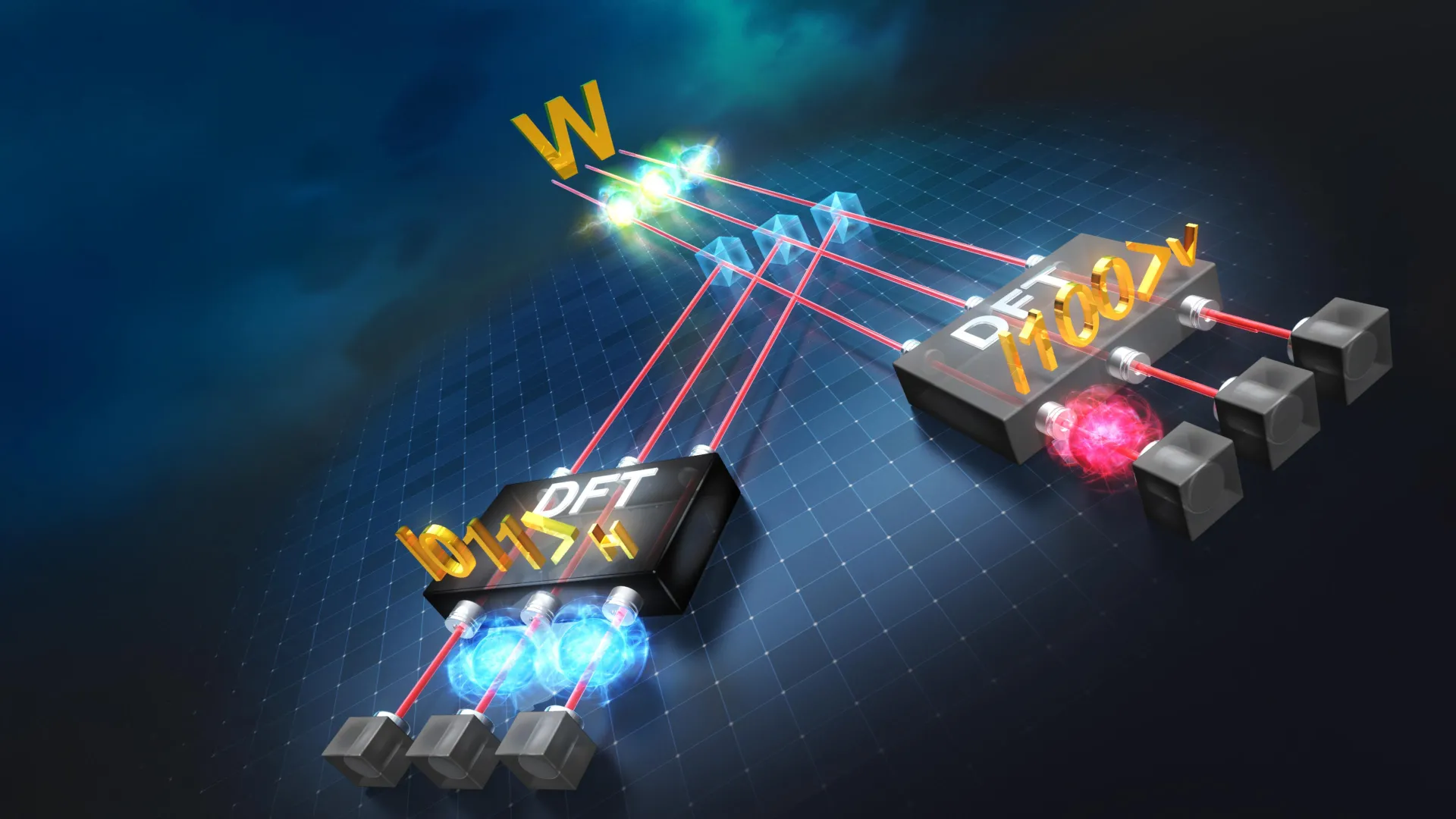
The research team's solution came from recognizing and exploiting the cyclic shift symmetry inherent in W states. By focusing on this mathematical property, the researchers designed a photonic quantum circuit that performs a quantum Fourier transformation specifically tailored to W states. This approach transforms the hidden quantum structure into a measurable signal, allowing for immediate identification without the need for multiple measurements. The team demonstrated their method using three photons in highly stable optical quantum circuits that could operate for extended periods without constant adjustment.
Corresponding author Shigeki Takeuchi emphasized the significance of achieving this long-sought capability, noting that it completes a fundamental toolkit for quantum state detection that began with GHZ state measurements decades ago. The breakthrough has immediate implications for quantum technology development, as reliable state detection is essential for error correction, quantum communication protocols, and the operation of quantum computers. The stability and practical design of the detection system also brings these advanced quantum capabilities closer to real-world applications, potentially accelerating the development of quantum networks and computing systems that could transform information processing, cryptography, and scientific computation.