Police 'Real-Time Crime Centers' Powered by Axon's AI Software Spread While Flock Takes the Heat
Privacy experts tell NPR that command centers that merge cameras, license-plate readers and other feeds into one view of a city deserve more scrutiny than the license-plate cameras drawing protests.
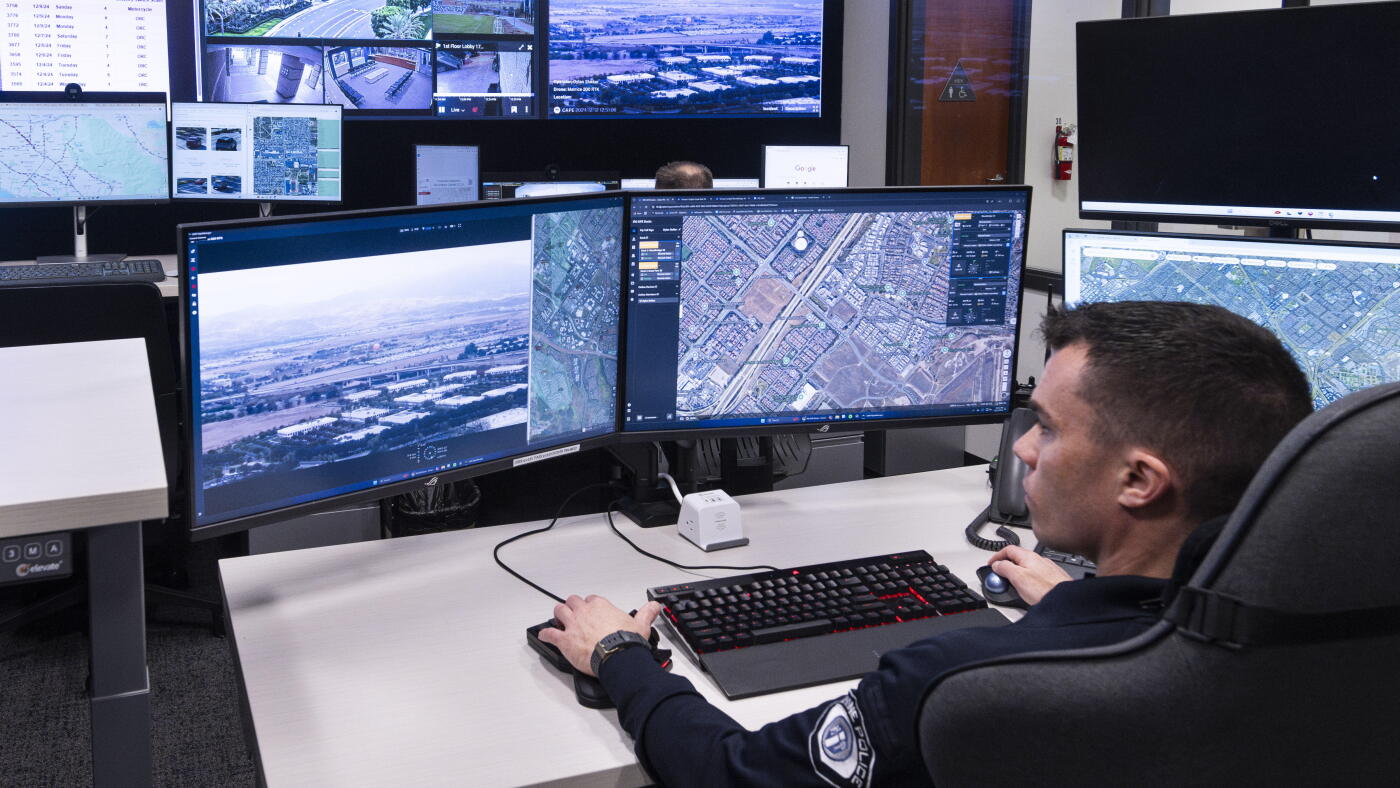
Protesters in cities across the country have targeted Flock Safety's automated license plate readers, the AI-powered cameras that log passing cars. Privacy experts told NPR this week that a quieter technology deserves at least as much attention: the real-time crime center, a hub where police watch a whole city from one room.
Hundreds of departments already run one. Officers describe them as a game changer for finding missing children, monitoring large events and scoping out dangerous scenes before sending an officer in. What has changed is the software behind them. Many are now powered by AI tools such as Fusus, from the public-safety technology giant Axon, which describes it as a "rapidly deployable real-time crime center in the cloud." It works like a brain, pulling in feeds from many sources and synthesizing them for command centers.
Use is growing fast. In 2024, the tech site 404 Media reported that just over 100 law enforcement agencies had deployed Fusus, which was then an independent company before Axon acquired it that year. Axon says the number of agencies using it has more than doubled since.
Police say it saves time. "We could put analysts in a room and have them access 40 different systems," said Benjamin Weir, a captain with the Oklahoma City Police Department. "But that slows them down." Quincy Whitner, a lieutenant with the Greenville County Sheriff's Office in South Carolina, said Fusus helped his department find a man who shot a police officer and fled, by combining city surveillance footage with license plate data. Michelle Iezzi of the Montgomery County, Maryland, police said she understands the concerns but argued, "if you're not up to no good, we're not looking at you."
Legal scholars see a bigger shift. Andrew Guthrie Ferguson, a law professor at George Washington University, said he has watched the Flock debate "with a little bit of puzzlement," because real-time crime centers combine license plate readers with much more. Another expert quoted by NPR warned that older, slower investigative methods imposed "organic friction" that constrained surveillance, and that as the friction disappears it becomes easier to investigate people and pull up broad-scale information.
Axon did not respond to NPR's repeated requests for comment, but its chief executive, Rick Smith, said on the company's latest earnings call that Axon strongly values privacy. "We just have to be thoughtful and understand those concerns," he said, calling the product "a tool to amplify human ability, not to replace human judgment."
The open question is whether oversight written for single-purpose cameras can keep up with systems that fuse dozens of them into one picture, a subject the public has barely begun to weigh.