Israel Finally Answers on the Hamas Disarmament Deal: 'Nothing Less' Than Physically Handing Over the Weapons
Netanyahu's office says it has serious concerns about the sequencing of Trump's 20-point plan, warning that a withdrawal before Hamas actually gives up its arms would let the group expand again.
Israel has broken its silence on the disarmament agreement President Donald Trump announced last week, and the answer is a qualified no. Doron Spielman, a spokesperson for Prime Minister Benjamin Netanyahu, said Israel has serious concerns with the arrangement and rejected any reading of it that would let Hamas keep weapons in place while Israeli forces pull back.
"Disarming means physically giving up the weapons. Nothing less," Spielman said. He framed the objection as one of sequencing rather than principle: "Our assessment is that if we redeploy before Hamas is truly disarmed, it will quickly expand its presence."
The dispute sits inside the 20-point ceasefire framework Trump brokered, which calls for Hamas to surrender its weapons and destroy its tunnel network, for Israeli forces to withdraw from Gaza, for an international security force to deploy, and for a technocratic Palestinian government to take over civil administration. Former British Prime Minister Tony Blair is part of the Trump-led Board of Peace overseeing the arrangement. Hamas agreed last week to begin disarming under the terms of the ceasefire it signed in October 2025 — an agreement now nine months old.
Israel's position turns the plan's central ambiguity into its central problem. The framework does not resolve which side moves first, and both parties have read the sequence in the way that protects them. Hamas has treated withdrawal as the precondition for handing over arms; Israel is now saying explicitly that verified disarmament must precede redeployment. Nine months of the ceasefire have already demonstrated what the gap in between looks like on the ground.
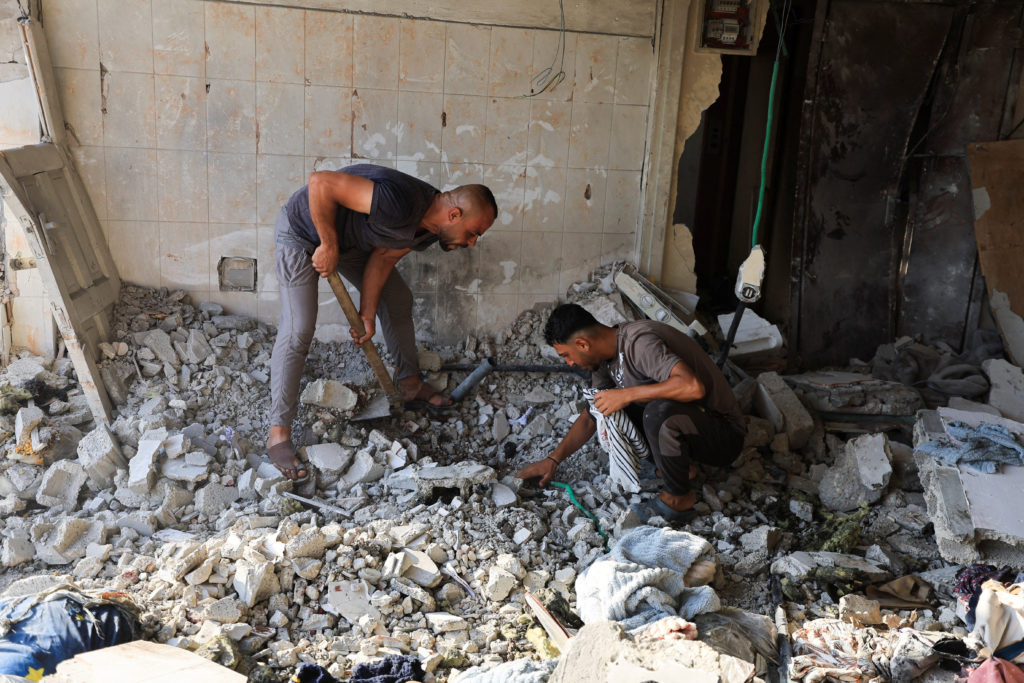
That ceasefire has never fully held. Israeli strikes continued through Sunday, killing at least 17 people including children, according to Palestinian officials, with reported strikes across Deir al-Balah, Gaza City and Khan Younis. Israel controls close to 70 percent of Gaza's territory under the current lines, well beyond what the original ceasefire terms contemplated, and the boundary has repeatedly moved.
The underlying casualty figures remain the grimmest arithmetic of the war. The October 7, 2023, Hamas attack killed roughly 1,200 people in Israel, most of them civilians, and 251 people were taken hostage. More than 73,000 people have been killed in Gaza since, according to the Gaza Health Ministry, whose counts do not distinguish between combatants and civilians. Hamas has dissolved its Gaza government and handed civil administration to a technocratic committee, but the weapons question — who holds them, and when they are surrendered — is the one that has stalled every previous attempt to convert this ceasefire into an ending.
Originally reported by PBS NewsHour.