A Humpback Mother Stayed for Hours, Possibly Days, With Her Stillborn Calf on the Seafloor Off Australia's Gold Coast, Holding Eye Contact and Touching It With Her Head and Fin. It's the First Documented Case of Grief-Like Behavior in the Species.
'At first sight, I thought it was just two whales resting on the surface.' The study, published Wednesday in Discover Animals, says she never tried to lift the calf, suggesting she knew it was dead soon after birth.
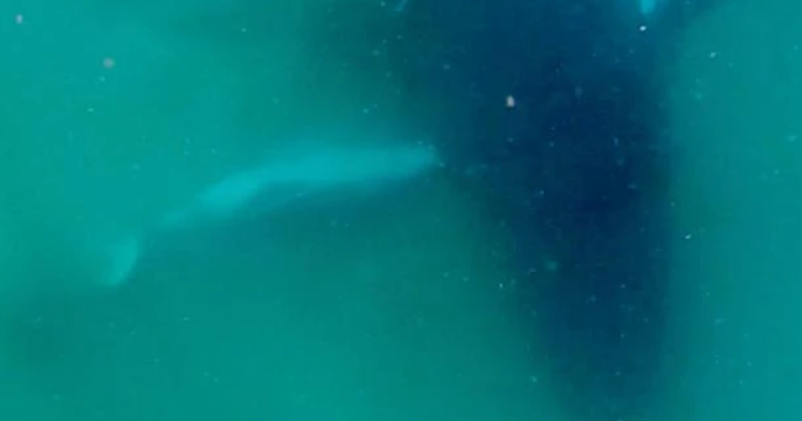
A female humpback whale was filmed keeping vigil over her stillborn calf on the seafloor off Australia's Gold Coast, staying beside the motionless body for hours and perhaps days while holding eye contact and repeatedly touching it with her head and pectoral fin, researchers reported Wednesday in the journal Discover Animals. It is, they say, the first detailed and documented case of what appears to be grief-related behavior in humpbacks.
The footage was captured last year by Andrew Mulville of the Sea World Foundation, who initially mistook the scene for something ordinary. "At first sight, I thought it was just two whales resting on the surface, but their behaviour was unusual," he said. "It was definitely not what I was expecting to see out at sea that day." A second adult whale accompanied the mother throughout.
"It's really sad," said Olaf Meynecke of Griffith University's Whales and Climate Research Program, one of the study's authors. "It's pretty heartbreaking to watch this female making continuous contact with the deceased calf." The mother made no attempt to bring the calf to the surface, which the researchers interpret as a sign that "she might have been aware that it was dead shortly after giving birth." Several other dead calves were observed in the same area at the time.
"To our knowledge, this is the first detailed, documented occurrence of this behaviour for this species," the authors wrote, adding that the mother's actions "may represent a form of grief-related behaviour in humpback whales." Meynecke said the observation speaks to the "strong bond" between mother and calf and to the emotional stages that "socially complex" mammals appear to pass through after losing offspring or companions.
Mourning-like behavior has been recorded in other cetaceans, most famously in 2018, when an orca known as Tahlequah carried her dead calf for 17 days across more than 1,000 miles of the Pacific Northwest. She was seen doing it again last year, days after researchers confirmed a new birth. Elephants and great apes have been observed lingering over dead relatives for years. "But on land we witness this more often," Meynecke said, "whereas at sea it's really rare to document something like this."
Humpbacks are baleen whales, not toothed whales like orcas and dolphins, and they are generally considered less tightly social. That is part of what makes the Gold Coast footage notable. Eye contact, sustained physical touch and the presence of an attending companion are the same features that scientists point to when describing grief in species whose social lives are better understood.
The study joins a run of unusually intimate humpback observations along Australia's east coast. Two months ago a photographer's drone captured what is believed to be the first recorded humpback birth. And in May, researchers reported that one whale photographed off Bahia, Brazil, turned up 22 years later at a breeding ground in Hervey Bay, Queensland, roughly 9,383 miles away, the longest documented movement between breeding grounds for the species.
Originally reported by CBS News.