A Seven-Story Building That Israeli Strikes Had Already Gutted Collapsed on 100 Sheltering Palestinians in Gaza City Overnight. At Least 20 Are Dead, Six of Them Children, and Rescuers Are Digging With Their Hands.
The UN says about 400 of the roughly 2,000 damaged buildings that displaced families are living in across Gaza are at risk of falling down. Egypt sent heavy machinery; Gaza's civil defense director said 'we are still hearing voices from under the rubble.'
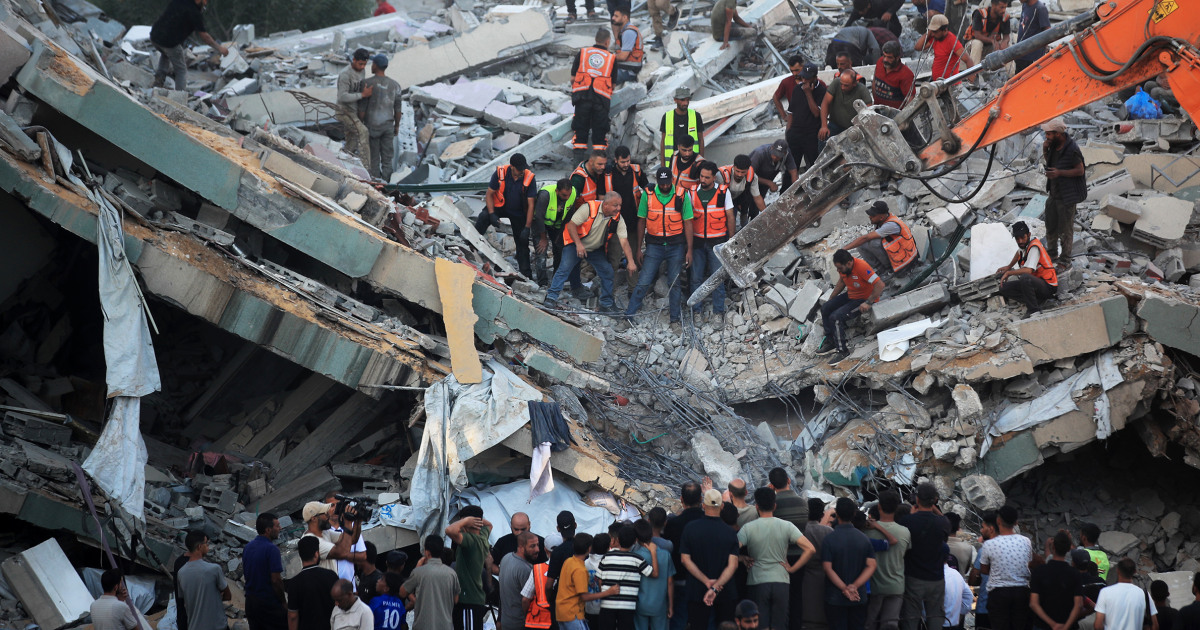
A residential building in western Gaza City that had been hollowed out by earlier Israeli strikes gave way in the middle of the night on Wednesday, September 16, burying scores of displaced Palestinians who had moved in because they had nowhere else to go. By Wednesday evening, Gaza's civil defense agency had confirmed at least 20 dead, including six children, with 14 people wounded and dozens more still unaccounted for beneath the concrete. The death toll rose through the day as bodies were pulled out, and rescuers said it was likely to keep rising.
The seven-story structure, identified by local officials as the Al Saada building, had been home to at least 10 families, close to 100 people in all. The UN's humanitarian coordinator for the Palestinian territories, Ramiz Alakbarov, said roughly 50 of them were children. The building had been hit during the war and was structurally compromised, but with the vast majority of Gaza's housing stock destroyed or damaged, families had crowded into its surviving floors anyway. "No one should have to risk their life simply to find a safe place to shelter," Alakbarov said. "Lives may still be saved, and every effort must be made to reach those trapped. Every minute counts."
The rescue effort has been defined by what is missing. Gaza's civil defense teams have almost no heavy equipment; most of it was destroyed during two years of bombardment, and Israel has limited the entry of machinery and fuel since the ceasefire. Rescuers spent Wednesday clearing slabs by hand and with basic tools. "We are still hearing voices from under the rubble, so there is still hope," said Raed Al-Dahshan, the director of civil defense in Gaza City. Alessandro Mrakic, who runs the UN Development Programme's office in Gaza, said his agency had sent whatever machinery and workers it had. "People digging with bare hands," he said. "We need to prepare for more deaths." By midday, Egypt had sent heavy machinery across the border, and the United Arab Emirates and Qatar had committed relief supplies. The UN issued a request for excavators, specialized rescue gear, tents, tarpaulins, fuel and engine oil.
The collapse is not an isolated event so much as the predictable result of how Gaza's 2 million people are living almost a year after the October 2025 ceasefire. According to UN figures cited by NBC News, roughly 2,000 damaged buildings across the strip are currently inhabited, and about 400 of them are at risk of collapse. The war generated an estimated 61 million tons of wreckage, which the UN says would take about seven years to clear even at full capacity, and clearance is nowhere near full capacity. Aid agencies have been warning for weeks that the coming rainy season will make unstable structures more dangerous, and that families need tents and safer shelter before the weather turns.
The ceasefire itself has not stopped the killing. Gaza health officials say more than 1,300 Palestinians, most of them civilians, have died in Israeli strikes and shootings since the truce took effect, while four Israeli soldiers have been killed in the same period. Separately on Wednesday, Israeli airstrikes in northern and southern Gaza killed at least five people, including two children and a Hamas armed commander, according to health officials. The head of the UN Human Rights Office in the Palestinian territories, Ajith Sunghay, said this week that an estimated 8,000 bodies remain buried under rubble across the strip, and that only about 800 have been recovered since the ceasefire was announced. At the current pace, he said, the recovery alone would take more than a decade.
Civil defense spokesman Mahmoud Basal said crews would keep working through the night. The families who survived the Al Saada collapse have, once again, no place to go.
Originally reported by NBC News.