A Suspected Black Hole in the Large Magellanic Cloud Turns Out to Be Two Bright Stars
New spectra from the Very Large Telescope show the system NGC 1850 BH1 holds no compact object, shrinking its estimated masses to 1.7 and 5.2 suns.

A strange pair of stars in the Large Magellanic Cloud that astronomers thought contained a dormant black hole has turned out to be a black hole "impostor." A new study led by Rhys Seeburger of Liverpool John Moores University finds that the system, known as NGC 1850 BH1, holds two luminous stars and no compact companion at all.
Massive stars are commonly born in binary systems. When one runs out of fuel and explodes, its remnant stays in orbit with the survivor. If that remnant is a black hole and emits almost no X-rays, it is called a dormant black hole. Such objects are hard to find, because the only way to detect them is through their pull on the visible star's motion. Models predict about 100,000 of these systems in the Milky Way, yet only a few have been confirmed, including VFTS 243 in the Large Magellanic Cloud and HD 130298 in our own galaxy.
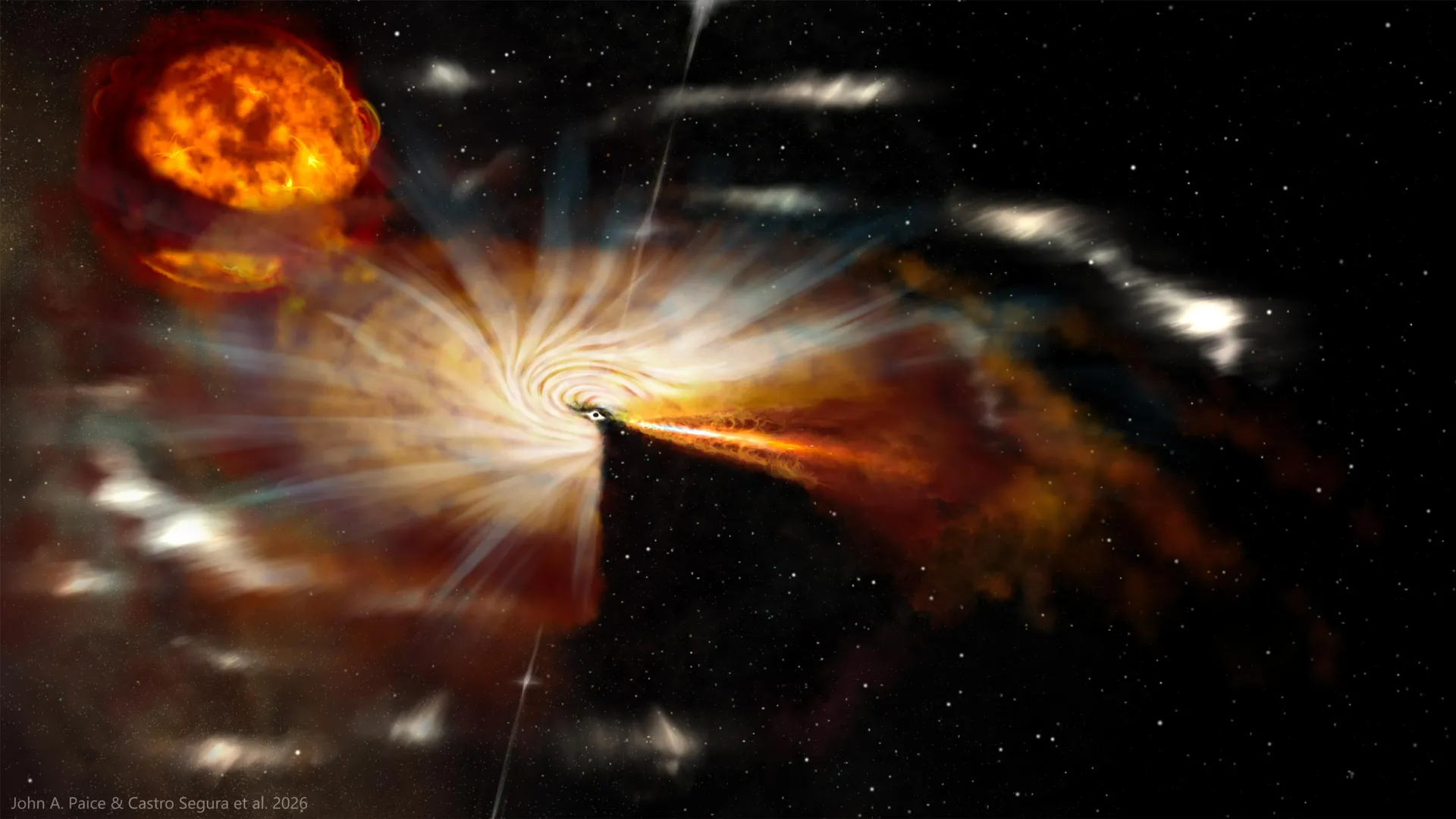
The trouble is that ordinary stars can fake the signal. When mass transfer leaves one star stripped and bloated, it can outshine its partner and mimic a black hole's tug, so impostors creep into the sample. In 2022, researchers interpreted NGC 1850 BH1 as an 11-solar-mass dormant black hole orbiting a 5-solar-mass star in the cluster NGC 1850, arguing that a normal star that heavy would outshine its companion. Later studies pointed elsewhere but did not settle it. The companion could have been a compact object, or a bright star hidden in a thick disk.
The new team used a technique called spectral disentangling, which separates the blended light of two stars into each star's own spectrum. They applied it to fresh, sharper observations from FLAMES, a high-resolution spectrograph on the Very Large Telescope, extending further into the shorter wavelengths where a hidden luminous star would show up more strongly.
The result showed two luminous stars. A comparatively cool, puffed-up, stripped star orbits a more massive, hotter, faster-spinning one, which rotates at a projected velocity of roughly 280 kilometers per second. The simplest explanation, the authors say, is earlier mass transfer between the two. "Spectral disentangling has demonstrated that the system known as NGC 1850 BH1 does in fact not contain a compact companion," the team writes, adding that it falls into the class of impostor systems with two bright components.
The measurements also shrink the masses. Where the system was once described as a 5-solar-mass visible star with an invisible 11-solar-mass partner, the new data give a 1.7-solar-mass donor star and a luminous companion of an estimated 5.2 solar masses.
Open questions remain. The mass ratio is not precisely known, so the system cannot be fully described yet. An earlier study found the companion contributes less than 10% of the light in a certain wavelength range, while this paper finds 30% to 50% in the same range, and the researchers do not know why the results differ. They say the next step is to get sharper, cleaner spectra.
The system still matters. It sits in a cluster whose age, composition and distance are all well known, which makes it a valuable test case for understanding how binary stars interact and how often mass transfer disguises ordinary stars as black holes.