The AfD Won Mecklenburg-Western Pomerania, the Far-Left Die Linke Won Berlin, and Chancellor Merz's CDU Fell to About 5% in a State Where It Once Governed, the Party's Worst Result Anywhere Since 1945. Merz Called It a 'Disaster' and Said He Is Not Going Anywhere.
Projections put the AfD at roughly 37% to 38% in the northeastern state and Die Linke at about 25% in the capital, where a Turkish-German lawyer named Elif Eralp declared that 'love and justice have triumphed over hatred.' The AfD's co-leader called Merz's response 'more than feeble' and demanded his resignation.
German voters in two states delivered a double blow to Chancellor Friedrich Merz on Sunday. In Mecklenburg-Western Pomerania, the far-right Alternative for Germany finished first for the first time in the state's history, and Merz's own Christian Democratic Union collapsed to roughly 5%, the worst result the party has ever recorded in any German state election. In Berlin, the far-left Die Linke came first, pushing the CDU out of the mayor's office it has held since 2023.
Projections from public broadcaster ARD put the AfD at about 38% in Mecklenburg-Western Pomerania, narrowly ahead of the Social Democrats of state premier Manuela Schwesig at roughly 36%. The CDU was projected at 4.9%, below the 5% threshold needed to enter the state parliament at all, meaning a party that once governed the state could end up with no seats. Turnout was reported at 78.1%, up more than seven points from 2021, when the AfD took under 17%. The AfD's lead candidate, Leif-Erik Holm, campaigned almost entirely against Schwesig; the CDU barely featured.
Berlin's result cut the other way but hurt Merz just as badly. Die Linke was projected at around 25%, with the CDU near 20% and the AfD around 16%. Three years ago the CDU won the capital with 28%. Die Linke's lead candidate, Elif Eralp, a lawyer and the daughter of Turkish migrants, told supporters: "In our city, love and justice have triumphed over hatred." She will need coalition partners to become the first Left mayor of Berlin since 1990. Kai Wegner, the CDU incumbent, did not seek re-election.
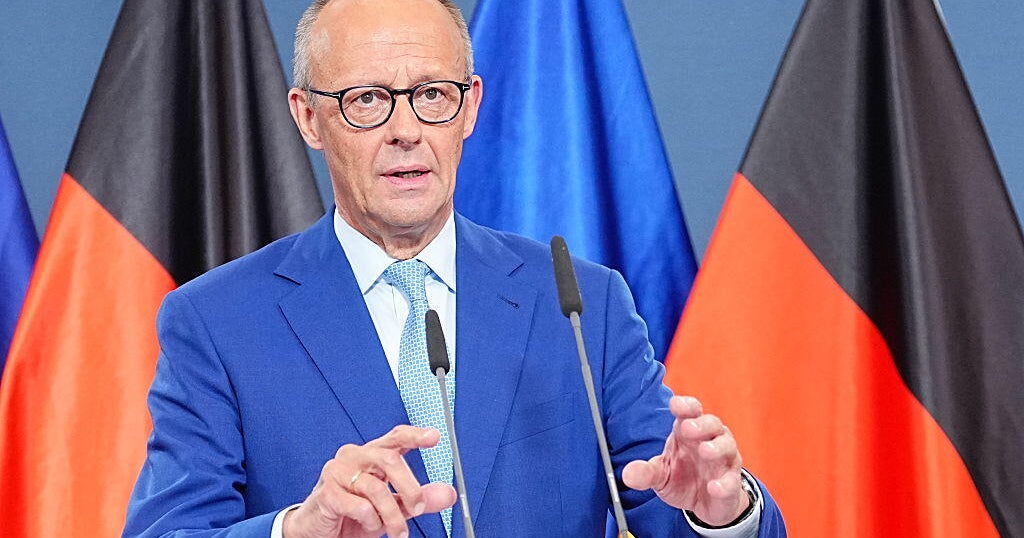
Merz, 70, who has been chancellor for 16 months, did not pretend the night had gone well. He called the Mecklenburg result a "disaster" but refused to step aside. "What needs to be done now requires backbone, steadfastness, and patience," he said. "The reforms have to come. I am taking on this responsibility." AfD co-leader Tino Chrupalla called that response "more than feeble" and said Merz should resign.
The pressure on the chancellor was already building before Sunday. Two weeks ago the AfD won Saxony-Anhalt outright, the first time a far-right party had led a German state since the Second World War. Merz canceled his trip to this week's U.N. General Assembly in New York, saying his presence was required in Berlin. His personal approval has sunk to about 14% in recent polling, unemployment topped 3 million in August, up 36,000 from a year earlier, and his coalition with the Social Democrats has fought over nearly every piece of his economic-reform agenda. Some CDU members are privately discussing a replacement, though none of his senior allies has called for him to go publicly.
Germany's mainstream parties maintain a "firewall" against governing with the AfD, so a Social Democrat-led coalition with Die Linke and the Greens is the likeliest outcome in Mecklenburg-Western Pomerania despite the AfD's first-place finish. That arithmetic keeps the far right out of power for now. It does nothing to answer the question every German newspaper asked Sunday night: how long can a chancellor whose party cannot clear 5% in a state it once ran stay in office? The next federal election is not due until 2029.
Originally reported by CBS News.