Ten Thousand AI Agents Ran for 88 Hours and Found a Vortex That Spins Faster Than the Navier-Stokes Equations Can Handle. OpenAI Says It Has Cracked a $1 Million Millennium Problem, and It Will Not Claim the Prize.
The 166-page proof, formalized in Lean, shows the three-dimensional fluid equations can 'blow up' under smooth forcing, reaching infinite velocity at a point. NYU's Tristan Buckmaster and Anthropic's Levent Alpöge announced a related Euler result 12 hours earlier, and the fight over credit has already begun.
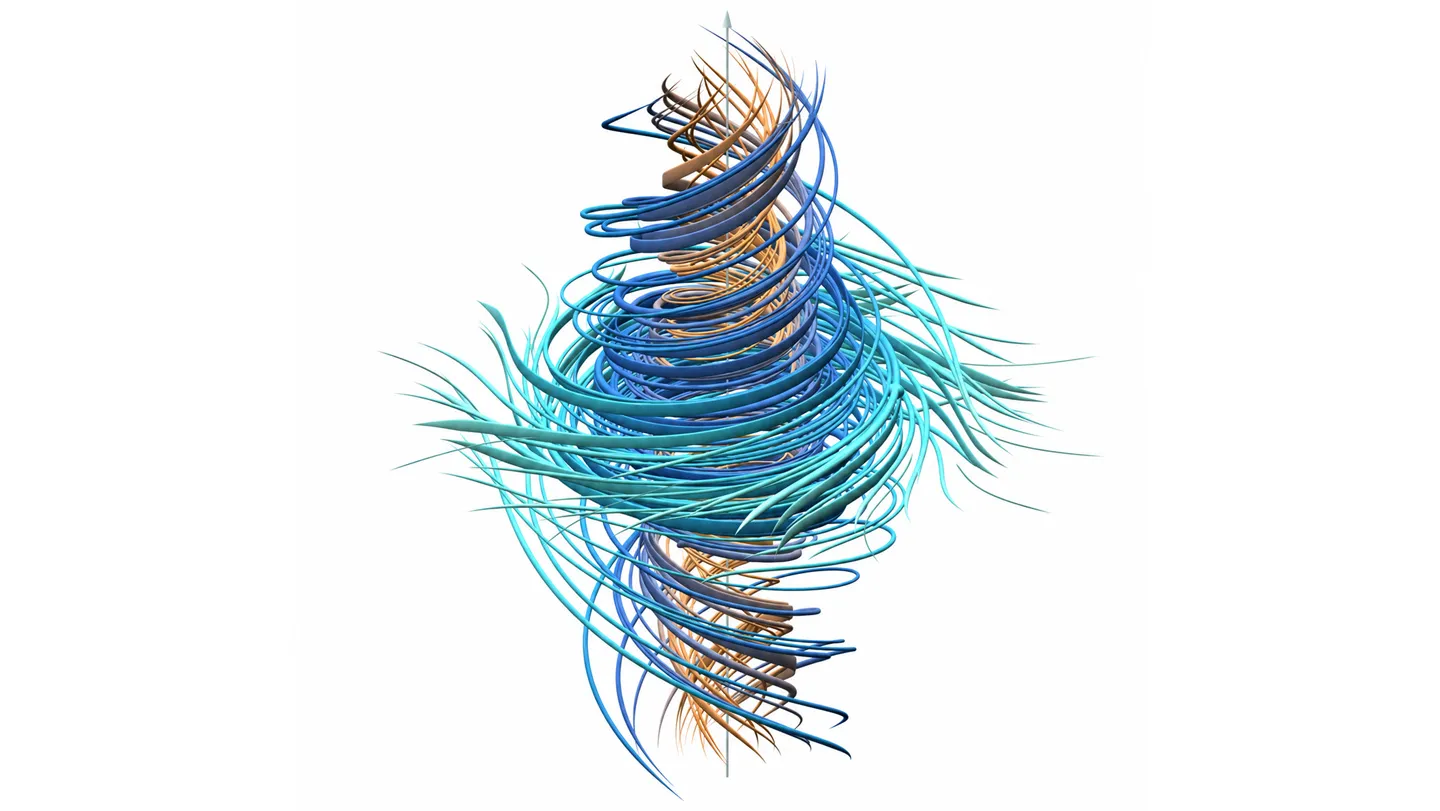
For 26 years, one of the seven Millennium Prize Problems asked a deceptively simple question about the equations that describe every fluid on Earth: do solutions to the three-dimensional Navier-Stokes equations always stay smooth, or can a perfectly well-behaved flow spin itself up to infinite velocity in finite time? On September 8, OpenAI announced that its AI agents had answered it. The equations break. A specific vortex configuration, spiraling inward and growing thinner and faster, reaches a "singularity," a point where the mathematical fluid's speed becomes infinite.
The Navier-Stokes equations, written down in the 19th century, track how pressure, density and velocity change over time in a moving fluid. They underpin weather forecasting, aircraft design and ocean modeling, and the Clay Mathematics Institute put a $1 million bounty on the existence-and-smoothness question in 2000. OpenAI's result shows blowup under smooth external forcing with no boundary walls. It comes as a 166-page manuscript and a companion proof in Lean, the formal verification language that checks every logical step by machine, both posted publicly for scrutiny. The company said it will not claim the Clay prize.
The method was as notable as the result. OpenAI said roughly 100 agents first spent about 50 hours on variants of the simpler Euler equations, which lack the viscosity term. Then approximately 10,000 agents running on an internal model attacked Navier-Stokes for 88 hours, exchanging nearly five million messages among themselves, before another model spent 17 hours translating the argument into Lean. Sébastien Bubeck of OpenAI put the compute cost at several million dollars and called it "the spectacular culmination of the arc we have seen over the last 12 months" in AI mathematics.
Human mathematicians were both impressed and wary. "It's one of the guiding problems for the field. It is a huge deal to know the answer," said Dallas Albritton of the University of Wisconsin-Madison. Gregory Eyink of Johns Hopkins noted that "I don't think anyone has completely verified the proof yet, certainly not on the human side," and pointed out that the physical stakes are smaller than the mathematical ones: real fluids are made of molecules, and the continuum equations already stop applying at those scales. "There's a huge mathematical celebrity associated with these equations," he said. The prestige is what changed.
The announcement also landed in the middle of a priority dispute. Twelve hours earlier, Tristan Buckmaster of New York University and Levent Alpöge of Anthropic had released results on the forced Euler problem, including a Lean-verified blowup they had completed by August 22, produced with help from several AI models including OpenAI's. Buckmaster says OpenAI researchers, after hearing rumors of his team's progress, asked to exclude Alpöge, an employee of a competitor, from a joint presentation. OpenAI denies its agents saw the pair's unpublished work but acknowledged that "while unlikely, we cannot rule out that de-identified data derived from their usage of our products helped improve our models." Buckmaster, comparing the moment to Deep Blue's defeat of Garry Kasparov in 1997, wrote that "the community needs to have serious and unhurried discussion about where to go from here."
Both results stand on human shoulders. Charles Fefferman of Princeton, who wrote the Clay Institute's official statement of the problem, said "the heroes of the story are Córdoba and Martínez-Zoroa," referring to Diego Córdoba of Madrid's Institute for Mathematical Sciences and Luis Martínez-Zoroa of CUNEF University, whose 2021-2023 work proved singularities in Euler flows with rough forcing and developed the "infinite cascade" technique the AI proofs build on. Buckmaster said Martínez-Zoroa "deserves a Fields Medal." What remains open is the original, unforced version of the problem, the question of whether a fluid left entirely alone can blow up on its own, and the harder question, as Eyink put it, of "the really serious ongoing problem" of who gets credit when the mathematician is a swarm.
Originally reported by Science News.