String Theory Emerges Naturally From Simple Physics Rules
Physicists discover that starting with basic particle collision principles, the mathematics spontaneously produces string theory signatures without assuming strings exist.
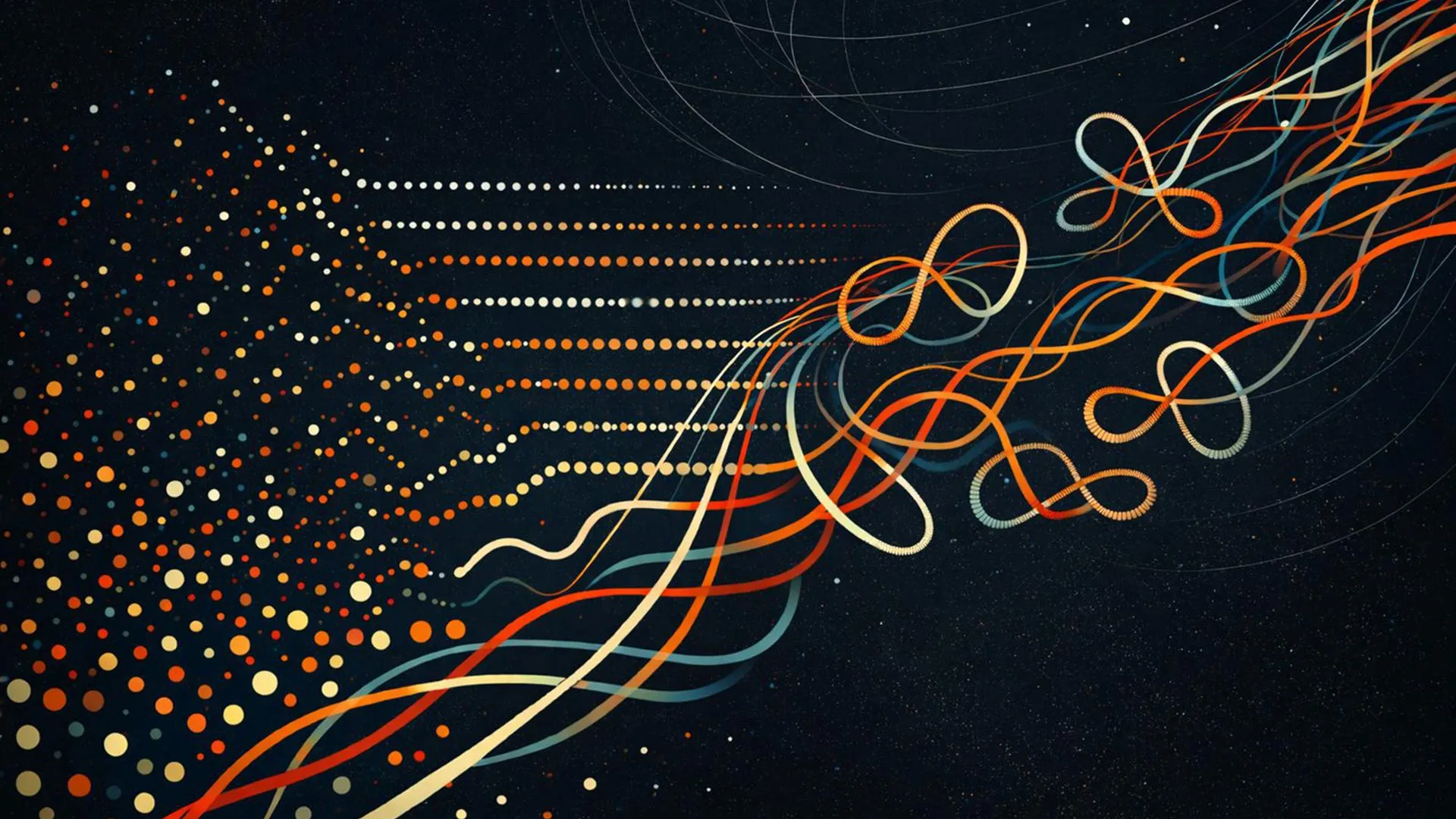
Physicists have uncovered a surprising discovery that could provide new support for string theory, the ambitious attempt to describe the universe's fundamental building blocks as tiny vibrating strings rather than point-like particles. Instead of assuming strings existed from the beginning, researchers at Caltech, New York University, and Institut de Fisica d'Altes Energies in Barcelona started with just a few simple rules about how particles behave at extreme energies and watched as the equations naturally produced string theory's telltale mathematical fingerprints.
"The strings just fell out," says Clifford Cheung, professor of theoretical physics and director of the Leinweber Forum for Theoretical Physics at Caltech. "We didn't start with any assumptions about strings at all, but then the solution contained the cornerstone signatures of strings." The finding, accepted for publication in Physical Review Letters in a paper titled "Strings from Almost Nothing," represents a breakthrough in the "bootstrap" approach to physics, where scientists begin with broad principles rather than detailed assumptions.
String theory emerged in the 1960s as a potential solution to one of physics' most vexing problems: reconciling quantum mechanics with Einstein's general relativity. The theory proposes that every particle, including the hypothetical graviton that would carry gravitational force, results from different vibrations of incredibly tiny strings existing in at least 10 dimensions. While elegant mathematically, string theory has faced criticism because testing it directly would require a particle collider as large as a galaxy.
The new research used computer-based bootstrap methods to investigate particle scattering at extremely high energies. By starting with just basic assumptions about how particles collide and scatter, the team discovered that the mathematics pointed toward only one possible solution. That solution contained what physicists call the "string spectrum" - an infinite tower of particles with specific mass relationships that Italian physicist Gabriele Veneziano first described at CERN in the late 1960s.
While the findings don't constitute experimental proof of string theory, Cheung emphasizes that the results are striking because many different mathematical outcomes were theoretically possible. The fact that the calculations converged on string theory signatures suggests the framework may be more fundamental to physics than previously understood. "We thought we were going to have a good and trustworthy calculation for a new fifth force," Cheung noted. "Instead, we found there is no fifth force. We did find a very precise proof of not just the Standard Model, but also of quantum field theory, which is the foundation on which the Standard Model was built."