87-Year-Old Quantum Prediction Confirmed: First Direct Observation of Migdal Effect Opens New Dark Matter Hunt
Chinese researchers have observed the Migdal effect for the first time, validating a 1939 theoretical prediction and providing a new experimental tool to search for ultra-light dark matter particles.

BEIJING — Physicists have achieved the first direct experimental observation of the Migdal effect — a quantum mechanical phenomenon first theorized by Soviet physicist Arkady Migdal in 1939 — closing an 87-year gap between theoretical prediction and experimental confirmation, and opening entirely new pathways in the global search for dark matter. The observation, confirmed by researchers at the University of the Chinese Academy of Sciences in early 2026, has been described by the particle astrophysics community as one of the most significant experimental milestones in years.
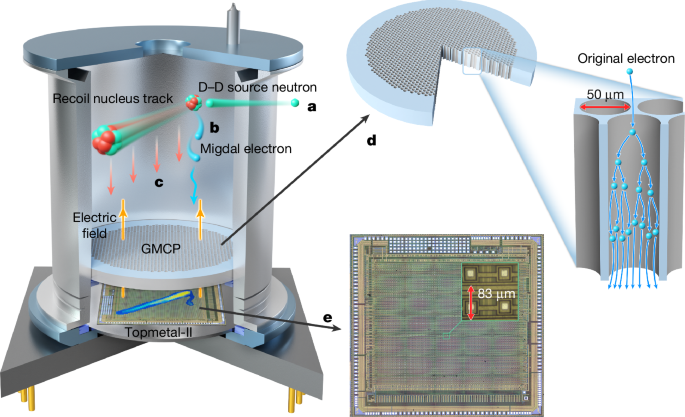
The Migdal effect describes what happens in the immediate aftermath of a nucleus being struck by a fast-moving particle. When the nucleus recoils from the collision, it can briefly disturb the electron cloud surrounding it, ionizing or exciting one of those electrons in a secondary quantum event. This secondary electron signal — the Migdal signal — is what researchers have now directly detected for the first time. While the concept has been part of theoretical physics for nearly a century, no laboratory had previously been able to isolate and measure this specific quantum process with sufficient precision to claim a direct observation.
The detection matters enormously for dark matter research. The leading candidates for dark matter — the mysterious substance that accounts for approximately 27% of the universe's total mass-energy content — include light particles that may be too lightweight to produce detectable nuclear recoil signals in conventional detectors. When a hypothetical light dark matter particle strikes a nucleus, the recoil energy might be far too small to register. But if that same collision generates a Migdal electron signal, detectors sensitive to electron ionization could potentially see it — dramatically expanding the range of dark matter masses that future experiments can probe.
Until now, dark matter detectors have operated largely in the dark below certain mass thresholds. The experimental confirmation of the Migdal effect means detector builders can now design experiments explicitly optimized to look for this signal, potentially accessing dark matter candidates orders of magnitude lighter than those previously searchable. Several large-scale dark matter experiments — including LZ, XENONnT, and PandaX — are already discussing how to incorporate Migdal-sensitive analysis pipelines into their existing data.
The Chinese Academy of Sciences team used a specialized low-threshold detector to isolate the Migdal signal from nuclear recoil backgrounds, a challenge that had stymied previous experimental efforts for decades. Their methodology relied on advances in detector cryogenics and signal processing that only became available in the past few years. The result has been submitted to a peer-reviewed physics journal and is being independently reviewed by dark matter physicists in Europe and the United States. Researchers emphasized that the observation does not detect dark matter itself — but it confirms that the quantum tool needed to find lighter dark matter candidates is now experimentally established.