Saudi Arabia, Turkey and Pakistan Signed a Mutual Defense Pact in Mecca
An Attack on One Is Now an Attack on All Three.
The Mecca Joint Defense Agreement binds an oil power, a nuclear-armed state and NATO's second-largest military — signed as the Iran war reshapes the region.
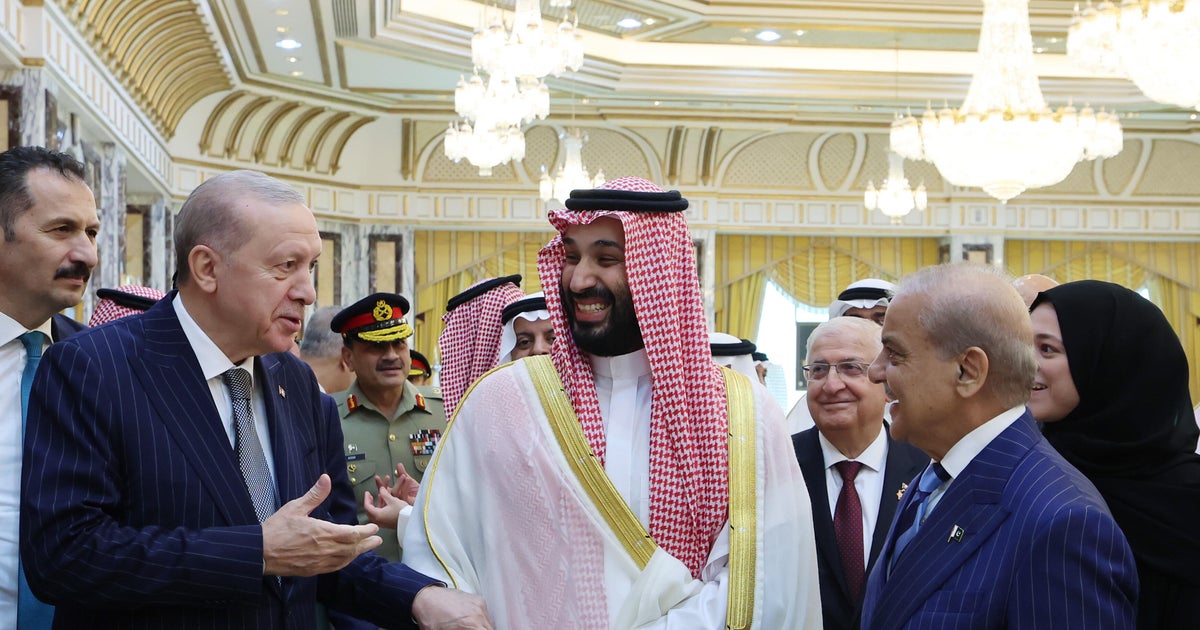
Saudi Crown Prince Mohammed bin Salman, Turkish President Recep Tayyip Erdogan and Pakistani Prime Minister Shehbaz Sharif signed a three-way mutual defense treaty in Mecca on Friday, committing each country to treat an attack on any one of them as an attack on all three.
The text of what officials are calling the Mecca Joint Defense Agreement states that "any armed attack against any one of the three states shall be regarded as an attack against them all," language modeled on the collective-defense clause that underpins NATO. The agreement also commits the three to deepen "all aspects of defense cooperation," and Turkish media reported that the expected provisions include joint military exercises, defense technology transfers and intelligence sharing.
The combination of signatories is what gives the pact its weight. Saudi Arabia brings oil wealth and the financial capacity to fund procurement. Pakistan is the only nuclear-armed state in the Muslim world. Turkey fields NATO's second-largest military and has built a drone and defense-export industry that has become a significant supplier across the Middle East, Africa and Central Asia. Bound together, they represent a bloc that did not previously exist in formal terms.
Officials from both Ankara and Riyadh moved quickly to characterize the treaty as defensive and non-exclusive. Turkish officials described it as "purely defensive in nature" and "not against any specific actor," and said it remains open to other regional countries that wish to join. A Saudi official said the pact "does not represent an effort to establish a military axis or a sectarian bloc" and is instead "focused on building sustainable capabilities."
Those disclaimers are doing considerable work, because the agreement was signed by three Sunni-majority states in the middle of a war involving Iran, and it follows a bilateral Saudi-Pakistani mutual defense pact concluded last September. Iran criticized the accord. The immediate regional backdrop includes escalating Houthi missile and drone attacks on Saudi-backed Yemeni government forces — at least 30 troops were killed in strikes on camps in Marib and Hadramout this week — and warnings that Iraqi militias aligned with Tehran may launch coordinated attacks on Saudi territory.
The practical question the treaty raises is what triggers it. NATO's Article 5 has been invoked once in 76 years, and collective-defense clauses tend to function more as deterrence than as automatic tripwires. What the Mecca agreement changes immediately is the calculation for anyone considering a strike on Saudi soil: an attack that once carried a Saudi response now carries, on paper, a Turkish and Pakistani one as well. Whether the three governments would actually act in concert is a question no clause can answer in advance.