Rare Fossils Reveal What Denisovans Looked Like: Low Flat Skulls, Thick Bone and Heavy Brows
Proteins pulled from skull and jaw fragments found in northern China in the 1970s identify the Xujiayao remains as Denisovan, hinting the lineage was widespread across East Asia.

Whenever scientists write about Denisovans, the word "mysterious" is almost guaranteed to appear. This extinct human group, close cousins of the Neanderthals, may have lived in East Asia from at least 300,000 to 45,000 years ago, yet the fossil record is so sparse that almost nothing was known about how they looked. A study published in the journal Nature now fills in some of that picture.
The work centers on a skull fragment and a jaw fragment excavated alongside other fossils from the Xujiayao archaeological site in northern China between 1976 and 1979. Researchers led by Qiaomei Fu at the Chinese Academy of Sciences extracted proteins from both pieces. Ancient DNA often does not survive in such old bone, but proteins can last far longer.
The team identified 18 ancient proteins and compared their sequences against data from other ancient hominins and modern humans. Small differences in the sequences act like molecular signatures that show evolutionary relationships and help place a fossil on the human family tree. The decisive clue was a specific collagen variant, COL1A2-996K, which has been found in Denisovans but not in Neanderthals or modern humans.
"Molecular phylogeny and shared morphological traits classify Xujiayao, initially assigned to different lineages, as Denisovan," the authors wrote.
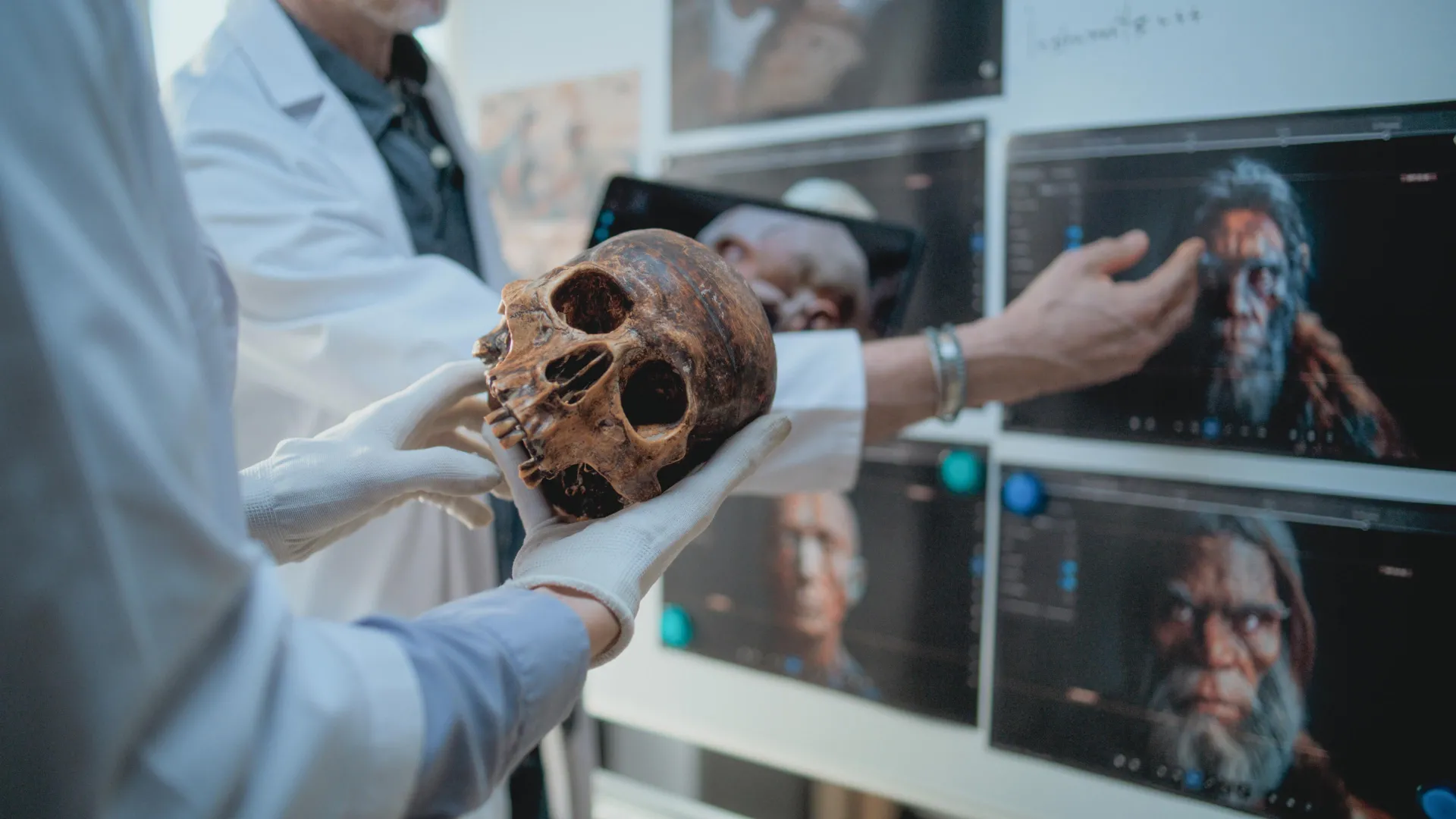
With the identification settled, the researchers turned to anatomy. They measured the remains and built 3D computer models of reconstructed skull and jaw bones, then compared those shapes with fossils from Neanderthals, modern humans and other ancient hominins. The results describe Denisovans as having low, relatively flat skulls with thick bones, prominent brow ridges and flattened facial features. Their traits look like a mix of ancestral hominin features and characteristics shared with Neanderthals and later humans.
The finding also changes the map. Together with other fossil evidence, it supports the idea that Denisovans were widespread across East Asia, far beyond the cold Siberian caves and Tibetan highlands that have dominated the story so far. The authors suggest many other fossils from the region may belong to the same lineage. "The inclusion of additional members of East Asian late Middle Pleistocene archaic Homo, alongside Xujiayao, expands the morphological variability of East Asian Denisovans," they wrote.
That matters because several East Asian fossils have long been hard to classify, sitting uneasily between older hominins and modern humans. If more of them are Denisovan, the group stops looking like a small, remote population known from a finger bone and a few teeth, and starts looking like one of the major human lineages of its time.
The paper, by Song Xing and colleagues, is titled "The proteome of Middle Pleistocene Xujiayao and common Denisovan morphology" (Nature, 2026, DOI 10.1038/s41586-026-11132-z). The approach of reading proteins from museum-stored bones decades after excavation could now be applied to other unclassified East Asian fossils, which may in turn reveal how widely Denisovans ranged.