Record Rain Floods Four Corners States, Driving Evacuations and Rooftop Rescues
Colorado's governor declared disasters in 12 counties and Utah and New Mexico communities issued emergencies after storms fueled by a strong El Niño dropped historic rainfall on the Southwest.
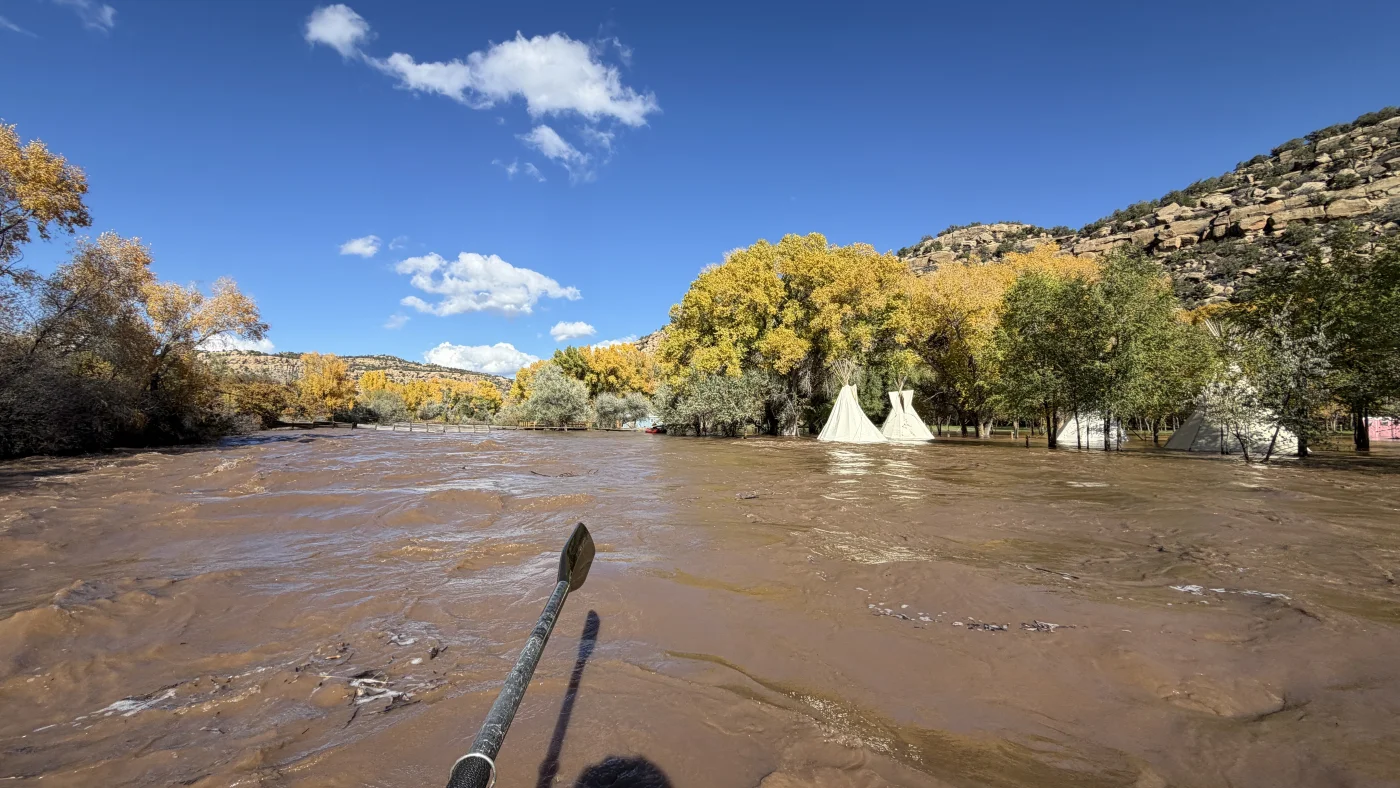
Rare, heavy rain has flooded the Four Corners region, forcing evacuations, closing roads and prompting emergency declarations in New Mexico, Colorado, Utah and Arizona. As of Saturday, the worst-hit areas were southern Utah, southwest Colorado and the northern parts of Arizona and New Mexico, and thunderstorm watches remained in effect in many of the same places through Sunday.
The storms began Wednesday. In Hurricane, Utah, resident Juana Puga went out for errands around 8:30 a.m. Thursday when it wasn't raining at her house. By the time she returned, floodwater covered her yard. "Within five minutes most of my house was underwater," she told NPR. Her family had moved back in on Oct. 1 after rebuilding from an August flood. "We were literally in our house for only 22 days," she said. Hurricane declared an emergency on Thursday after flooding damaged more than 100 homes and RVs. Utah Gov. Spencer Cox said the state's hearts were with the families affected.
In San Juan County, New Mexico, Devin Neeley, the county's public information officer for emergency management, said crews rescued people from rooftops after floodwater swamped homes. Residents in vulnerable areas were told to evacuate Thursday afternoon. "We have not seen flooding like this in generations," Neeley said. In Farmington, Police Chief Steve Hebbe told reporters on Friday that "this is singular and this is real." No deaths had been reported as of Saturday, which he called very fortunate.
Colorado Gov. Jared Polis declared disaster emergencies in 12 counties and authorized National Guard members to help with rescues in the southwest. The La Plata County sheriff closed parts of the Animas River near Durango to recreation. Aaron Schenk, who floated 26 miles of the river that remained open, said that in places it was half a mile wide, when it is normally a couple hundred feet at most. Arizona also saw baseball-sized hail and a possible tornado Wednesday evening that injured at least one person.
Kris Sanders, a meteorologist at the National Weather Service in Grand Junction, Colorado, said the remnants of Hurricane Trudy, which was active from Oct. 15 to Oct. 18 in the Pacific, formed a slow-moving low-pressure system that drifted southwest. Many storms weakened as they crossed the region, but the rain did not. Parts of southwest Colorado and southeast Utah received two to four inches. "Those rainfall amounts are records in themselves," Sanders said, adding that a similar event last year caused major flooding in the same spots, "like a carbon copy."
Climate scientist Daniel Swain of the University of California Agriculture and Natural Resources said the moisture feeding the storms comes from record-warm waters off parts of the West Coast, driven by an ongoing strong El Niño and a recent marine heat wave that he attributes largely to human-caused climate change. Swain said he and others predicted in the spring that the Southwest could see extreme precipitation through October if El Niño developed as forecast. "That is exactly what we've seen," he said, noting this was not even the first such event this fall.
The area saw deadly flash flooding in the Grand Canyon in August. Puga said she and her neighbors were cleaning up and had no plans to leave. "We already did this. We can do it again," she said. "But it's just hard."