Octopuses Learn to Use Mirrors to Find Hidden Food in Groundbreaking Intelligence Study
Dartmouth researchers demonstrate that octopuses can master mirror use for spatial reasoning, a skill previously documented only in vertebrates like mammals and birds.
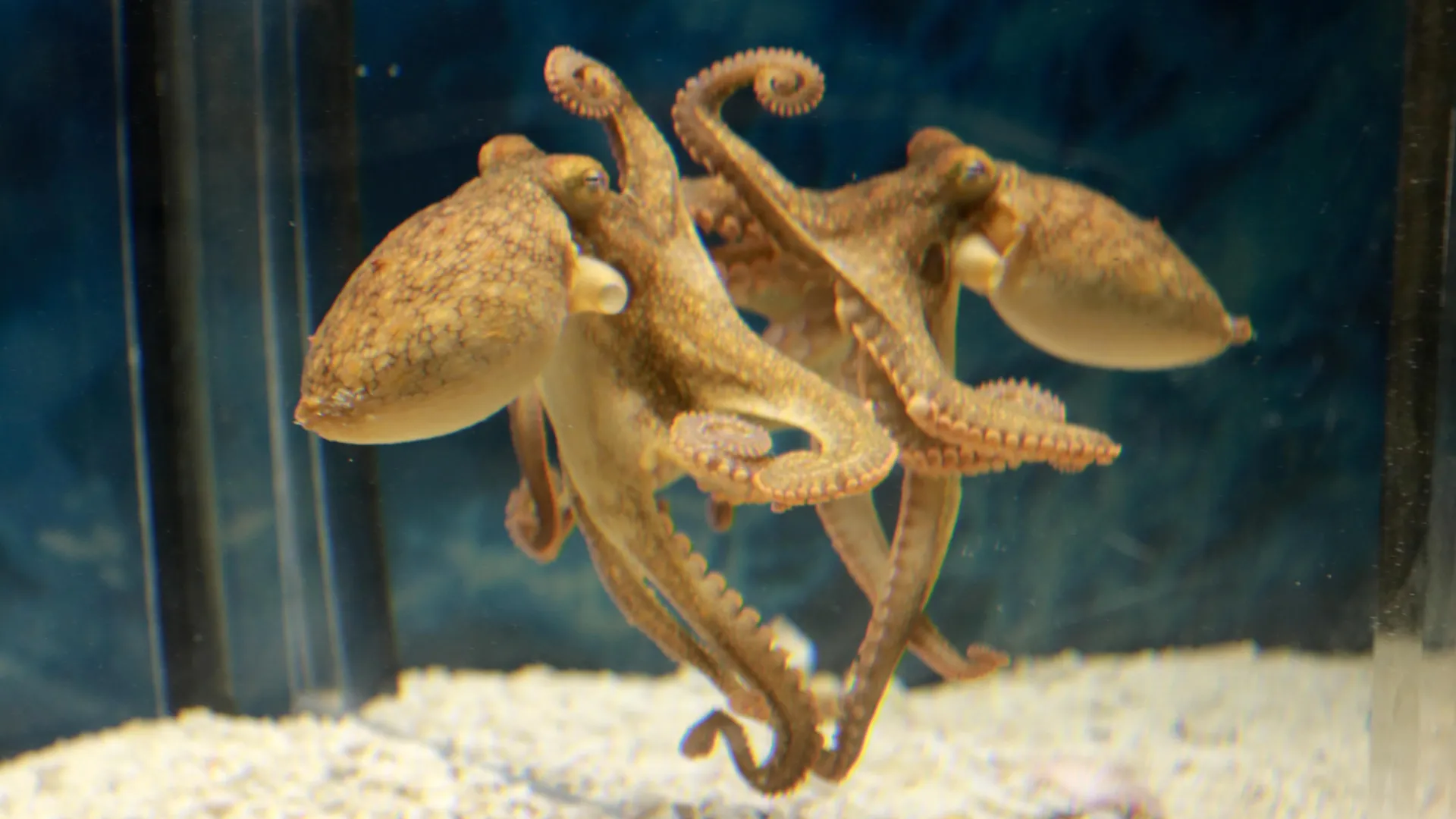
Researchers at Dartmouth College have made a remarkable discovery about octopus intelligence, demonstrating that these invertebrates can learn to use mirrors to locate food hidden from direct view. The groundbreaking study, published in Current Biology, shows that octopuses successfully identified the correct location of food about 73% of the time after training, revealing sophisticated spatial thinking abilities previously documented only in vertebrates.
Lead author Mary Kieseler, who conducted the research as a PhD student in Dartmouth's Department of Psychological and Brain Sciences, emphasized the significance of the findings. "Our findings are the first to demonstrate that invertebrates can use mirrors to understand their environment to find prey," said Kieseler, now a postdoc at Switzerland's University of Fribourg. "It's a skill that previously has only been documented in vertebrates, such as in some mammals and some birds."
The research team worked with three California two-spot octopuses in Dartmouth's Octopus Lab, designing experiments to test whether the animals could learn the relationship between reflections and real-world locations. The octopuses were first given time to familiarize themselves with mirrors in their habitat, then trained to understand that reflections corresponded to actual objects. During training, a live crab was placed in a glass jar positioned so the octopus could see it only through the mirror, requiring the animal to turn 90 degrees and move around a corner to reach the food.
To avoid potential complications from the octopuses' chemoreceptors, which allow them to smell and taste through touch, researchers used virtual crab images during the actual testing phase. Each octopus was placed in a start box with a mirror positioned directly in front of it, while the virtual crab image appeared behind the animal, visible only in the reflection. The octopuses had to recognize the image's actual location and move toward that position rather than approaching the mirror itself.
Senior author Peter Tse, a cognitive neuroscientist and professor at Dartmouth, drew parallels to human learning processes. "We don't enter the world knowing how to use a mirror but learn how to use a mirror," Tse explained, comparing it to how new drivers learn to use rearview mirrors. "Octopuses can also learn how to use a mirror to infer where things are in the world." The study adds to growing evidence of remarkable intelligence in octopuses, famously demonstrated by cases like Inky, the octopus that escaped from New Zealand's National Aquarium in 2016 through a drainpipe.