Octopuses Learn to Use Mirrors to Hunt Prey They Cannot See, a First for Invertebrates
In a Dartmouth experiment, octopuses trained on a virtual crab turned 180 degrees to strike the real target behind them, showing they can treat a mirror as a tool — a skill long thought to belong only to vertebrates.
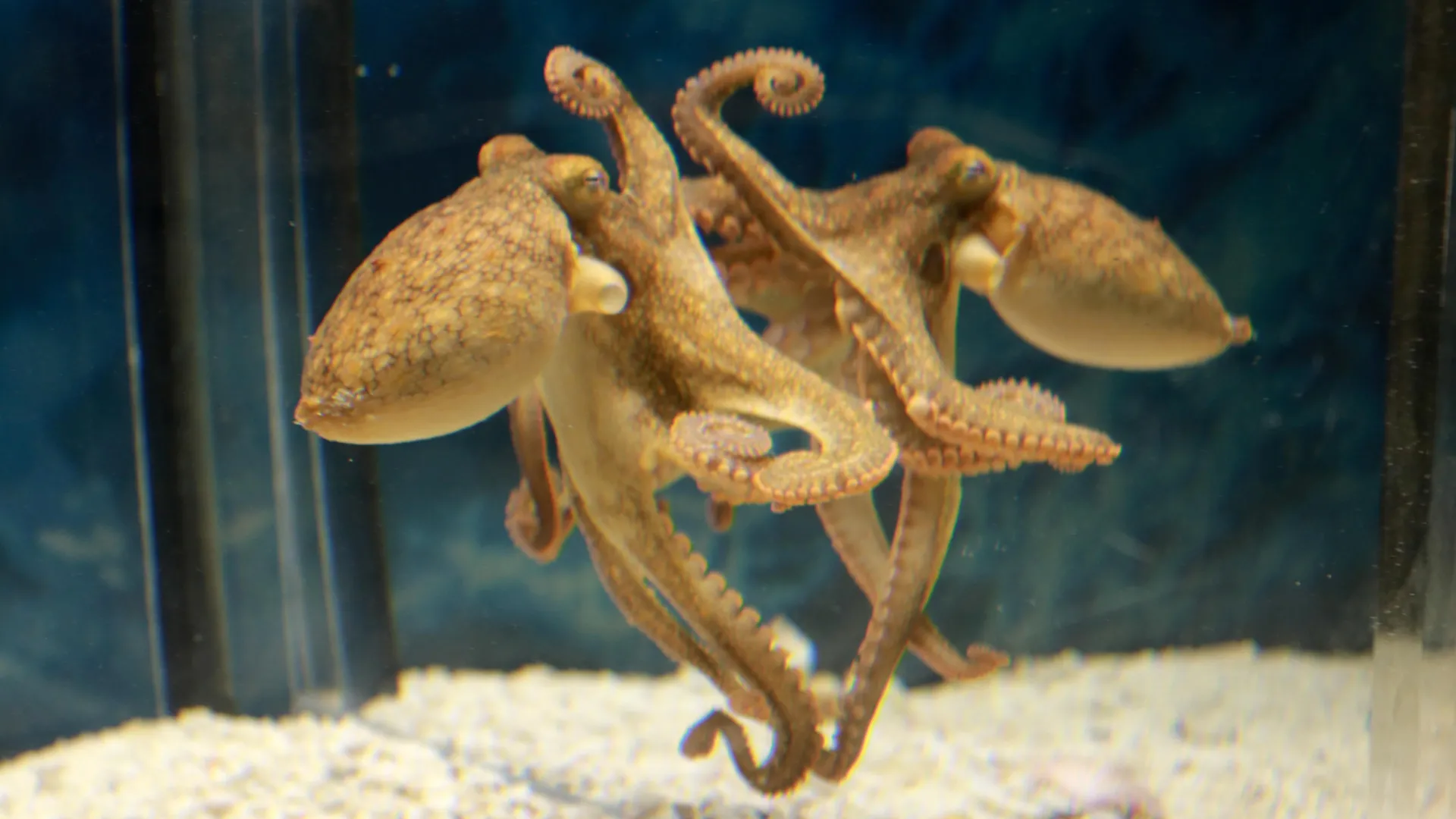
Octopuses can learn to use mirrors to find food hidden behind them, a skill previously demonstrated only in vertebrates such as mammals and birds, according to a Dartmouth study that pushes the boundaries of how scientists understand intelligence in the animal kingdom. The findings, published in the journal Current Biology, are the first to show that an invertebrate can exploit a mirror's reflection to make sense of its surroundings.
To rule out the possibility that the animals were simply reacting to a reflection or following a scent, the researchers replaced live crabs with a projected virtual crab. An octopus was placed inside a start box facing a mirror, and a virtual crab appeared, projected from behind the animal so that it could be seen only in the mirror. Rather than lunging at the mirror image, the octopuses made a full 180-degree turn — or climbed over the enclosure walls — to strike the actual location where the projection originated, earning a live food reward.
After training, the animals correctly identified the food's true location about 73 percent of the time. That success rate, well above chance, indicated that the octopuses were not fooled by the reflection but were instead using it as a source of information about a target they could not directly see — in effect, treating the mirror as a tool for spatial inference.
"Our findings are the first to demonstrate that invertebrates can use mirrors to understand their environment to find prey," said lead author Mary Kieseler. The distinction matters because the so-called mirror test has long been a benchmark in comparative cognition, used to probe how animals process visual information about themselves and the space around them.
Octopuses have increasingly upended assumptions about where complex cognition can arise. They are mollusks, more closely related to clams and snails than to any backboned animal, yet they exhibit problem-solving, tool use and learning that rival those of vertebrates. Crucially, their nervous system is organized very differently, with the majority of their neurons distributed through their arms rather than concentrated in a central brain.
That makes the mirror result more than a charming party trick. Because octopuses evolved their intelligence along an entirely separate branch of the tree of life, studying how they navigate space and infer the unseen offers a kind of natural experiment in how sophisticated behavior can emerge from radically different biological hardware — and a reminder that the capacity to reason about a hidden world may be far more widespread than once believed.