London Police Arrest 117 Outside the First Palestine Action Court Hearings
The Metropolitan Police said most were detained for expressing support for a proscribed organization. More than 3,000 people have been arrested since the ban took effect, and the Supreme Court has now agreed to hear a challenge.
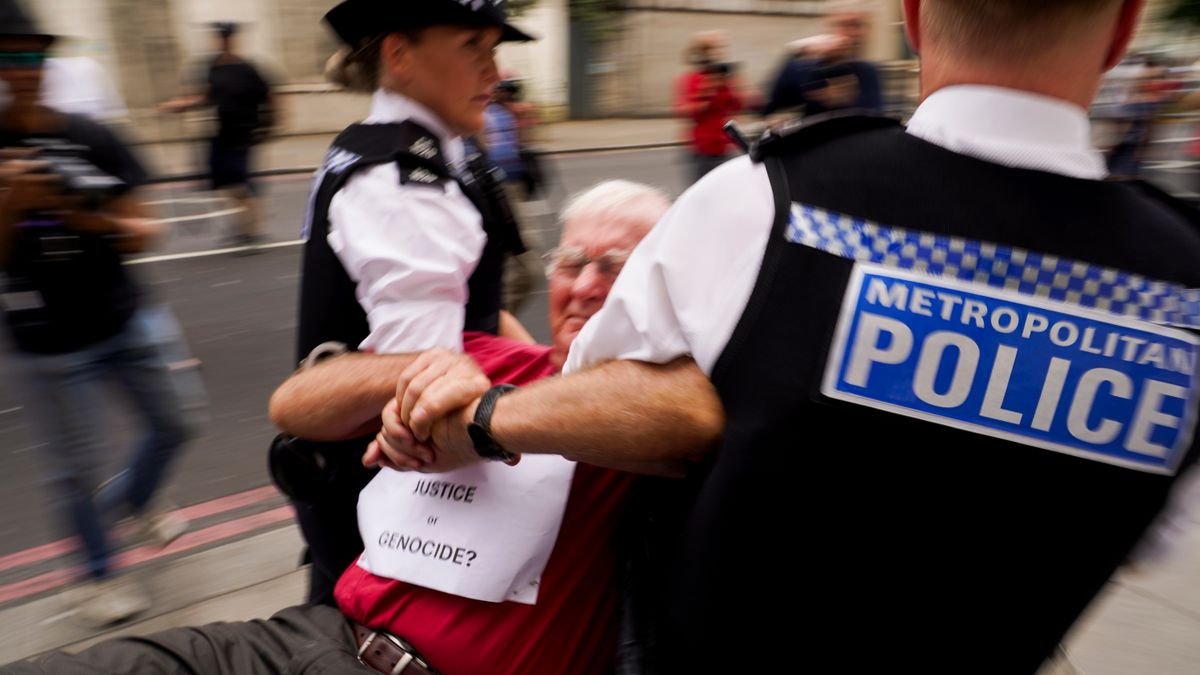
LONDON — Metropolitan Police officers arrested 117 people outside Westminster Magistrates' Court on Thursday, most of them for expressing support for Palestine Action, the protest group the British government banned as a terrorist organization last year.
The demonstration was organized by Defend Our Juries and timed to coincide with a plea hearing for 25 people accused of showing support for the group — among the first such prosecutions to reach court. Protesters held Palestinian flags and chanted "I oppose genocide, I support Palestine Action" as officers moved in. Onlookers shouted "Shame!"
The Met's position is that the law leaves it no discretion. "Expressing support for Palestine Action is an offence under the Terrorism Act," the force said in a statement. Under the proscription, membership in or support for the group carries a maximum sentence of 14 years in prison.
The scale of enforcement is now extraordinary by any historical measure. More than 3,000 people have been arrested since the ban took effect, and over 1,200 have been charged under the Terrorism Act. The overwhelming majority were detained for holding signs or saying words, not for property damage or violence.
The ban itself has bounced through the courts. Palestine Action was proscribed in 2025 after activists broke into a Royal Air Force base to protest British military support for Israel's offensive in Gaza. In February 2026 the High Court quashed the ban. In June the Court of Appeal reinstated it, calling the designation "justified and proportionate" given what the court characterized as the group's support for violence. Cofounder Huda Ammori has now been granted permission to take the case to the U.K. Supreme Court, with hearings expected between October and December. She has said she will go to the European Court of Human Rights if she loses there.
Human rights organizations have grown increasingly blunt about what they see happening. "Using counterterror powers to suppress dissent goes against democratic values and harms freedom of expression and assembly in this country," said Thomas Bell, acting U.K. director of Human Rights Watch. Green Party leader Zack Polanski called for the proscription to be reversed, describing the mass arrests as dystopian scenes incompatible with a democracy.
The government has held its ground, arguing that the RAF base break-in and similar actions cross the line from protest into the kind of conduct the Terrorism Act was written to cover. That argument has now survived one round at the Court of Appeal, and it will get its final test at the Supreme Court before the end of the year.
Until then, the arithmetic outside Westminster Magistrates' Court is unlikely to change: a few dozen defendants inside, a few hundred supporters outside, and police obliged to arrest anyone who says the group's name approvingly.
Originally reported by Associated Press.