A Light Sail Traveling at 75% of Light Speed Starts Feeling a Push Backward
Two researchers at Harbin Institute of Technology worked out what relativity does to a laser-driven sail. Past a certain speed the photons bouncing off it stop helping and start braking.
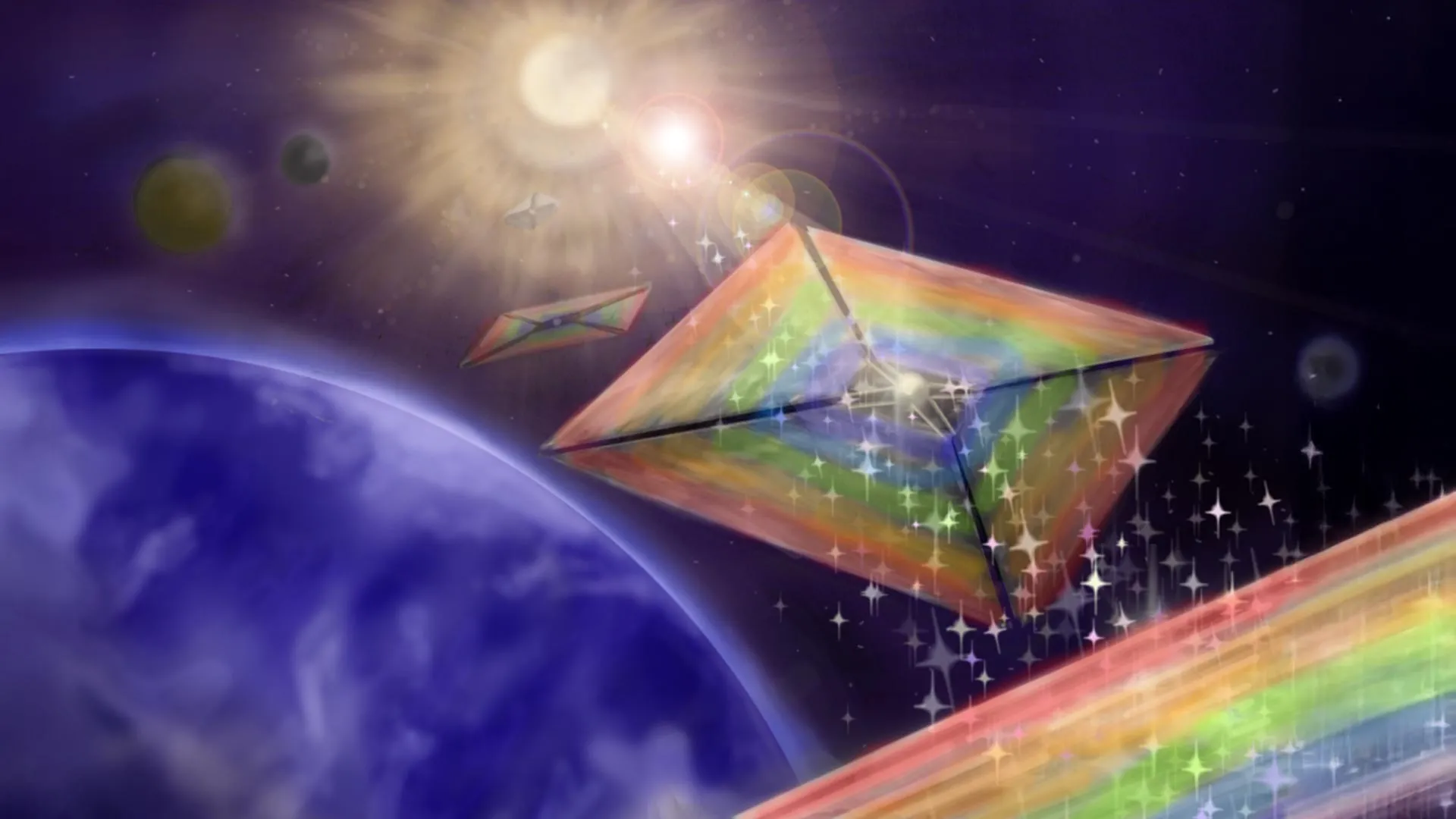
The standard plan for reaching another star within a human lifetime is to build a very large laser, point it at a very thin sail, and let photon pressure do the rest. A new analysis says that plan has a ceiling nobody had properly accounted for, and it sits at about 75% of the speed of light.
Chao Shen and Jiaze Li of the Harbin Institute of Technology worked through the radiative dynamics of a laser-driven sail and found that relativity turns the sail's own reflectivity against it. Their paper, posted in June, breaks the light pressure on a sail into three separate forces: the momentum delivered by the incoming beam, which is by far the strongest; the recoil from specularly reflected light, meaning light that bounces off cleanly like a mirror; and the recoil from diffuse scattering, light that bounces off in scattered directions, which is the weakest of the three.
At ordinary spacecraft speeds all three push in the same direction, forward. The problem starts when the sail is moving fast enough that the geometry of light itself changes in the sail's frame of reference. "Relativistic light aberration becomes important" at around three-quarters of light speed, the researchers write. Aberration is the effect that makes the apparent direction a photon arrives from shift when you are moving quickly relative to its source — the same reason rain appears to come at you at an angle when you run through it.
Two things go wrong at once. The Doppler effect progressively drains energy from the driving laser as the sail races away from it, so the beam that reaches the sail is redder and weaker than the beam that left the emitter. And the aberration shift means the photons the sail scatters are increasingly thrown forward relative to the sail's own motion. A photon leaving forward carries momentum forward, which means the sail takes momentum backward. The scattering term flips sign and becomes a brake.
The result is not that interstellar sailing is impossible, but that the acceleration curve is worse than the naive calculation shows, and the terminal velocity of a laser-pushed sail is set by its optical properties rather than only by the power of the laser. There may also be an engineering opportunity buried in the same physics: the authors note that advanced metamaterials are being investigated that could exploit aberration effects to make a sail passively self-stabilizing, keeping itself centered in the beam without active steering.
The study is deliberately narrow. It models only the radiative forces and leaves out collisions with interstellar gas, dust drag, and the thermal limits of the sail material itself — all of which are known to be serious problems in their own right. What it establishes is that even in the clean case, with nothing but light and a mirror, the physics does not simply keep pushing.