'Schrödinger's Clock': Physicists Lay Out How an Atomic Clock Could Tick Faster and Slower at the Same Time
Stevens Institute theorist Igor Pikovski's proposal with Colorado State and NIST experimentalists pinpoints a measurable quantum signature of relativistic time inside ion clocks already in operation.
Time itself may be even stranger than Albert Einstein imagined. A team of physicists has now laid out a concrete experimental recipe to place a working clock into a quantum superposition — a state in which the device ticks faster and slower at the same time, the temporal analogue of Schrödinger's famous cat being both alive and dead until measured.
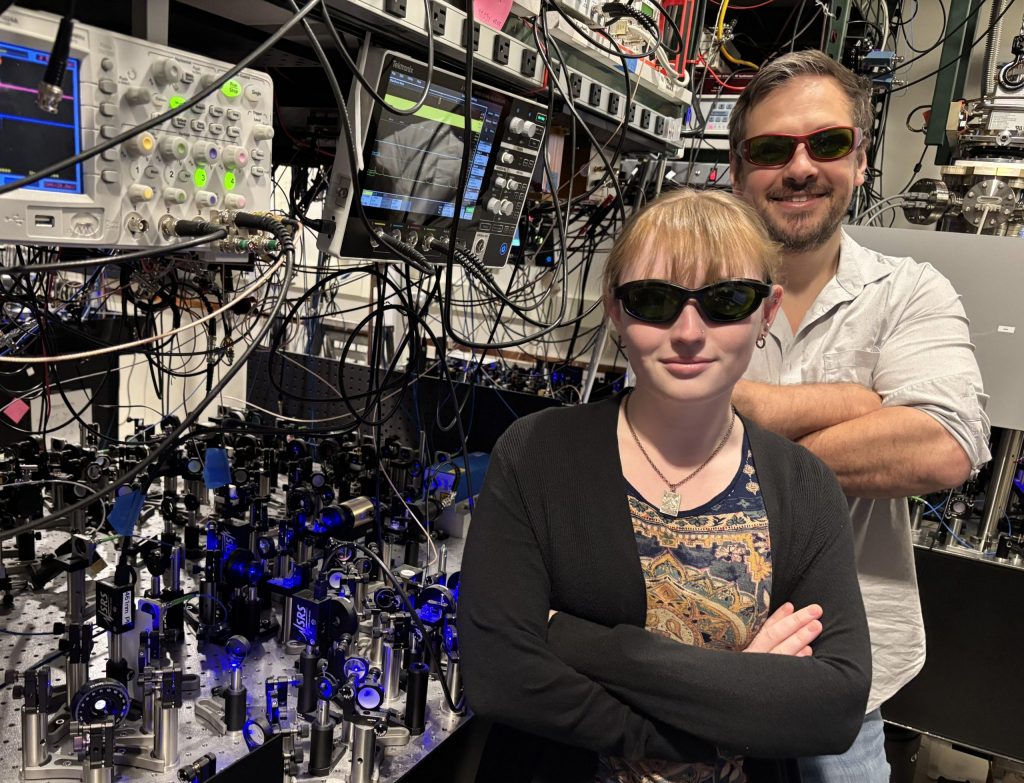
The proposal, titled "Quantum signatures of proper time in optical ion clocks" and led by theoretical physicist Igor Pikovski of the Stevens Institute of Technology, appeared April 20 in Physical Review Letters and was the subject of a Physics Magazine feature this past weekend. Pikovski worked with experimentalists Christian Sanner of Colorado State University and Dietrich Leibfried of the National Institute of Standards and Technology to lay out, step by step, how existing trapped-ion atomic clocks at NIST and elsewhere could be repurposed to detect time itself behaving quantum-mechanically.
The insight bridges two of the most successful but historically incompatible theories in physics. Einstein's general relativity treats time as a smooth, continuous coordinate that flows differently in different gravitational fields and at different speeds — a phenomenon already exploited every day by the corrections built into the GPS satellite network. Quantum mechanics, by contrast, allows particles to occupy multiple states at once until they are observed. Pikovski's team argues that a trapped ion held in a controlled quantum superposition of two different motional states will, in principle, experience two slightly different rates of proper time simultaneously, and that this temporal superposition should leave a measurable signature in the ion's internal energy levels.
"What we are saying is that a clock can be in a quantum superposition of ticking rates," Pikovski said. "The clock doesn't just have an uncertain rate — it really has both rates at once, and a precise experiment should be able to see the interference between the two." The required experimental sensitivity is extreme but within reach of the most advanced optical ion clocks now operating, which are stable to one part in 10^18 — equivalent to neither gaining nor losing one second in 30 billion years.
The potential payoffs are significant. If the experiment confirms the theory, it would constitute the first laboratory observation of a regime where general relativity and quantum mechanics genuinely overlap, addressing what is arguably the deepest unsolved problem in fundamental physics. "For nearly a century we have known that gravity and quantum theory must meet somewhere," said Caslav Brukner, a quantum gravity theorist at the University of Vienna who was not involved in the work. "This proposal puts that meeting place inside a laboratory device that already exists, not at the Planck scale or the edge of a black hole. That is enormous."
The practical implications are not far behind. Optical clocks underpin financial timestamping, telecommunications synchronization, deep-space navigation and the latest generation of gravitational sensors used to map oil reservoirs and underground aquifers. A demonstrated quantum-superposition clock would not only sharpen the foundations of physics but could in principle deliver new measurement protocols that beat the standard quantum limit, offering precision boosts of orders of magnitude. Sanner's group at Colorado State and Leibfried's at NIST have already begun retrofitting their ion traps for the test, with first-results expected sometime in 2027.