Hidden Atomic Gap Could Break Next-Generation Computer Chips, Scientists Warn
Researchers discover that promising 2D materials lose their electronic advantages when paired with insulating layers due to invisible nanoscale separation.
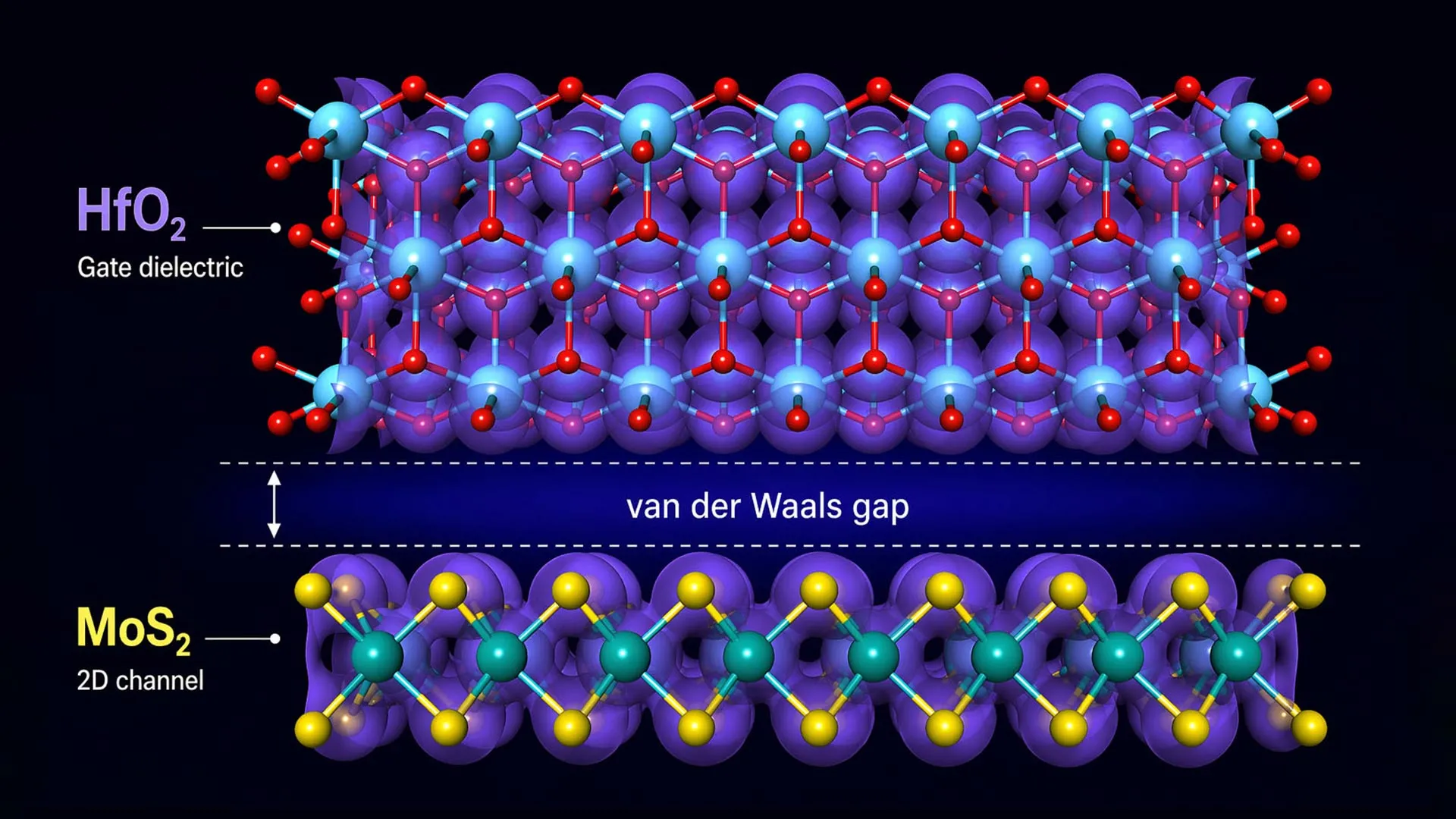
A major obstacle may be blocking the path to the next generation of ultra-tiny computer chips, according to new research from TU Wien. Scientists discovered that many promising 2D materials lose their electronic advantages when combined with the insulating layers required for real-world devices. The problem stems from an invisible atomic-scale gap that forms between the materials, weakening electronic performance and potentially preventing further miniaturization of computer components.
For decades, smaller and more powerful electronic components have driven technological advances, and many researchers believe 2D materials could enable the next breakthrough in chip design. These ultrathin materials, composed of just one or a few atomic layers, have shown remarkable electronic properties in laboratory settings. However, the TU Wien study suggests that when these materials are integrated into actual electronic devices, fundamental physical limitations emerge that could derail billions of dollars in semiconductor industry investments.
"For many years, researchers have quite rightly been fascinated by the remarkable electronic properties of novel 2D materials such as graphene or molybdenum disulfide," explains Prof. Mahdi Pourfath, who conducted the research with Prof. Tibor Grasser at TU Wien's Institute for Microelectronics. "What is often overlooked, however, is that a 2D material alone does not make an electronic device. We also need an insulating layer -- usually an oxide. And this is where things become more complicated from a materials science perspective."
The root of the problem lies in the weak bonding between 2D semiconductor materials and their insulating layers. These components are held together only by van der Waals forces, which provide relatively weak attraction compared to chemical bonds. As a result, the layers cannot come into close contact, leaving a gap measuring about 0.14 nanometers - thinner than a single sulfur atom, yet large enough to dramatically affect electronic behavior.
"This gap weakens the capacitive coupling between the layers," notes Grasser. "No matter how good the intrinsic properties of the materials may be, the gap can become the limiting factor. As long as it exists, it imposes a fundamental limit on how far these devices can be miniaturized." The researchers suggest that new "zipper materials" that lock together more tightly may offer a potential solution, though significant engineering challenges remain before such materials could reach commercial applications.