Hidden Atomic Gap Threatens Next-Generation Computer Chip Technology
Researchers discover that tiny 0.14-nanometer separation between materials weakens electronic performance and could prevent further miniaturization of computer chips.
A fundamental physical barrier may be blocking the development of next-generation computer chips, according to new research from TU Wien that reveals how microscopic gaps between materials severely limit the performance of promising two-dimensional semiconductors. The discovery suggests that many approaches to building smaller, more powerful electronic devices may face insurmountable physical limitations.
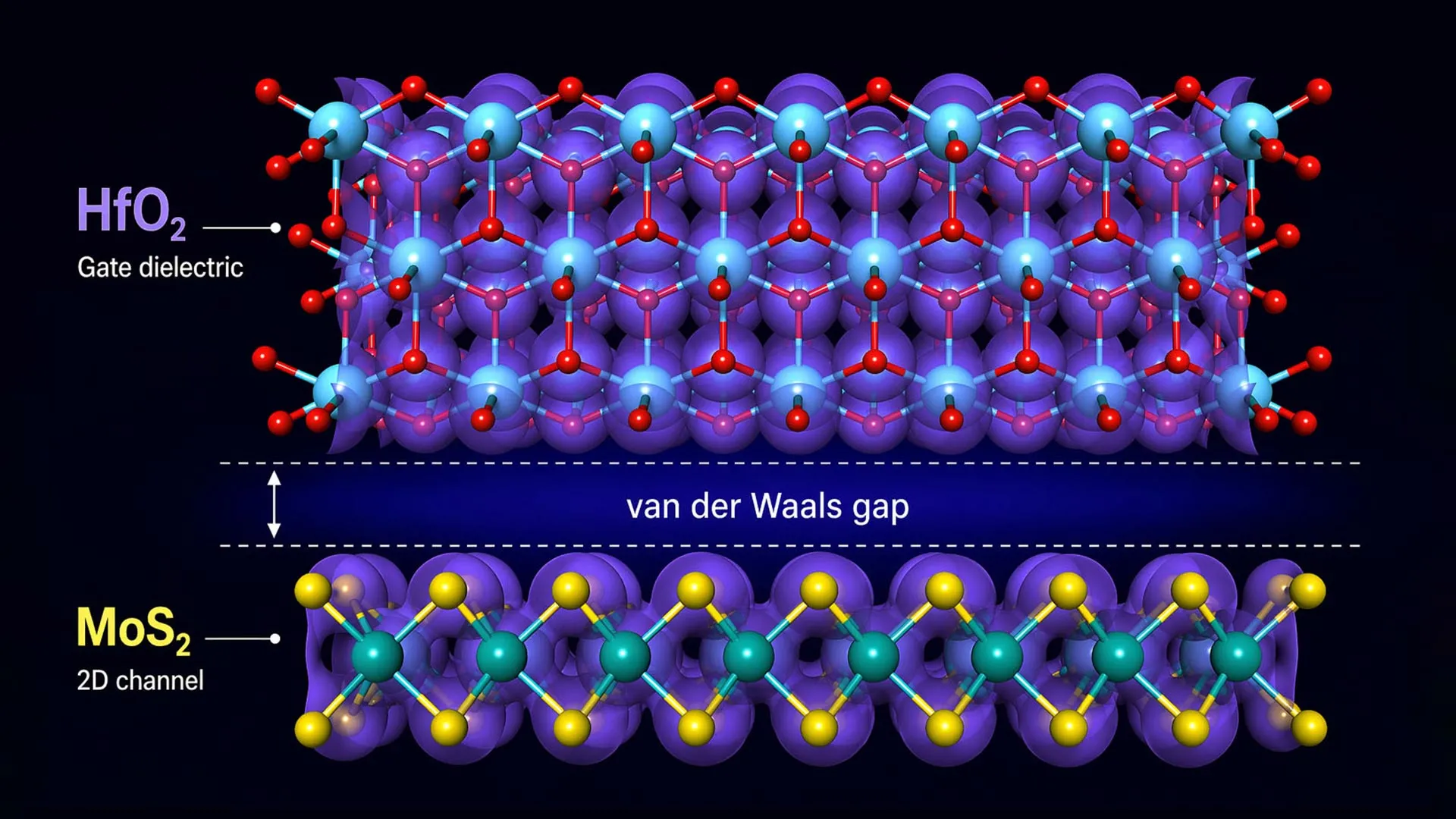
The research team found that when ultra-thin two-dimensional materials like graphene or molybdenum disulfide are combined with insulating layers required for electronic devices, an unavoidable atomic-scale gap forms between them. This separation, measuring only about 0.14 nanometers but thinner than a single sulfur atom, dramatically reduces the materials' electronic performance and creates what researchers describe as a fundamental limit on device miniaturization.
Professors Mahdi Pourfath and Tibor Grasser at TU Wien's Institute for Microelectronics explained that the problem stems from weak van der Waals forces that hold the materials together. "In many combinations of 2D materials and insulating layers, the bonding between them is relatively weak," Grasser noted. "They are held together only by so-called van der Waals forces, which provide only a weak attraction between the semiconductor and the insulator."
The tiny gap significantly weakens the capacitive coupling between layers, meaning that no matter how excellent the intrinsic properties of the individual materials may be, the gap becomes the limiting factor for device performance. "As long as it exists, it imposes a fundamental limit on how far these devices can be miniaturized," the researchers explained.
The findings could help the semiconductor industry avoid investing billions of dollars in technological approaches that may never overcome these physical constraints. However, the team suggests that new "zipper materials" designed to lock together more tightly could potentially offer a path forward, though such materials would require significant advances in materials science to develop and implement commercially.