The FAA Just Handed an $875 Million Contract to the Startup That Reroutes Alaska Airlines' Planes
Air Space Intelligence's Flyways system saves one airline a million gallons of fuel a year. Now it has to work for the busiest airspace on Earth.
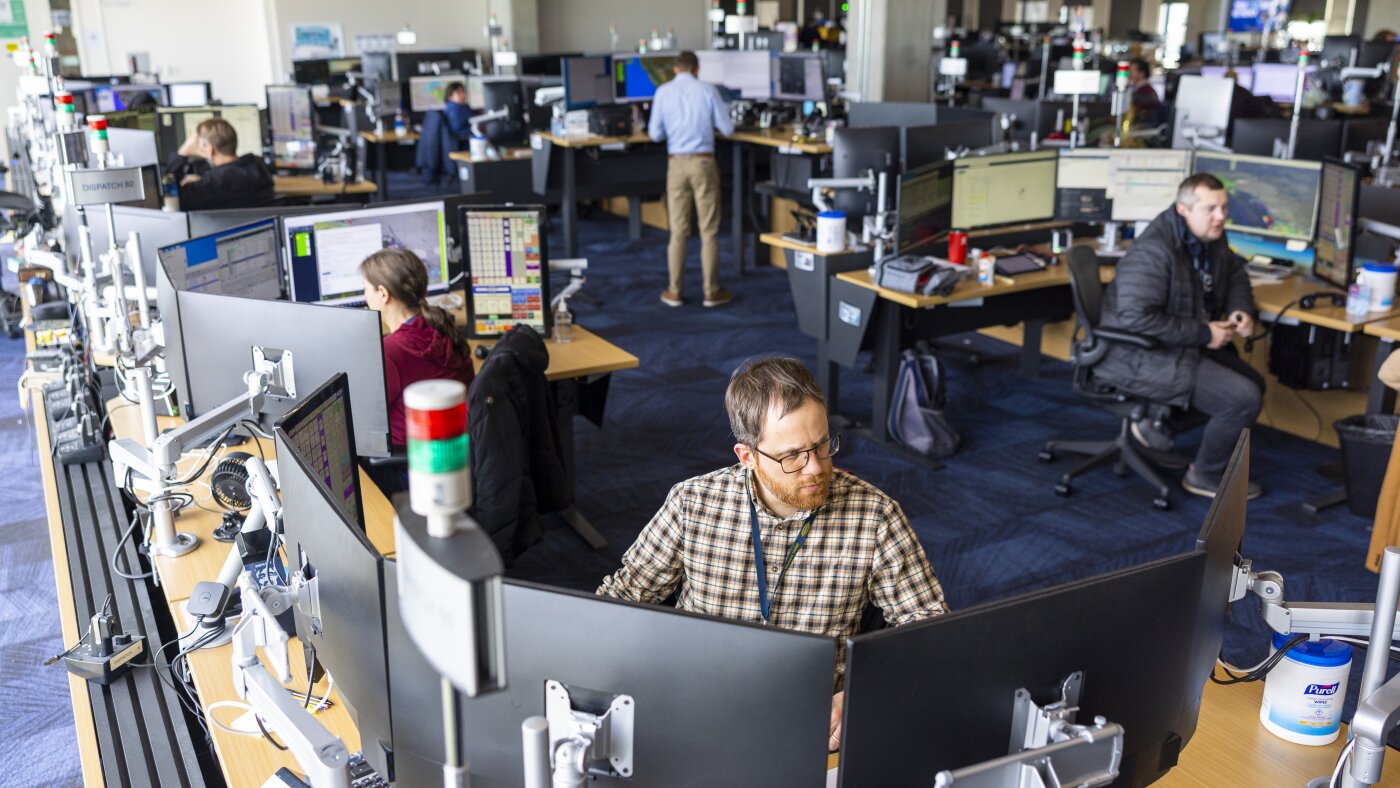
On the sixth floor of an office building near Seattle-Tacoma International Airport, in a room Alaska Airlines calls "The Hub," dispatchers sit behind as many as five flatscreen monitors apiece. On a typical day they guide roughly 1,500 flights, watching real-time air traffic, weather and upper-level wind patterns scroll past simultaneously.
It is more information than a person can hold at once. For the past five years, the dispatchers have had help from a software tool called Flyways AI.
"It ingests all that information," said Alek Mead, a manager in Alaska's Network Operations Center, "and it really kind of puts us all together in a nice little package for the dispatcher to look at, take some options, maybe play around with some different ideas, and then pick the most efficient and the safest route."
The company behind Flyways is Air Space Intelligence, a startup Alaska turned to when it wanted to squeeze more out of its operation. The Federal Aviation Administration has now hired the same company to attempt something vastly larger: a reboot of the entire U.S. airspace. The agency recently announced an $875 million contract with Air Space Intelligence to build what it is calling SMART, short for Strategic Management of Airspace, Routes, and Trajectories. It is a centerpiece of the Trump administration's push to deliver what it has branded a Brand New Air Traffic Control System.
Alaska became the first airline to use Flyways in 2021. The system does not choose flight paths. "It doesn't decide the route or waypoints that a dispatcher uses to get an airplane from A to B, but it does help provide suggestions that might be more efficient," said Captain Bret Peyton, managing director of Alaska's network operations control. "That's where Flyways is really excelling for us." The airline says the result is tens of thousands of hours saved in the air and roughly a million gallons of fuel a year.
The mechanism is prediction. Flyways crunches data on traffic, wind and weather to anticipate what will happen during a flight before it happens — which, according to the company's co-founder and chief executive, Phillip Buckendorf, is a harder sell than it sounds. "It's actually a really fundamental change, a massive behavior change," Buckendorf said in an interview last year on the podcast Crossing the Valley. "One of the hardest things is we're dealing with users that have basically made decisions against static displays for like 10, 20 years of their career. And so now they basically make a decision against a predictive picture."
Air Space Intelligence has since expanded beyond Alaska to Delta Air Lines and United Airlines, as well as the U.S. Army and Air Force. Federal regulators are now betting the same predictive approach can be scaled to the national level.
FAA Administrator Bryan Bedford has been blunt about the current system's shortcomings. American airspace is safe, he says, because controllers keep aircraft separated at every stage of flight — but safe is not the same as efficient. "What we're seeing is a system that is woefully unorganized," Bedford said at an industry conference in May. "We don't have in any of our facilities the ability to see the entire national airspace picture in a unified way." He added: "I think we've got a real opportunity to do something transformational with AI."
Bedford argues that predictive analytics can head off bottlenecks and congestion before they form, using comparatively small adjustments to schedules and routes. FAA officials say the goal is to assist air traffic controllers rather than replace them.
Skeptics question whether a tool that helps a few hundred airline dispatchers can be stretched across the busiest and most complex airspace in the world. Peyton says Alaska's own dispatchers started out in the same place.
"It took a while for us to convince the dispatch group that it is what we say it is, which is a decision making aid, and not a tool that's going to run rogue and make weird decisions for the dispatcher," Peyton said. "And it happened relatively quickly once dispatchers saw their true results that were pretty immediate."