Carney Got a Standing Ovation in the European Parliament and Said Canada Wants to Get 'as Close as We Possibly Can' to the EU. Trump Called It 'Laughable' and Threatened 'Very Heavy Tariffs on Europe' if the Intention Is 'Bad.'
Canada sends 70% of its exports to the U.S. Carney told lawmakers in Strasbourg that when countries negotiate alone with a dominant power, 'we negotiate from weakness.'
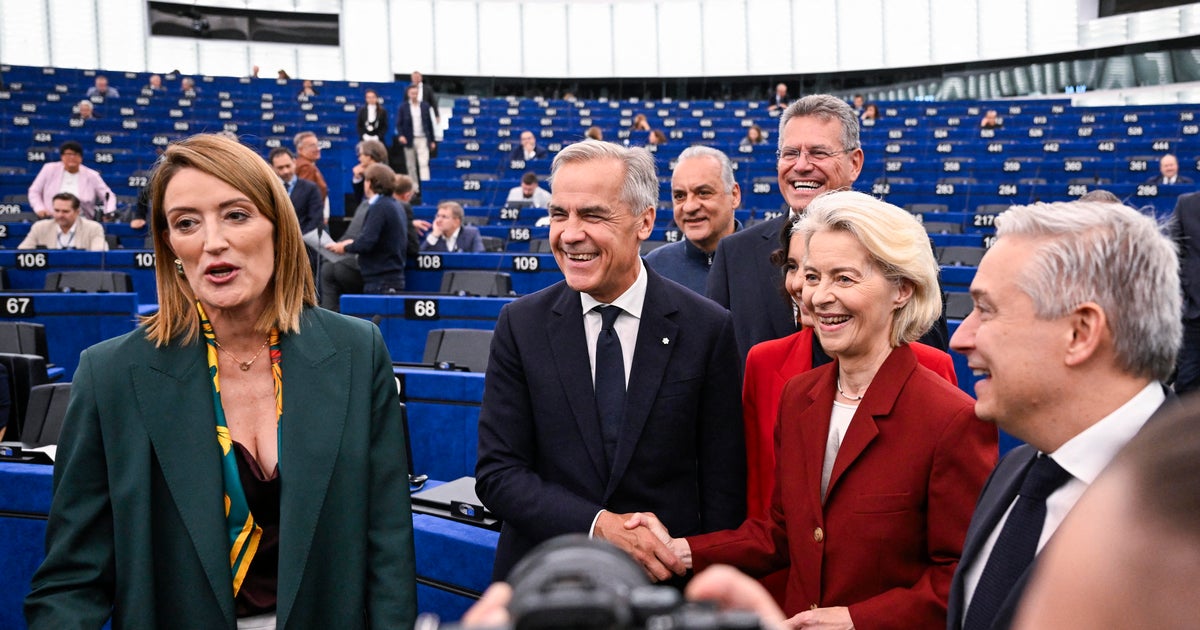
STRASBOURG, France — Canadian Prime Minister Mark Carney walked into the European Parliament on Thursday to lawmakers lining up for handshakes and selfies, and walked out to a standing ovation, a day after President Trump warned that Canada's push for a first-of-its-kind "associate membership" in the European Union could trigger new tariffs on the bloc.
Carney used the address to embrace the proposal that European Commission President Ursula von der Leyen floated Wednesday in her State of the Union speech, while acknowledging that "associate membership" is a status that does not yet exist in EU treaties and would have to be defined and negotiated. He told reporters afterward that Canada is not seeking full membership. What he laid out instead was deeper integration across trade, defense, critical minerals, artificial intelligence, energy, space, research and financial services, aimed at making both sides harder to squeeze.
"We do not seek power to dominate others," Carney told the chamber. "On the contrary, we are pursuing resilience so that no one can control our open markets, impair our sovereignty, threaten our territorial integrity, or undermine our freedoms, our democracies, our rule of law."
The speech was a thinly veiled answer to Washington. Canada sends roughly 70% of its exports to the United States, and Trump's tariffs, demands for economic concessions and repeated talk of making Canada the 51st state have pushed Ottawa to look for a way out of that dependence. Speaking in Charlotte, North Carolina, on Wednesday, Trump mocked the EU idea as "laughable," called Canada a "terrible trade partner" and said the U.S. response would depend on the "intention" of European leaders. "If it's a good intention, that's fine," he said. "If it's a bad intention, we'll put very heavy tariffs on Europe." He did not explain how he would judge the difference, and he raised the possibility of cutting off trade with the bloc entirely in some sectors. The Wall Street Journal reported he described the arrangement as potentially a "hostile act."
Carney has been building toward this moment since January, when he told the World Economic Forum in Davos that great powers were using economic dependence to bully smaller nations and that there had been a "rupture in the world order." When countries negotiate alone with a dominant power, he said then, "we negotiate from weakness. We accept what is offered." He proposed a comprehensive strategic partnership with the EU that would create a trading bloc of 1.5 billion people. Trump rebuked him the next day.
Europe and Canada have taken very different paths on Trump's tariffs. Ottawa retaliated and rejected U.S. demands Carney says threaten Canadian sovereignty. Brussels shelved retaliation and accepted duties of up to 15% on most EU exports to the United States. Even so, Canada this year became the first non-European country to join the EU's 150-billion-euro ($173 billion) SAFE defense procurement program, giving Canadian firms access to joint purchasing as Europe rearms.
Jonathan Wilkinson, Canada's ambassador-designate to the EU, said Wednesday that full membership was off the table because it would mean surrendering some sovereignty. The goal, he said, is "to get as close as we possibly can" to Europe while increasing Canada's independence. Von der Leyen has described the proposed relationship as an "Alliance for the Future" built around a "common prosperity and economic security space" that goes beyond the existing free trade agreement.
The two sides will take up the details at a Canada-EU summit Carney is hosting in Montreal on Oct. 29 and 30. Between now and then, Trump will be in New York for the U.N. General Assembly, where the trade fight with both Ottawa and Brussels is likely to follow him.
Originally reported by CBS News.