Carney Has Quietly Talked to Nearly Every Major EU Leader About Making Canada an 'Associate Member' of the Union, WSJ Reports. He Says He Wants a 'Unique Alliance,' Not Membership, and Addresses Strasbourg Thursday.
With the United States still taking about 72% of Canadian exports and 50% Trump tariffs in place, Ottawa is exploring a status that does not yet exist. Germany's Friedrich Merz floated the same 'associate member' idea for Ukraine earlier this year.
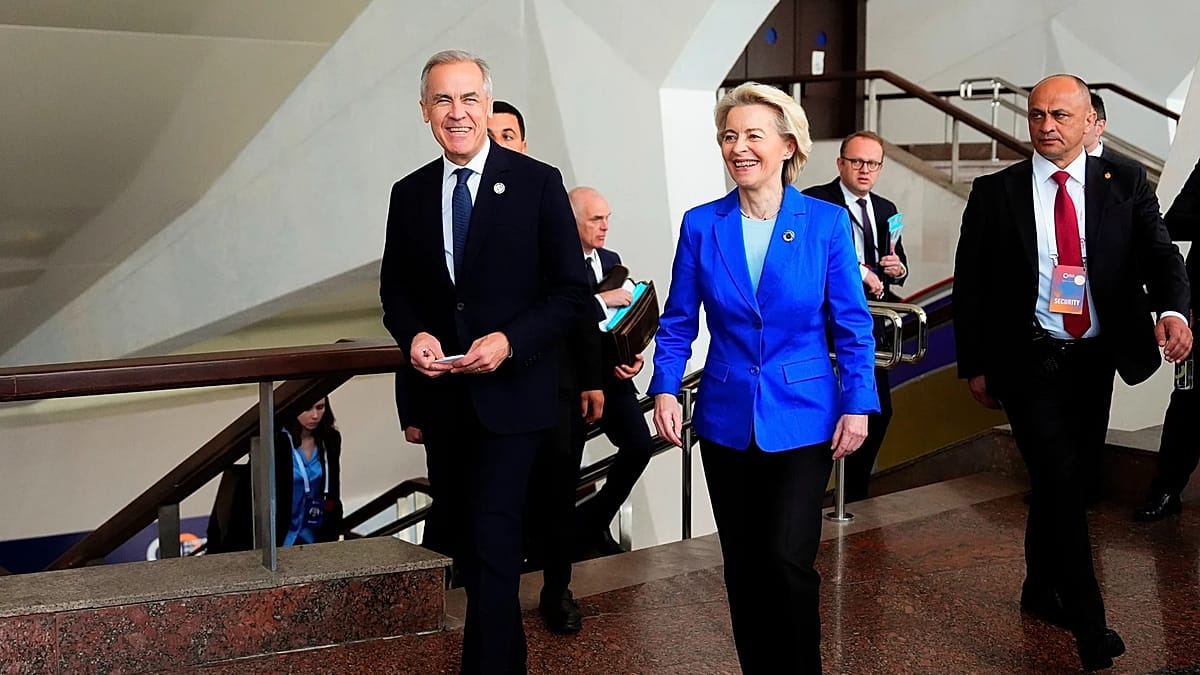
Canadian Prime Minister Mark Carney has held private conversations with nearly every major national leader in the European Union about a form of attachment to the bloc that does not currently exist: associate membership. The Wall Street Journal, citing unnamed EU and Canadian officials, reported over the weekend that Carney has instructed a special envoy to explore what Canada could obtain short of joining the single market, and that both sides are preparing what one Bloomberg report called a "far-reaching deal" to be unveiled when Carney addresses the European Parliament in Strasbourg on Thursday.
Carney did not deny the substance. Asked about the report at the Toronto International Film Festival, he drew a careful line. "We're not looking to become a member of the European Union," he said. "What we are looking for and will begin discussion for, is a unique alliance with the European Union." The European Commission declined to comment.
The impetus is the trade war with Washington. The United States still takes roughly 72% of Canada's exports, and since July, when President Donald Trump imposed 50% tariffs on most Canadian goods by reviving a 1930 statute unused for nearly a century, there has been no sign of de-escalation. Canada already has a comprehensive free-trade agreement with the EU, CETA, which has been provisionally applied since 2017. What Ottawa is now discussing goes well beyond tariff schedules. According to the Journal, the areas under negotiation include energy exports, artificial intelligence, defense procurement, critical minerals, undersea cables, data centers, cloud infrastructure and satellite networks, the digital and physical plumbing of a modern economy that Canada currently shares almost entirely with the United States.
The "associate member" label has a recent European pedigree. German Chancellor Friedrich Merz outlined the concept earlier this year as a way to bind Ukraine to the EU without the decade-long accession process, deepening economic and security integration without granting a seat at the Council table or a vote on the budget. Officials told the Journal that the same template could be adapted for Canada, a G7 economy with a NATO army, a common law system and no interest in the euro.
There is symbolism scheduled alongside the substance. French President Emmanuel Macron and Carney plan a joint visit to Saint-Pierre-and-Miquelon, the French territory 20 kilometers off Newfoundland, a demonstration of European solidarity within sight of the Canadian coast.
The political risk at home is manageable but real. Carney won a majority in April on a platform of standing up to Washington. But any arrangement that looks like submitting to Brussels regulation, on agriculture or digital rules in particular, will draw fire from the Conservative opposition and from provinces that export south. Carney's insistence on the word "alliance" rather than "membership" is meant to keep that door closed before it opens.
For the EU, the calculation is simpler. A closer Canada offers energy, minerals and a like-minded voice on trade at a moment when the bloc's relationship with Washington is equally strained. Whether the two sides can invent a legal status that satisfies both by Thursday, or merely announce that they intend to, will become clear in Strasbourg.
Originally reported by Euronews / The Wall Street Journal.