Army Delays Detonation of 5 Tons of Lead Azide in Iowa Until Monday
Army Secretary Adam Telle postponed the controlled blast at the Iowa Army Ammunition Plant hours after two environmental groups asked a federal appeals court to halt it.
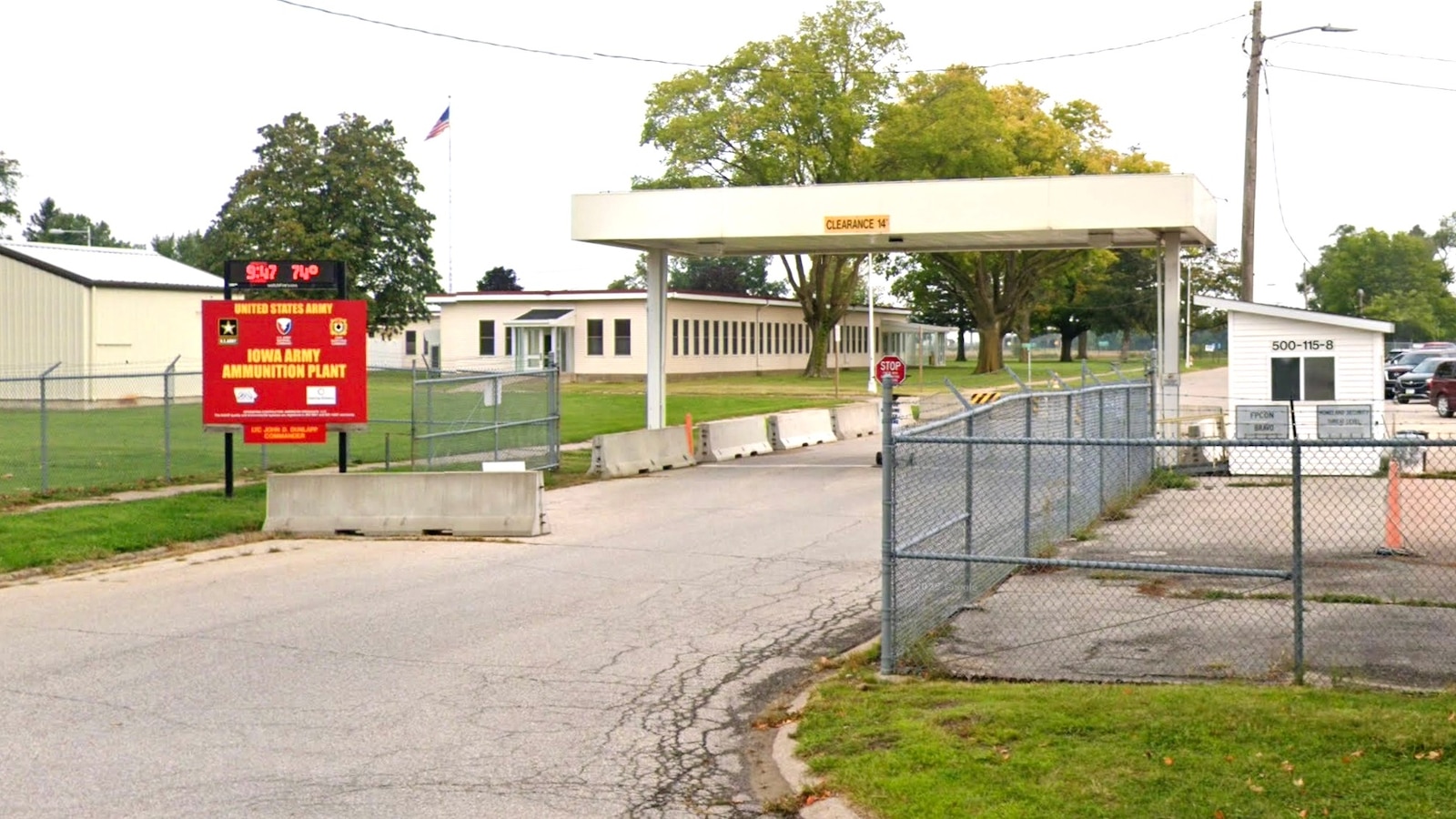
The U.S. Army has postponed the planned detonation of nearly 10,000 pounds of degraded lead azide at the Iowa Army Ammunition Plant until Monday, Nov. 23, a day before the blast was scheduled to take place.
"Public safety is the Army's top priority, and I have directed Army Materiel Command to postpone tomorrow's controlled detonation at the Iowa Army Ammunition Plant in Middletown, Iowa until Monday, November 23," Army Secretary Adam Telle said in a post on social media Thursday. He said Monday is the "latest possible moment prior to a forecasted temperature drop, which would risk further destabilization of the material."
Two rapid, controlled detonations had been set for midday Friday to dispose of 68 barrels of lead azide, about 9,700 pounds, according to Army Sustainment Command spokesperson Justine Barati. Lead azide is the primary explosive used to start munitions. The Army says the stored material has recrystallized, which the Environmental Protection Agency says has raised its sensitivity to friction and shock. Moving the containers, the EPA said, "could create an unacceptable risk of unintentional detonation." The Army has said destroying it in place is the only responsible option.
The delay came hours after the Iowa Environmental Council and the Sierra Club's Iowa chapter filed an emergency motion asking a federal appeals court to stay the EPA permit that authorizes the blasts. The groups argue the agency approved the permit without adequately weighing the health and environmental consequences or fully evaluating alternatives. They asked the court to rule by 10 a.m. Central on Friday, right before the detonation was due. The filing says the Army's latest modeling projects that lead dust could settle across an area about 25 miles long and 5 miles wide, including homes and waterways, and that dust could reach communities more than 100 miles away. It also alleges some potentially affected communities did not get direct or timely notice.
The Army has said the blast will happen inside earth-covered concrete magazines surrounded by sand barriers two stories high. Before and during the detonation, crews will saturate the soil above the magazines with water and run water misters to reduce the amount of lead that drifts off the installation. The blast is expected to cause loud noises and ground vibrations and to send up a dust plume that contains some lead and could linger for up to an hour, depending on wind. The Army has also said the blast could break windows.
Residents near Middletown City Park and Butterfly Park, in a town of nearly 400 people near the Iowa-Illinois border, were asked to leave for several hours before and after the blast. Those who could not leave were told to stay indoors with windows and doors closed. Several school districts, including Burlington, Mediapolis, Columbus, Danville and Winfield Mt. Union, had planned to close Friday. Updated guidance had not been released as of Thursday. Lead exposure is a particular concern for young children, and the Centers for Disease Control and Prevention says there is no safe blood lead level for kids.
Republican Sen. Chuck Grassley said he raised questions with the Army and stressed the need for better communication, and that the delay is "to further educate the public." Telle said the Army "will continue to actively engage with state and local officials throughout the region to distribute accurate, up-to-date information." On Friday, the Department of Health and Human Services, the EPA and the Army issued a joint statement saying the agencies are preparing "the most extreme mitigation measures available" and have been planning for the event since March. A time for Monday's detonation has not been announced, and the appeals court had not ruled on the groups' request as of the latest reports.