A Quantum Computer That Runs Itself: HRL Put the Control Chip Inside the Refrigerator, at Minus 450 Degrees
Instead of racks of room-temperature electronics feeding signals down cables, HRL Laboratories built a CMOS controller that sits next to the qubits in the cold and executes error correction on its own. Control errors dropped tenfold.
HRL Laboratories has demonstrated a silicon quantum processor that controls itself, replacing the racks of room-temperature electronics that normally drive a quantum computer with a single custom chip sitting inside the refrigerator alongside the qubits.
The result, published in Nature, addresses a bottleneck that has quietly become one of the hardest engineering problems in quantum computing. Every qubit in a conventional machine needs its own control lines running from warm electronics down into a cryostat. Each cable carries heat and occupies space. Scaling from tens of qubits to the thousands or millions that useful error correction requires would mean a cable count no dilution refrigerator can physically accommodate.
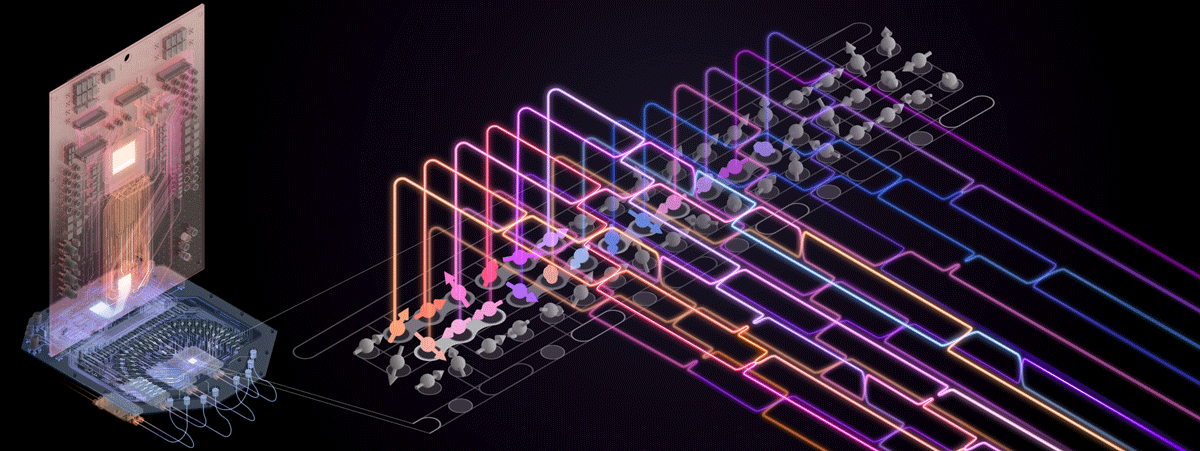
HRL's approach was to move the controller into the cold. The company built a custom CMOS control chip that operates at roughly minus 450 degrees Fahrenheit — about 4 kelvin — inside the cryostat, generating every signal needed to run its 18-qubit devices. The quantum chip itself is a three-rail array of 54 exchange-coupled quantum dots, configurable to host up to 18 exchange-only qubits. A superconducting ribbon cable carries hundreds of control signals between the two while transmitting very little heat to the qubits, which sit at a far colder stage.
The performance numbers are what make the architecture more than a packaging exercise. Control errors came in roughly ten times lower than any prior demonstration using this type of qubit, helped by a new fabrication process that produced markedly less device noise. Individual operations completed in under a microsecond. Most consequentially, when the team added more qubits to an error-correcting repetition code, error rates fell about fivefold — the behavior every quantum computer will ultimately depend on, and the property that separates a system that gets better as it grows from one that drowns in its own noise. The measured results matched theoretical predictions, which the team took as evidence that the design scales.
Running error correction autonomously is the part that closes the loop. In most machines, measuring qubits, decoding the results and issuing corrections requires a round trip to room-temperature hardware fast enough to beat the qubits' decoherence. HRL's system performs repeated rounds of error correction in the cold, without real-time instruction from outside the refrigerator.
"Our goal is to build these powerful computers using standard microchip production lines and fit each one inside a single refrigerator," HRL chief executive Rob Vasquez said, framing the work as an effort to make quantum machines cheap enough and small enough to leave the national-laboratory setting.
The commercial verdict arrived quickly. IBM has signed a definitive agreement to acquire HRL, citing the goal of accelerating quantum development and commercialization — a bet that the control problem, not the qubit itself, is what determines who gets to a useful machine first.