A New Quantum Gate Turns Its Own Failures Into Missing Photons the Computer Can See
Writing in Nature, researchers report a two-qubit gate that operates in 500 nanoseconds and converts roughly 0.5% of its operations into flagged, detectable errors while leaving hidden errors below 0.1%.

The hardest problem in quantum computing is not that qubits fail — it is that they fail silently. A bit of stray heat or a microscopic vibration flips a value, the calculation carries on, and nobody finds out until the answer comes back wrong. The standard remedy is to throw hardware at it: encode one useful qubit across dozens or hundreds of physical ones and use the redundancy to infer where the errors were. That is why current machines are so large and so expensive.
A paper published in Nature attacks the problem from the other end. Instead of catching errors after the fact, researchers at D-Wave Quantum Inc. built a two-qubit link — a controlled-Z, or CZ, entangling gate — that converts most of its own failures into something the machine notices immediately: a missing photon. Errors of that kind are called erasures, and an erasure is enormously more useful than a silent flip, because the computer knows both that something went wrong and exactly where.
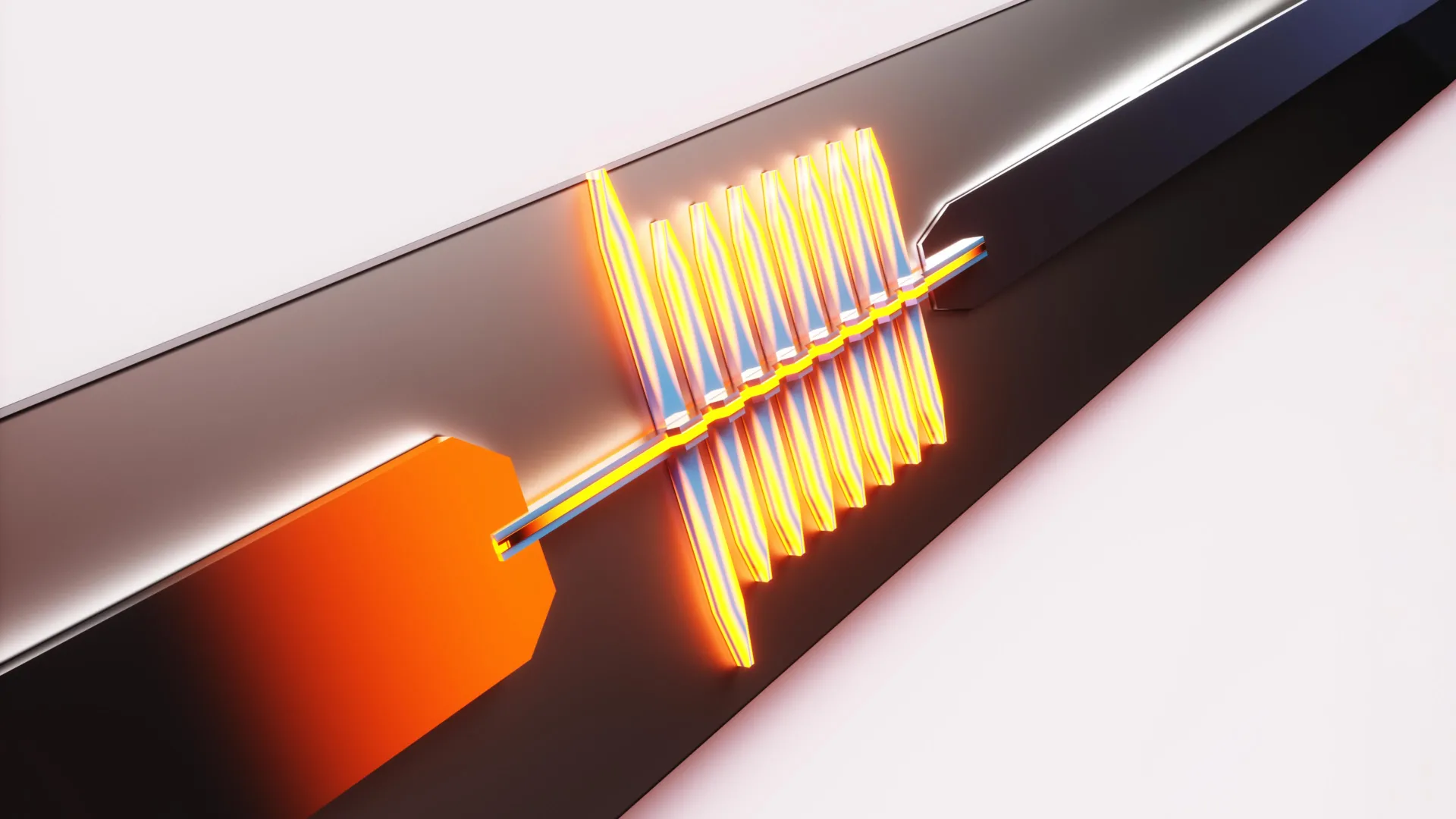
The hardware works by splitting each qubit across two tiny superconducting microwave cavities, an arrangement known as a dual-rail encoding. In that scheme, the information lives in which of the two cavities holds a photon, so if the photon leaks away entirely, its absence is detectable. To make two such qubits interact, the team briefly shifted a photon into a central bridge between them, waited for the interaction, then shifted the light back to where it started. The whole operation takes 500 nanoseconds.
The reason that matters is that previous attempts at entangling gates for this type of qubit tended to destroy the very property that made them attractive. Connecting two dual-rail qubits typically broke the built-in error detection, converting easy-to-spot erasures back into hidden glitches. Here, the tests showed the opposite: about 0.5% of operations produced flagged photon losses, remaining hidden errors stayed below roughly 0.1% per gate, and bit-flip errors — the catastrophic kind that silently turn a 0 into a 1 — occurred at a rate near one in a million.
"Our experimental demonstration confirms that the error hierarchy is largely preserved during the gate," the authors wrote. That phrase is the whole result. The hierarchy is the property that most failures are loud rather than quiet, and preserving it through a two-qubit operation is what had never been done.
Simulations run by the team suggest the payoff compounds with scale. In an ordinary architecture, adding qubits adds hidden errors faster than the code can absorb them; in one where failures announce themselves, error suppression improves as the machine grows. The paper — "An entangling gate for dual-rail erasure qubits" — concludes that the results "enable a faster path to error-corrected systems that rapidly suppress errors as they scale." The control qubit takes marginally more stress during the operation than the target, a lopsidedness the team notes but does not consider disqualifying.