Wesley Bell Beat Cori Bush by 22 Points in St. Louis, and Her Concession Speech Went After AIPAC Anyway
The freshman congressman won the Missouri 1st District Democratic primary 59.2% to 36.9% in a rematch that turned almost entirely on U.S. military aid to Israel. Roughly $8.4 million was spent on the race, about $7.2 million of it behind Bell.
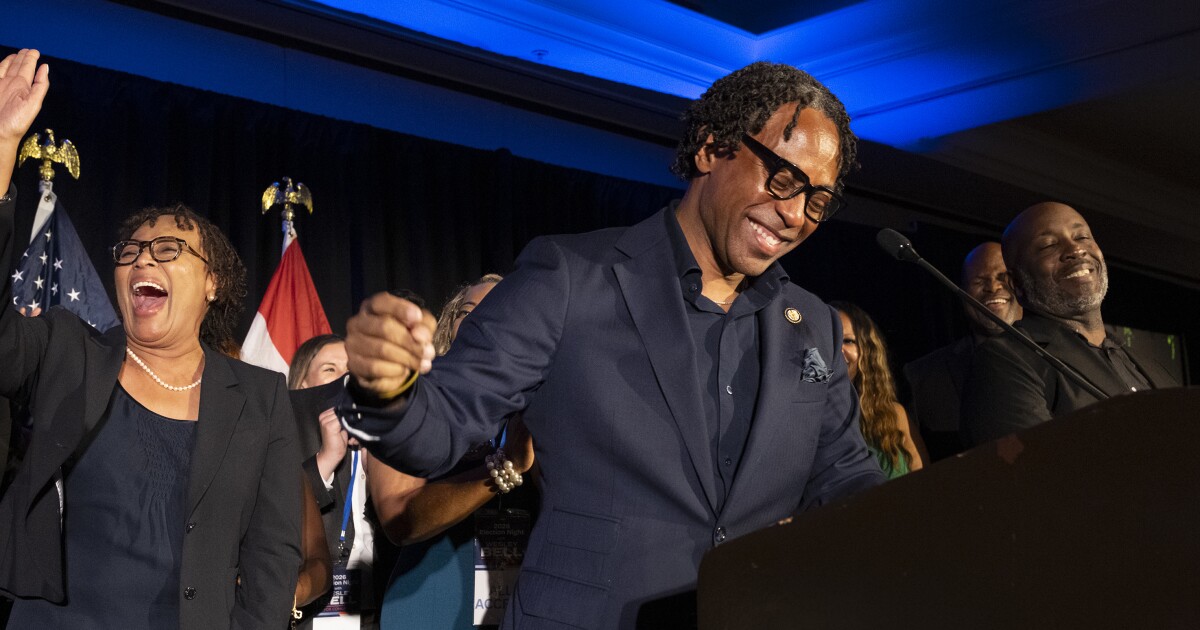
Rep. Wesley Bell defeated former Rep. Cori Bush on Tuesday in the Democratic primary for Missouri's 1st Congressional District, winning 59.2% to 36.9% with nearly all votes counted. It was a rematch of the 2024 primary in which Bell, then the St. Louis County prosecuting attorney, unseated Bush after her two terms in Congress. The margin this time was wider than the first.
The district covers the city of St. Louis and much of St. Louis County and is overwhelmingly Democratic, so Bell is heavily favored to hold the seat in November against Republican Paul Berry III, who beat Andrew Jones in the GOP primary. Berry will be joined on the ballot by Libertarian Tom Schmitz.
Bell had the party establishment behind him: House Minority Leader Hakeem Jeffries, former Speaker Nancy Pelosi, Kansas City Rep. Emanuel Cleaver, the Congressional Black Caucus and a range of trade unions. Candidates and outside groups combined to spend about $8.4 million on the race, roughly $7.2 million of it on Bell's side. The United Democracy Project, a super PAC affiliated with the American Israel Public Affairs Committee, spent heavily against Bush in both 2024 and 2026 — and Bush's campaign never raised enough to answer Bell's television advertising.
The two candidates agreed on a great deal. Bush campaigned on Medicare for All, affordability, abolishing Immigration and Customs Enforcement, opposition to the Iran war and federal money for St. Louis residents still recovering from the May 2025 tornado. Bell shared many of those positions. Where they split was Israel: Bush wanted U.S. military aid cut off, citing Amnesty International and Human Rights Watch reports characterizing Israel's conduct in Gaza as genocide. Bell criticized Prime Minister Benjamin Netanyahu but argued the United States must stand by allies in the region, and declined to use the word genocide.
"I am extremely humbled and honored that you have put your faith in me for a second time," Bell told supporters at the Marriott St. Louis Grand. "You sent me to D.C. to get things done." He highlighted working with Missouri Republicans to pass tornado relief and turned to the White House: "We are seeing from this administration, cruelty, chaos and corruption. Costs are out of control, health care costs have skyrocketed, the Voting Rights Act has been gutted by the Supreme Court, which means our very democracy is under attack."
Bush, conceding at the Family Haven Event Center in Dellwood, was not conciliatory about the money. "When I said last time, 'AIPAC, I'm coming to tear your kingdom down?' Let's be clear. That kingdom is falling down, and I ain't done," she said. "And I'm not just coming for AIPAC. This ain't even about AIPAC. The billionaires, the corporations that think they're people — that's who I'm coming for." She also told the room she would not villainize her opponent: "We're not walking out of here with hatred. Not even for the congressman."
The loss lands awkwardly for the progressive left, which has spent recent months unseating incumbents in primaries in New York, Denver and elsewhere. Bush herself came out of that tradition, beating longtime Rep. Lacy Clay in 2020. Meanwhile, Missouri Republicans have openly discussed another redistricting push next year that would carve up the St. Louis area — meaning the district both candidates just fought over may not exist in its current shape much longer.
Originally reported by St. Louis Public Radio.