Two Time Crystals 40 Micrometers Apart Locked Into the Same Beat — Over a Thousand Times Farther Than They Should Reach
Physicists at TU Dortmund built self-oscillating spin systems inside a semiconductor chip and found that distant ones synchronize, holding the rhythm for hours.

Physicists at TU Dortmund University have shown that separate time crystals formed inside a single semiconductor chip will fall into step with one another across distances more than a thousand times larger than the oscillators themselves — a result that turns an exotic quantum curiosity into something that looks like the beginning of a network.
An ordinary crystal repeats in space: atoms sit at regular intervals, and the pattern is the same wherever you look. A time crystal repeats in time. Its internal state cycles through the same sequence over and over without being driven at that rhythm and without settling into equilibrium, which is the part that once seemed impossible. Continuous time crystals — the kind that keep oscillating on their own rather than being periodically kicked — were only demonstrated in a semiconductor in January 2024, by the same Dortmund group led by Professor Alex Greilich.
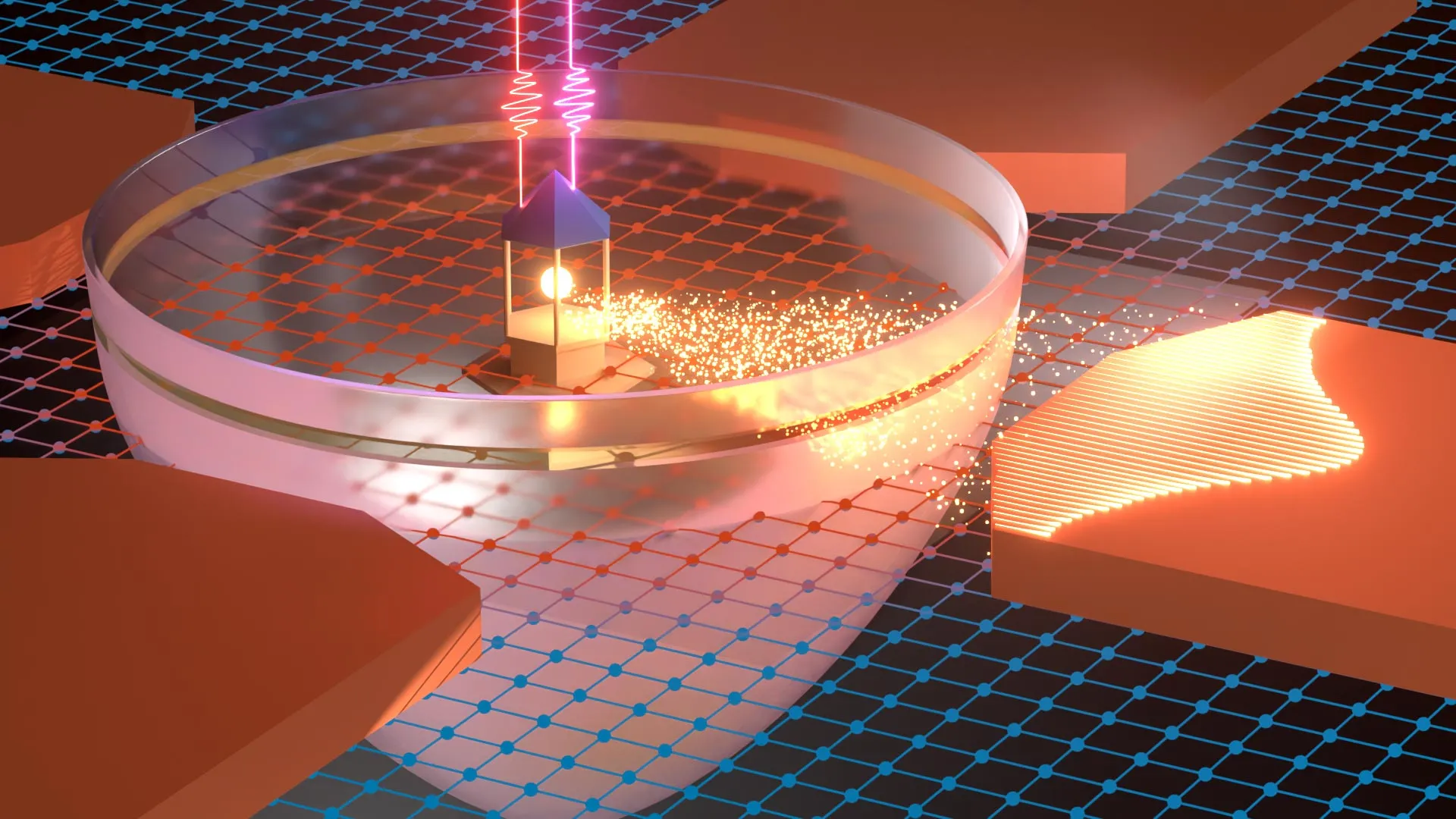
The material is gallium arsenide doped with small amounts of indium and silicon, which pins electrons in place at specific sites. Each of those localized electrons sits in a bath of roughly one million surrounding atomic nuclei, every one of them carrying its own spin. A pump laser aligns the electron spins; that alignment is transferred into the nuclear spins around them. In a weak magnetic field the nuclear-spin polarization begins to rotate, and feedback between the electrons and the nuclei sustains the rotation instead of letting it damp away. A second laser watches what happens. The experiments ran at about minus 270 degrees Celsius, three degrees above absolute zero.
The new question was whether two such oscillators, formed at different places in the same crystal, would care about each other. They did. Time crystals separated by 40 micrometers — a distance more than 1,000 times the size of an individual oscillator — synchronized their oscillations and held that synchrony for hours.
Forty micrometers is roughly half the width of a human hair, and on the scale of the spin systems involved it is enormous. Nothing in the setup obviously carries a signal that far; the individual electron-nuclear systems interact strongly only with their immediate surroundings. "The results demonstrate nonlocal coupling between spatially separated spin systems," the authors write, "and may provide a foundation for controllable networks of spin oscillators in future spin-based technologies."
That last phrase is the point of the work. A single time crystal is a demonstration. A set of them that can be placed at chosen locations and will lock to a common rhythm is closer to a component — a distributed clock, a set of coupled oscillators, or an addressable array of spin systems that stay coherent with one another without a wire between them. Coupled oscillators are the substrate for a surprising amount of computation, from synchronization-based signal processing to certain optimization schemes, and the fact that these particular ones live inside a conventional semiconductor rather than in an ion trap or a dilution-refrigerator-scale apparatus makes the engineering path shorter.
The cryogenic requirement remains the obvious limitation: minus 270 degrees is not a temperature at which anything ships. But the January 2024 result established that continuous time crystals form in an ordinary III-V semiconductor at all, and this one establishes that they talk to each other across chip-scale distances. The work appears in Nature Communications.