Three Houston Mothers Are Suing Texas Over the Ten Commandments — Using a Parental Rights Amendment Conservatives Wrote
A state lawsuit filed in Harris County argues that Senate Bill 10, which orders the Ten Commandments onto every public school classroom wall, collides with the parental rights amendment Texas voters approved in November 2025.
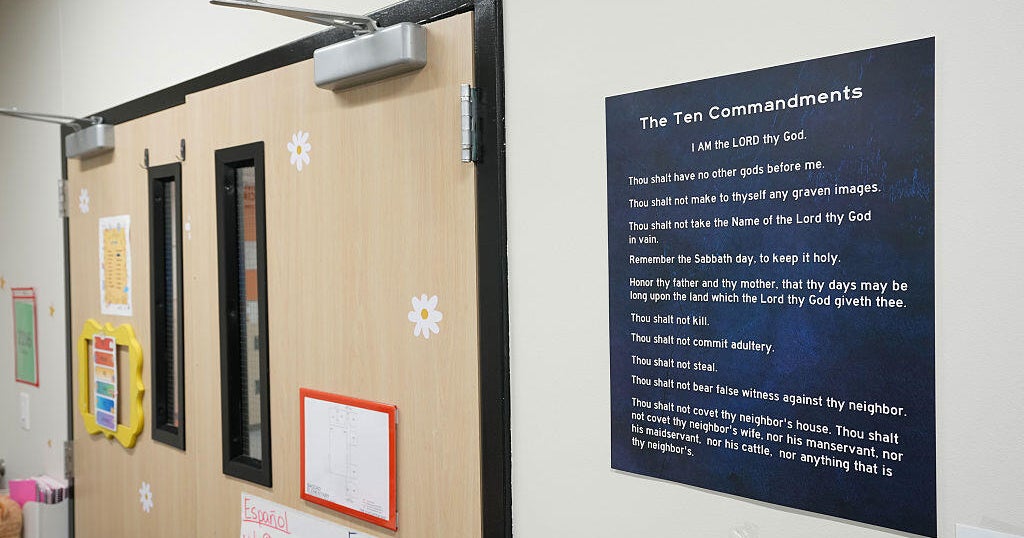
Three mothers from the Houston area have sued the state of Texas to stop a law that requires the Ten Commandments to hang in every public school classroom, and they are not making the argument most people expect. Instead of leading with the First Amendment, Audrey Nath, Emily Roth and Sanjam Sohal filed in Harris County District Court under two pieces of Texas law that conservatives themselves built: the 1999 Texas Religious Freedom Restoration Act, which bars a government agency from substantially burdening a person's free exercise of religion, and the Parental Rights amendment that Texas voters added to the state constitution in November 2025.
That amendment guarantees parents the "fundamental right to exercise care, custody, and control" of their children, "including the right to make decisions concerning the child's upbringing." The mothers argue that a state-mandated poster of one religion's laws on a classroom wall is exactly the kind of decision the amendment reserved to them. Texas Attorney General Ken Paxton and Texas Education Agency Commissioner Mike Morath are both named as defendants.
Senate Bill 10 passed the Texas Legislature last year. One of several federal challenges to it failed in April, when the Fifth Circuit Court of Appeals upheld the law — a ruling that can still be appealed to the U.S. Supreme Court. Attorneys for a separate group of 15 families who sued in federal court in September told CBS News they plan to petition the Supreme Court within the next few weeks. The new Harris County case runs on a parallel track, in state court, under state law, where the Fifth Circuit's ruling does not control the outcome.
"My kids are young and they don't have the concept of murder … and adultery and servitude," Roth told CBS News. Nath framed the objection differently: "This is presenting the beliefs of one religion as rules on the wall. And I think that implies that any kids that believe something different aren't following the right thing at school." Roth added that she is not opposed to religion in the curriculum outright — "There can be a place for religion in school, if it's being taught in an historical context with other religions" — but said that if "the state of Texas is going to let Christian nationalists dictate what goes on our kids' walls, they're going to hear from Texas moms."
Supporters see it as heritage, not doctrine. Paxton has argued that Biblical texts are a foundational part of American history and belong in the classroom. Jonathan Covey, director of policy at Texas Values, a Christian advocacy group that supplies schools with the posters, pushed back on the parental-rights theory directly: "Parental rights are fundamental, but they're not a license for one family to rewrite that for every child in Texas and what they learn in public schools."
The practical effect is already visible as Texas students head back to class next week. The Arlington Independent School District said it has received donated copies of the Ten Commandments but that its schools "remain legally prohibited from displaying them while the litigation remains pending in any form," and that "federal courts must ultimately resolve the conflict between state law and federal precedent surrounding S.B. 10."
Texas is one of four states that currently require the displays, alongside Louisiana, Alabama and Arkansas. Nearly a dozen more are weighing similar bills, including West Virginia, Oklahoma, Utah, Mississippi, South Carolina, Georgia, Montana, Missouri, North Dakota, South Dakota and Indiana. "I feel like Texas is being a test case right now," Roth said, "and I don't want my kids to be the guinea pigs."