Scientists Solve 40-Year Physics Puzzle About Universal Growth Laws
Researchers use quantum light-matter particles to prove that wildly different systems—from crystals to living organisms—follow the same hidden growth rules.
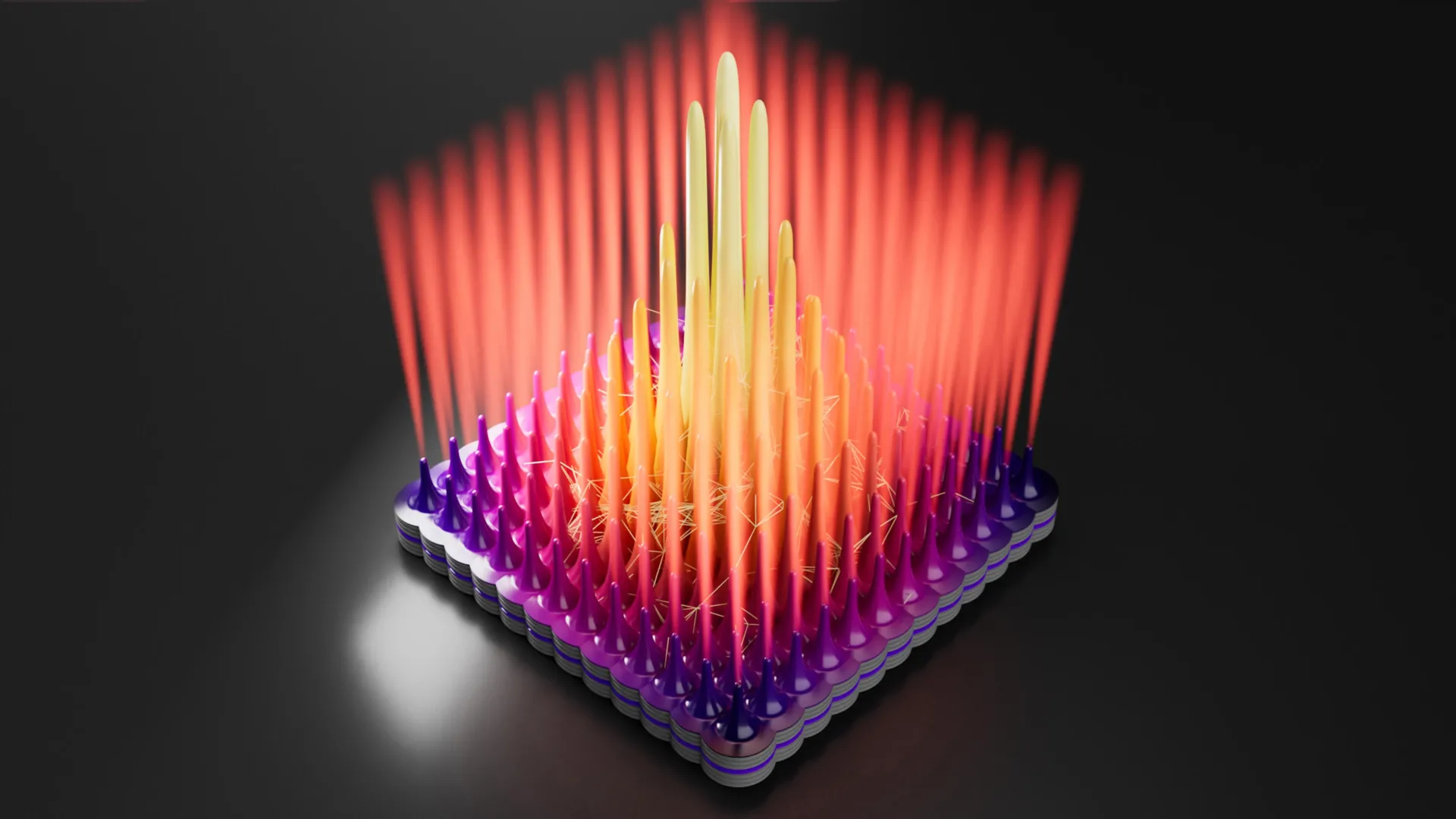
Scientists at the University of Würzburg have achieved a major breakthrough in understanding how things grow, providing the first experimental confirmation in two dimensions of a universal growth law that has puzzled physicists for four decades. Using a quantum system of fleeting light-matter particles called polaritons, the team demonstrated that the Kardar-Parisi-Zhang (KPZ) equation—a theoretical framework introduced in 1986—accurately describes growth processes across vastly different systems.
The KPZ equation was designed to reveal hidden universal rules governing growth in everything from crystal formation and population dynamics to flame fronts and even machine learning algorithms. The theory suggests that seemingly unrelated processes may all follow the same fundamental mathematical principles when they grow, but proving this experimentally has been extraordinarily challenging, especially in two dimensions.
"When surfaces grow—whether crystals, bacteria, or flame fronts—the process is always nonlinear and random. In physics, we describe such systems as being out of equilibrium," explains Siddhartha Dam, a postdoctoral researcher at the University of Würzburg. "Engineering a system capable of simultaneously measuring how a non-equilibrium process evolves in space and time is extremely challenging—especially because these processes unfold on ultrashort timescales."
To overcome these challenges, the researchers designed a highly controlled quantum experiment using gallium arsenide semiconductors cooled to −269.15°C and continuously stimulated with lasers. Under these extreme conditions, they created polaritons—hybrid particles combining light and matter that exist only briefly under non-equilibrium conditions. These particles form and disappear within picoseconds, making them ideal for studying rapid growth processes.
The successful confirmation of KPZ behavior in two dimensions represents a significant milestone in understanding universal growth patterns. The discovery strengthens the idea that despite their apparent differences, many natural and artificial systems may be governed by the same deep mathematical principles. This understanding could have far-reaching implications for predicting and controlling growth processes in fields ranging from materials science to biology and technology development.
