Scientists Experimentally Confirm Universal Growth Law in Two Dimensions
Researchers use quantum system of fleeting light-matter particles to prove 40-year-old physics theory applies across wildly different processes.
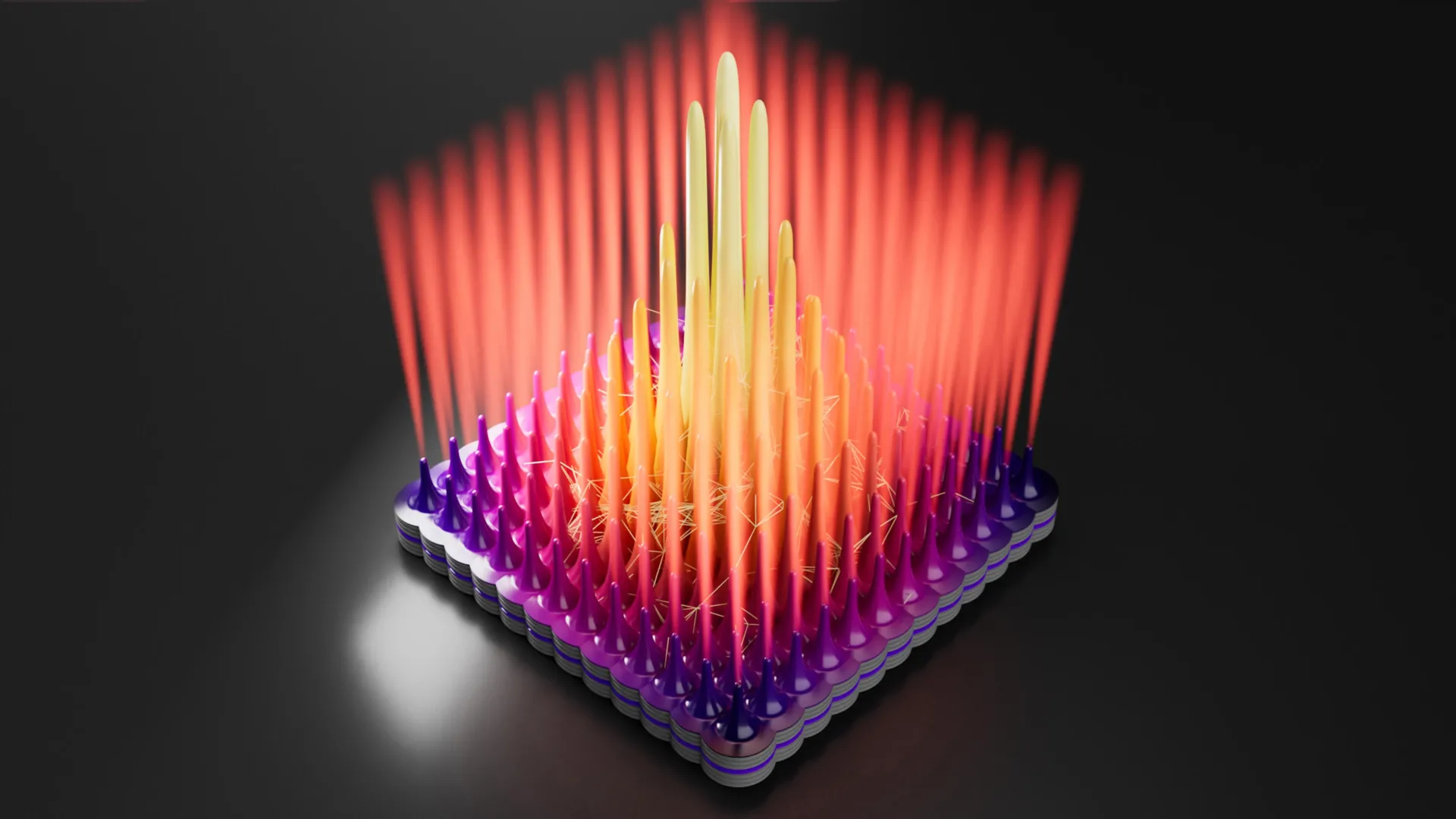
Scientists at the University of Würzburg have achieved a breakthrough in understanding how surfaces grow, providing the first experimental confirmation that a universal mathematical law governs growth processes in two dimensions. The research validates the Kardar-Parisi-Zhang equation, a 40-year-old theory suggesting that vastly different systems follow identical underlying rules when they grow.
The team created an ultracold quantum experiment using gallium arsenide cooled to -269.15°C and stimulated with laser light to produce exotic particles called polaritons. These hybrid light-matter particles exist only briefly under non-equilibrium conditions, making them ideal for studying rapid growth phenomena. "Engineering a system capable of simultaneously measuring how a non-equilibrium process evolves in space and time is extremely challenging," explained postdoctoral researcher Siddhartha Dam.
Polaritons formed when the laser created them disappeared within picoseconds, but researchers could precisely track their spatial and temporal evolution. The experimental data matched predictions from the KPZ model, demonstrating that the same mathematical principles governing crystal formation, bacterial growth, and flame propagation also apply to quantum systems.
The findings strengthen the idea that nature follows hidden universal patterns across seemingly unrelated processes. Previous research had confirmed KPZ behavior in one-dimensional systems in 2022, but extending the proof to two dimensions required unprecedented experimental precision and control over quantum phenomena.
This fundamental advance could eventually impact technologies ranging from materials science to machine learning algorithms. By understanding the universal rules that govern growth, scientists may develop better methods for controlling how crystals form, how biological systems develop, and how artificial intelligence networks evolve during training.