Scientists Experimentally Confirm Universal Growth Law After 40-Year Physics Puzzle
Researchers used quantum light-matter particles to prove the Kardar-Parisi-Zhang theory works in two dimensions, strengthening ideas about hidden rules governing everything from crystals to living systems.
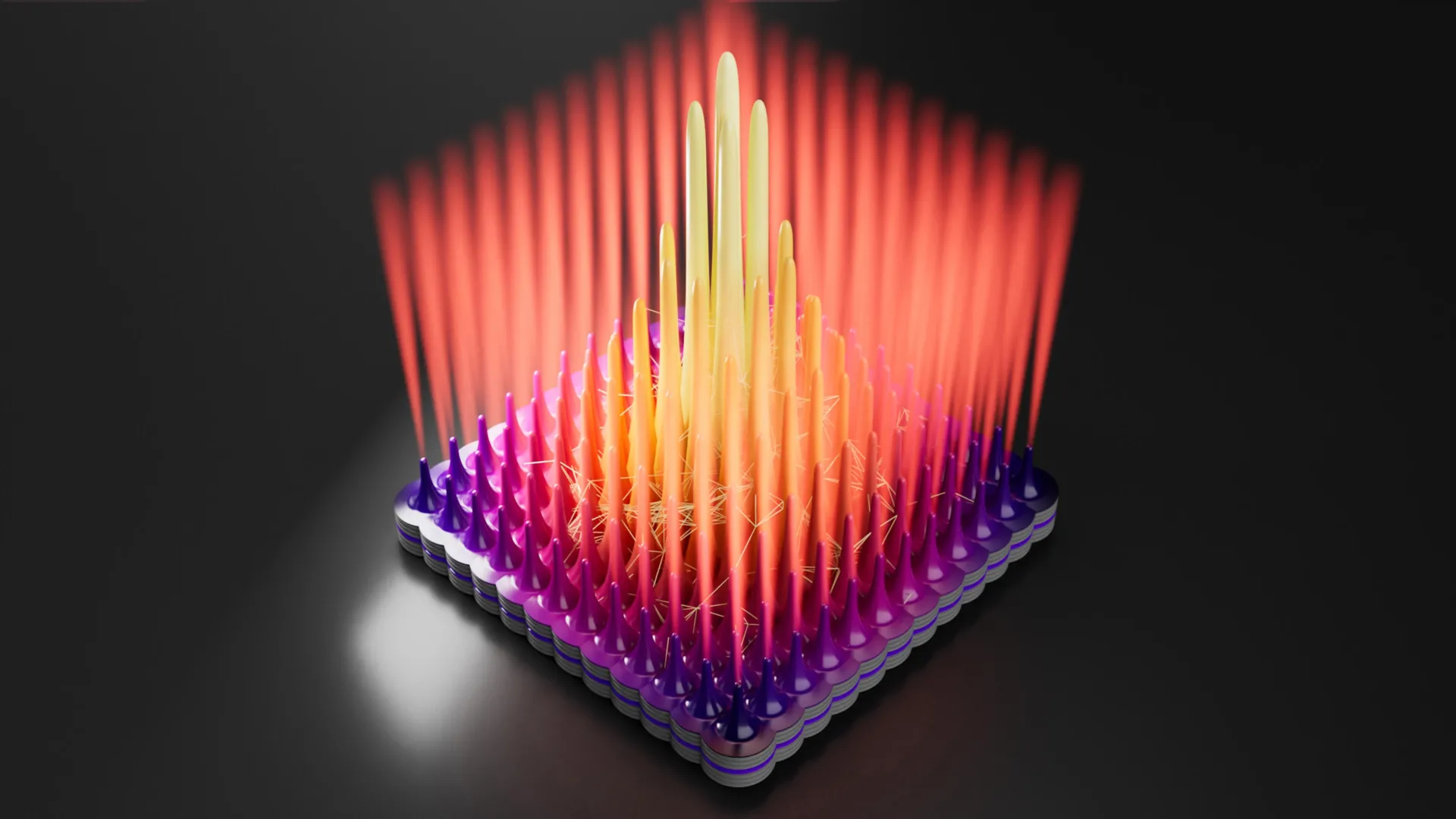
Scientists at the University of Würzburg have achieved a major breakthrough in physics by providing the first experimental confirmation that a universal growth law applies in two dimensions, solving a puzzle that has challenged researchers for four decades. The team successfully demonstrated that the Kardar-Parisi-Zhang (KPZ) equation, first proposed in 1986, accurately describes growth processes across wildly different systems using a quantum setup involving fleeting light-matter particles called polaritons. This landmark achievement strengthens the revolutionary idea that diverse natural processes, from crystal formation to population dynamics, may all follow the same fundamental mathematical rules.
The KPZ framework has become one of physics' most important theoretical tools for understanding how surfaces grow over time. Since its introduction, scientists have applied this mathematical model to an extraordinary range of phenomena including crystal formation, bacterial growth, flame propagation, and even machine learning algorithms. The theory's central premise is elegantly simple yet profound: despite appearing completely different on the surface, these varied growth processes may be governed by identical underlying principles that emerge from the nonlinear and random nature of growth itself.
After earlier teams confirmed the theory's validity in one-dimensional systems in 2022, the Würzburg researchers tackled the significantly more challenging task of proving it works in two dimensions. "Engineering a system capable of simultaneously measuring how a non-equilibrium process evolves in space and time is extremely challenging, especially because these processes unfold on ultrashort timescales," explained Siddhartha Dam, a postdoctoral researcher at the university. "That's why verifying the KPZ model in two dimensions has taken so long. We have now succeeded in controlling a non-equilibrium quantum system in the laboratory, something that has only recently become technically feasible."
To conduct their groundbreaking experiment, the researchers created an ultracold quantum environment by cooling a gallium arsenide semiconductor to minus 269.15 degrees Celsius and continuously stimulating it with laser light. Under these extreme conditions, exotic hybrid particles called polaritons formed within the material. These polaritons represent a unique quantum state that combines properties of both light photons and matter-based excitons, existing only briefly and exclusively under non-equilibrium conditions before vanishing within picoseconds.
The successful experimental validation of KPZ theory in two dimensions represents more than just an academic achievement. It provides crucial evidence that nature operates according to universal mathematical principles that transcend individual physical systems. This discovery could lead to better predictions of how everything from biological tissues to technological materials develop over time, potentially revolutionizing fields ranging from materials science to medicine. The research demonstrates that some of the most fundamental processes in our universe may be far more interconnected than previously imagined.