Scientists Discover 'Narwhal' Light Waves That Trap Photons in Subwavelength Spaces
Breakthrough in 'singulonics' uses purely dielectric materials to confine light far beyond conventional limits without energy losses from metals.

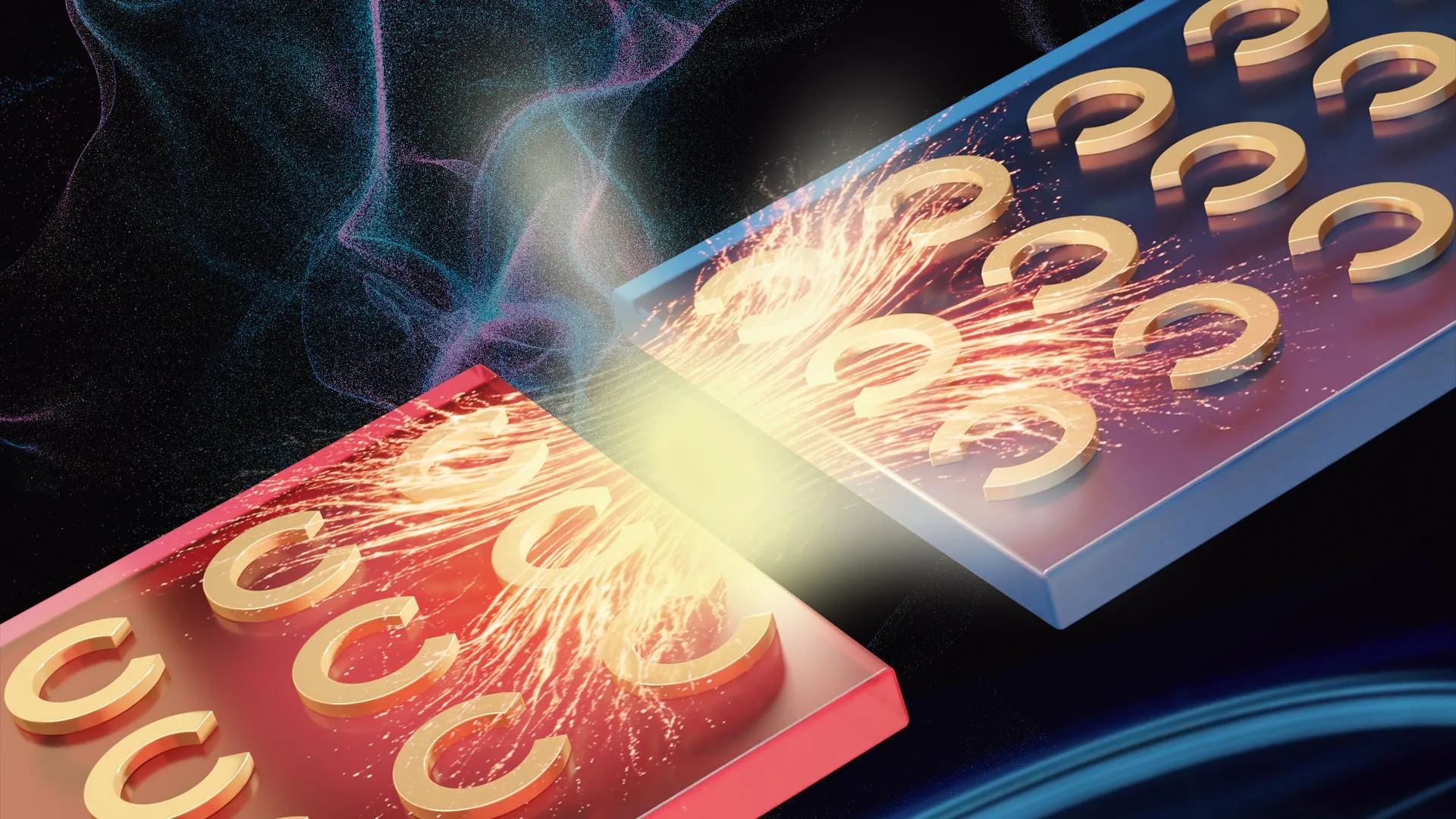
Physicists at Peking University have discovered a revolutionary method to confine light in extraordinarily small spaces without relying on metals and their inherent energy dissipation problems. The breakthrough centers on unusual "narwhal-shaped" wavefunctions that can trap light at deep-subwavelength volumes using only dielectric materials, potentially transforming photonic chip design and quantum technologies.
The research team, led by Ren-Min Ma, developed what they call the singular dispersion equation, a new theoretical framework showing that light can be confined to scales far smaller than previously thought possible. This advance, dubbed "singulonics," represents a major step forward in miniaturizing photonic devices, which have long lagged behind electronic components due to fundamental physical constraints related to light's wavelength.
The newly discovered narwhal-shaped wavefunctions exhibit two crucial behaviors that enable extreme light confinement. Near the singularity point, electromagnetic fields experience local power-law enhancement, while at larger distances, the fields rapidly decay through global exponential dampening. This combination allows researchers to concentrate and compress light far beyond traditional diffraction limits.
Using near-field scanning measurements, the team directly observed these unusual wavefunctions in action and achieved an ultrasmall mode volume of just 5 × 10^-7 λ³, representing extraordinary light confinement. Their experimental observations closely matched theoretical predictions and full three-dimensional simulations, confirming the viability of the approach.
The breakthrough could enable ultra-efficient photonic chips, advanced quantum technologies, and imaging tools with unprecedented resolution. Unlike previous plasmonic approaches that used metals to squeeze light into small spaces, the new dielectric-based method avoids significant heat losses, making it more suitable for practical applications requiring energy efficiency and scalability.