Scientists Discover Strange 'Narwhal' Waves That Trap Light Beyond Known Limits
Physicists have uncovered a new way to confine light in extremely small spaces using purely dielectric materials, avoiding the heat losses that plague current technologies.

Physicists at Peking University have uncovered a revolutionary method to confine light far beyond conventional limits without relying on metals and their inherent energy dissipation problems. By formulating what they call the singular dispersion equation, the research team discovered narwhal-shaped wavefunctions that can trap light at deep-subwavelength volumes using only lossless dielectric materials. This breakthrough, which they term "singulonics," could pave the way for ultra-efficient photonic chips, advanced quantum technologies, and imaging tools with unprecedented resolution.
The discovery addresses a fundamental challenge in photonic device miniaturization that has persisted for decades. Unlike electronic components, which have become increasingly compact, photonic devices have remained relatively bulky due to the physics governing light confinement. The uncertainty principle links light's confinement to its wavelength, and in the visible and near-infrared spectrum, this wavelength can be up to a thousand times larger than the de Broglie wavelength used in electronic circuits, creating inherent size limitations for optical systems.
Previous attempts to overcome these limitations through plasmonics, which uses metals to squeeze light into spaces smaller than its wavelength, suffered from significant energy dissipation that generated problematic heat. The new approach, developed by Ren-Min Ma's team at Peking University and published in Nature in 2024, demonstrates that lossless dielectric materials can achieve similar or superior light confinement without the thermal losses that have limited plasmonic systems.
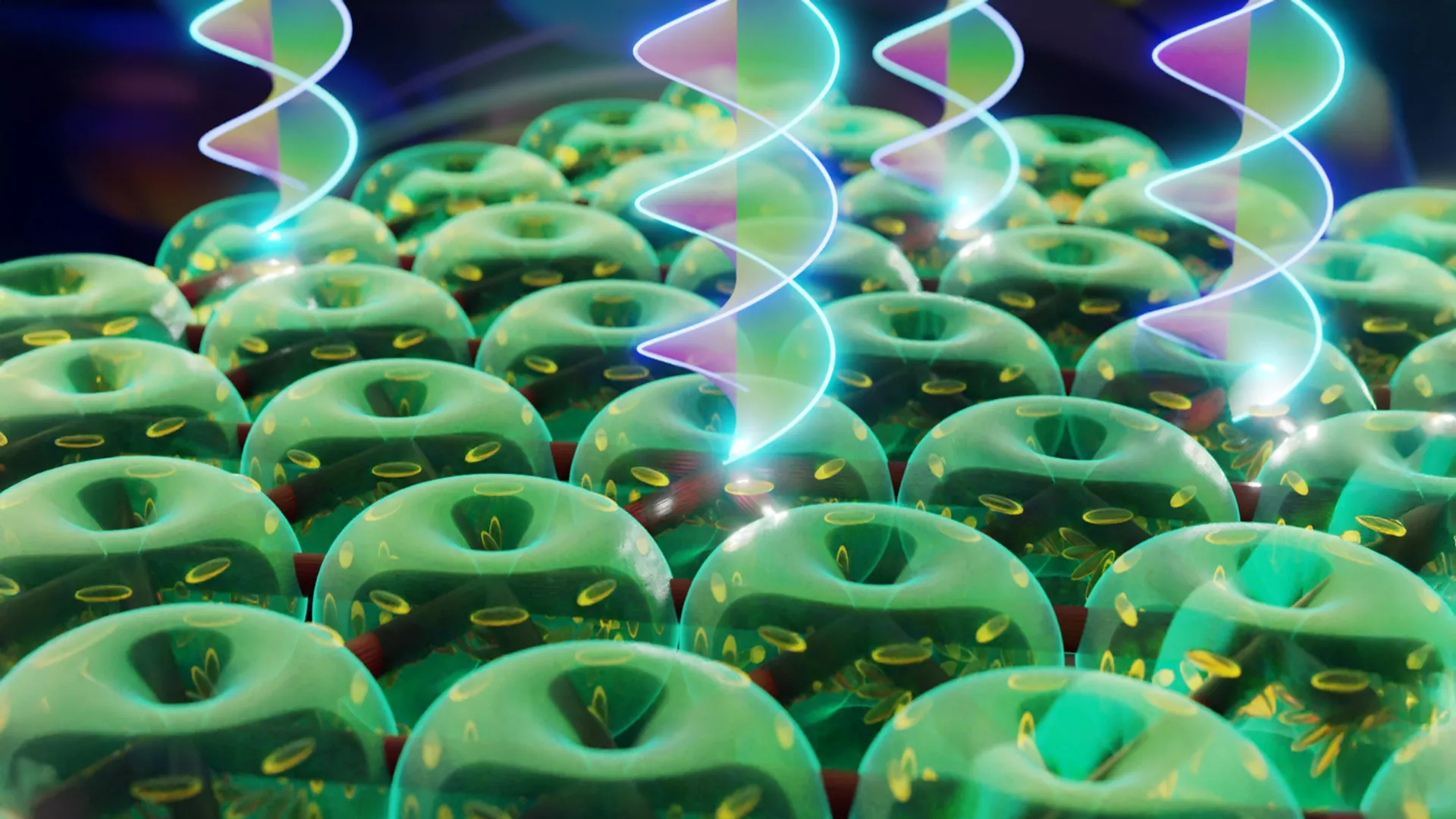
In their latest research published in eLight, the team reveals that this extreme light confinement arises from an entirely new class of electromagnetic eigenmodes they dubbed "narwhal-shaped wavefunctions." These unusual modes exhibit dual behavior: near the singularity, the electromagnetic field experiences local power-law enhancement, while at larger distances, the field rapidly diminishes through global exponential decay. This combination allows light to become concentrated and compressed far beyond traditional physical limits.
The researchers validated their theoretical predictions through experimental demonstrations using a three-dimensional singular dielectric resonator. Near-field scanning measurements directly observed the narwhal-shaped wavefunctions in action, showing both the predicted power-law growth near the singularity and exponential decay at greater distances. Their system achieved an ultrasmall mode volume of just 5 × 10⁻⁷ λ³, representing an extraordinary level of light confinement that could revolutionize photonic device design and enable new applications in quantum technologies and precision imaging.