Breakthrough Heat Transfer Technology Uses Gold Nanostructures to Cool Computer Chips
Carnegie Mellon researchers achieved four times greater heat transfer than conventional systems, potentially revolutionizing electronics cooling.
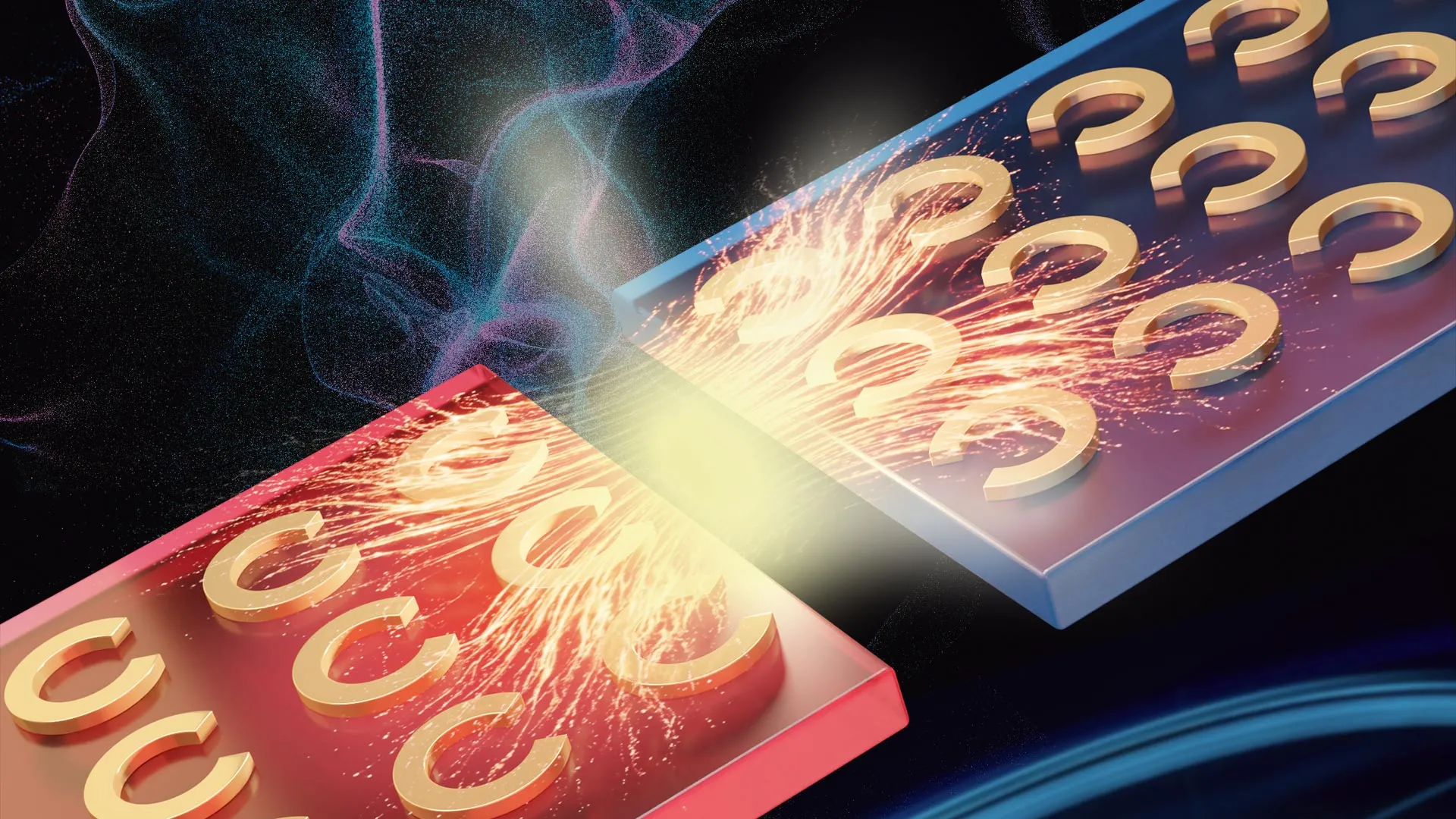
Scientists at Carnegie Mellon University have developed a revolutionary method for controlling heat at the nanoscale that could transform how electronic devices are cooled. The breakthrough, achieved in collaboration with Stanford University and Purdue University, uses specially designed gold metamaterials to dramatically enhance heat transfer across microscopic gaps.
The research focuses on near-field radiative heat transfer, a phenomenon that occurs when objects are separated by extremely small distances of only a few hundred nanometers. At these scales, heat can tunnel across gaps through electromagnetic waves far more efficiently than under normal conditions. The Carnegie Mellon team found that by patterning microscopic gold structures onto thin membranes, they could boost this effect by up to four times compared to similar systems without the engineered patterns.
"Unlike conventional materials, metamaterials are built with tiny, repeating patterns that interact with energy in precise ways," explained Sheng Shen, a professor of mechanical engineering at Carnegie Mellon and senior author of the study published in Nature. The gold structures work by interacting with naturally occurring energy waves in the material called surface phonon polaritons, creating a resonance effect that allows energy to move more freely across the nanoscale gap.
The enhancement isn't simply a matter of providing more pathways for heat to travel. Instead, the microscopic gold patterns and the material's natural energy waves work cooperatively, creating what researchers describe as coupled vibrations that facilitate more efficient energy transfer. This represents a fundamentally new approach to thermal management at the smallest scales.
The technology could have significant applications in electronics, where managing heat buildup is crucial for performance and reliability. As computer chips become smaller and more powerful, traditional cooling methods are reaching their limits. The ability to engineer heat transfer at the nanoscale using metamaterials opens possibilities for more efficient chip cooling systems, advanced energy technologies, and precision thermal control in quantum devices.

