Engineered Gold Metamaterials Supercharge Heat Flow Across Nanoscale Gaps, Study Finds
Researchers at Carnegie Mellon, Stanford and Purdue showed that patterning microscopic gold structures can boost radiative heat transfer up to fourfold, a result that could reshape cooling for electronics and energy systems.

Physicists have demonstrated a way to dramatically increase how much heat flows between two objects separated by a vanishingly small gap, using carefully engineered "metamaterials" patterned with microscopic gold structures. The work, published in the journal Nature by a team from Carnegie Mellon University in collaboration with Stanford University and Purdue University, found that the approach can boost the flow of thermal energy up to fourfold compared with conventional materials.
The effect exploits a strange feature of physics at the nanoscale. When two surfaces are brought to within a few hundred nanometers of each other — far thinner than a human hair — heat can travel between them far more efficiently than everyday experience would suggest, with thermal energy effectively tunneling across the narrow gap as electromagnetic waves. This phenomenon, known as near-field radiative heat transfer, breaks the familiar rules that govern how warm objects radiate energy at a distance.
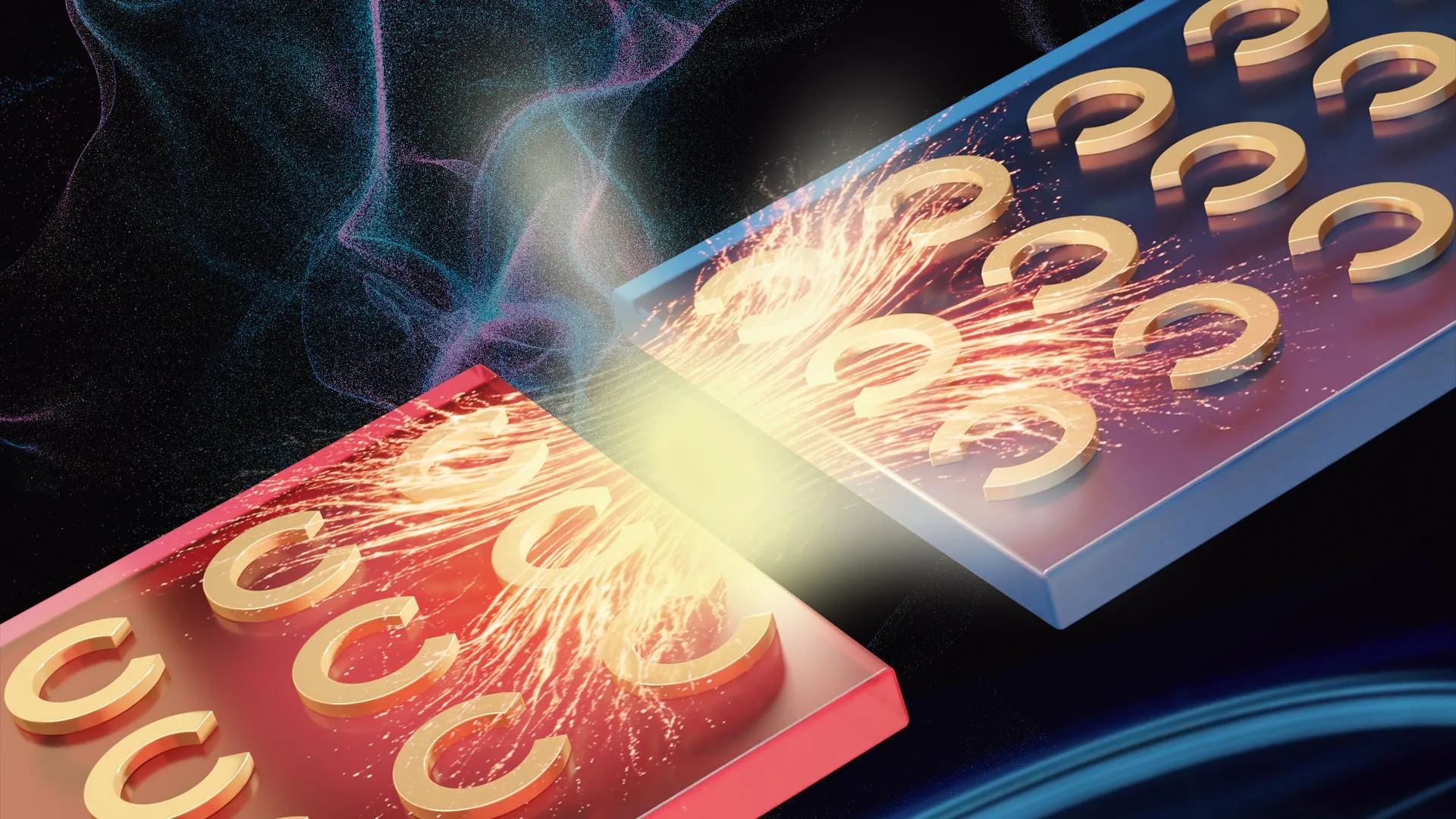
To harness it, the researchers fabricated arrays of tiny gold "split-ring resonators" on thin silicon nitride membranes. Compared with unstructured gold plates or bare membranes, the patterned metamaterials channeled radiative heat between the surfaces several times more effectively. By designing the geometry of the structures, the team was able to control and amplify the way the two surfaces exchanged energy — in effect engineering the thermal behavior of the system rather than accepting whatever the raw materials offered.
The implications reach into some of the most pressing problems in modern technology. Managing heat is a central challenge for everything from densely packed computer chips to solar-energy harvesting and devices that convert waste heat back into electricity. A method to deliberately enhance — or, by the same logic, suppress — heat flow at the nanoscale could give engineers a powerful new lever for keeping electronics cool or for squeezing more useful energy out of thermal gradients.
The study, with a DOI of 10.1038/s41586-026-10595-4 and authored by Wang, Yu, Salihoglu and colleagues, is an experimental demonstration rather than a finished product, and significant engineering would be required to scale the technique into commercial devices. But by showing that metamaterials can reliably control heat at the most fundamental level, the work opens a path toward a generation of thermal technologies that treat heat not as an inevitable byproduct but as something to be precisely directed.