Nine Dead as Thousands Swim and Storm Into Ceuta, and Spain Sends In the Army
Spain's border with Morocco at the Tarajal crossing 'totally collapsed' Thursday, a Civil Guard official said. Bodies could be seen in the water as crowds swam around the coastal barriers.
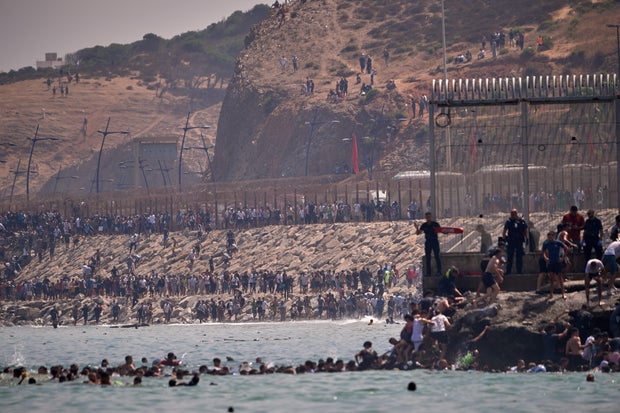
Spain said Thursday it would deploy the armed forces to its border with Morocco after thousands of people surged into the North African enclave of Ceuta in a single day, leaving at least nine dead and overwhelming a frontier that Spanish officials described as having completely broken down.
Spain's government delegation in Ceuta confirmed the nine deaths but gave no details about the circumstances. Bodies could be seen floating in the water off the coast, where much of the crossing took place. Video from the area showed large groups entering through the Tarajal border zone, many of them swimming around the coastal barriers that separate Moroccan territory from Spanish soil. Most of those arriving appeared to be young men, though families with women and children were also among them, and some in the crowds could be heard shouting in support of Spain. The reason for the sudden surge was not immediately clear.
"The situation is absolute chaos," a Civil Guard representative said, describing "thousands of migrants crossing" and a border that had "totally collapsed." A Moroccan human rights advocate called the conditions "exceptional," adding that "the Tarajal border was opened under unusual circumstances" — a pointed observation in a place where Rabat's management of the frontier has repeatedly been read as a diplomatic signal to Madrid and Brussels.
The Spanish government said it would send the armed forces to support border security operations, and Prime Minister Pedro Sánchez and Interior Minister Fernando Grande-Marlaska were scheduled to travel to Ceuta on Friday to assess the situation. Spain's Interior Ministry said the Moroccan government was "closely cooperating" with Spain to handle the crisis, and both governments committed to working together on returns.
Ceuta's regional government had already asked Madrid to declare a national emergency before Thursday's crossings, saying its reception facilities were overwhelmed. By July 15, nearly 3,000 migrants had entered the enclave this year — a figure Thursday's events dwarfed in a matter of hours. Ceuta covers only about seven square miles and houses roughly 85,000 residents, leaving almost no capacity to absorb a surge of that scale.
Ceuta and its sister enclave Melilla are the European Union's only land borders with Africa, and they have been among the continent's most active migration flashpoints for years. Migrants from across the continent regularly try to reach them by swimming from Moroccan beaches or scaling the heavily fortified fences that ring both cities, because setting foot inside means standing on EU soil. The last mass crossing on this scale came in May 2021, when roughly 8,000 people entered Ceuta during a diplomatic rupture between Madrid and Rabat, and Spain deployed troops then as well.
Originally reported by CBS News.