Judge Throws Out a Third 9/11 Defendant's Confessions, Citing Years of CIA Custody
Air Force Lt. Col. Michael Schrama ruled the government failed to prove Mustafa al Hawsawi's 2007 statements to the FBI were voluntary. Three of the four men charged in the death-penalty case now have confessions excluded.
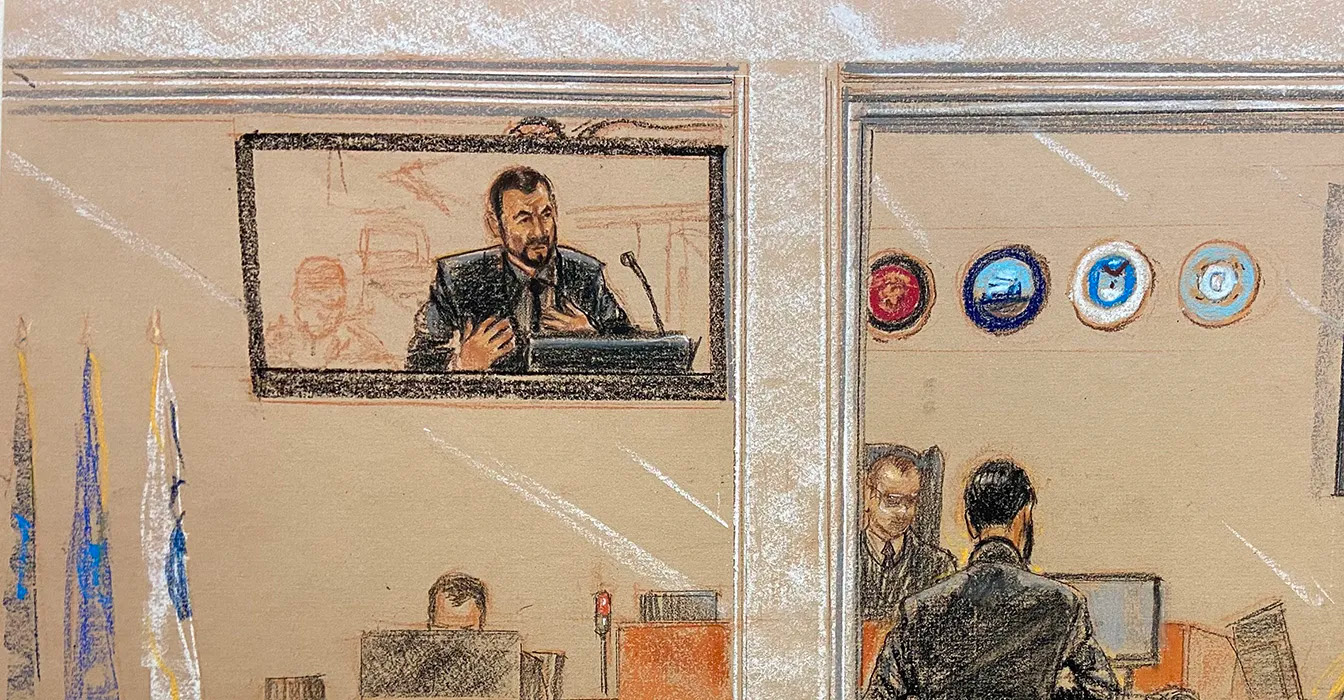
A military judge at Guantanamo Bay has thrown out another set of confessions in the September 11 case, ruling that statements Mustafa al Hawsawi gave the FBI in 2007 were not voluntary. It is the third time judges have shut out a defendant's confessions in the long-stalled death-penalty prosecution.
Air Force Lt. Col. Michael Schrama, the military judge in the case, found that prosecutors failed to show by a preponderance of the evidence that al Hawsawi spoke freely to FBI agents in January 2007. By then, al Hawsawi had spent more than three years in CIA custody. Captured in Pakistan in March 2003, he was held for months at a black site known as Location 2, or Cobalt, where he was subjected to what the agency called enhanced interrogation techniques.
The government argued that visits from the International Committee of the Red Cross, along with the passage of time, had cleared away the effects of the CIA's treatment. Schrama rejected that. "Mere ICRC visits are insufficient to dispel the impact of years of isolation from family and other detainees," he wrote. His ruling says the government did not establish that the FBI interviews were free from what came before.
Al Hawsawi is accused of providing money and other help to some of the 19 hijackers. His defense lawyer, Walter Ruiz, has said his client was tortured in CIA custody and suffered permanent injury.
Schrama had already ruled against the government once this year. In August 2026 he excluded statements from Khalid Shaikh Mohammad, the alleged mastermind of the attacks, citing what he described as "extraordinary physical and mental abuse." Before that, in April 2025, his predecessor suppressed confessions from Mohammad's nephew, Ammar al Baluchi. Four men are charged in the joint capital case, and a ruling on the confessions of the fourth, Walid bin Attash, is expected before hearings resume in December 2026.
The case has dragged on for nearly two decades. The five defendants were arraigned in 2012, and the proceedings have been slowed by disputes over classified evidence, the effects of torture on the defendants. Each ruling that keeps out a confession leaves prosecutors leaning on other evidence, which the defense says is thinner than the confessions the government wanted.
Legal experts say the rulings make a trial that could end in executions harder to bring. Statements obtained through coercion are barred in military commissions, and judges have now applied that rule to the central defendants in the case. Prosecutors can appeal to the U.S. Court of Military Commission Review. Families of the victims, many of whom have waited since 2001 for a verdict, have said repeatedly that they want the case resolved.