IBM Quantum Chip Tames Chaos in 100 Qubits, a Step Toward Self-Correcting Computers
Rutgers and IBM researchers measured and reset qubits in real time nearly 5,000 times and found a sharp switch from chaotic to controllable behavior at a 50-50 balance.

A quantum computer has checked what was happening inside itself and responded while it was running, repeatedly resetting parts of the system to bring chaotic behavior under control, researchers from Rutgers University, IBM and several partner institutions report in Nature Physics.
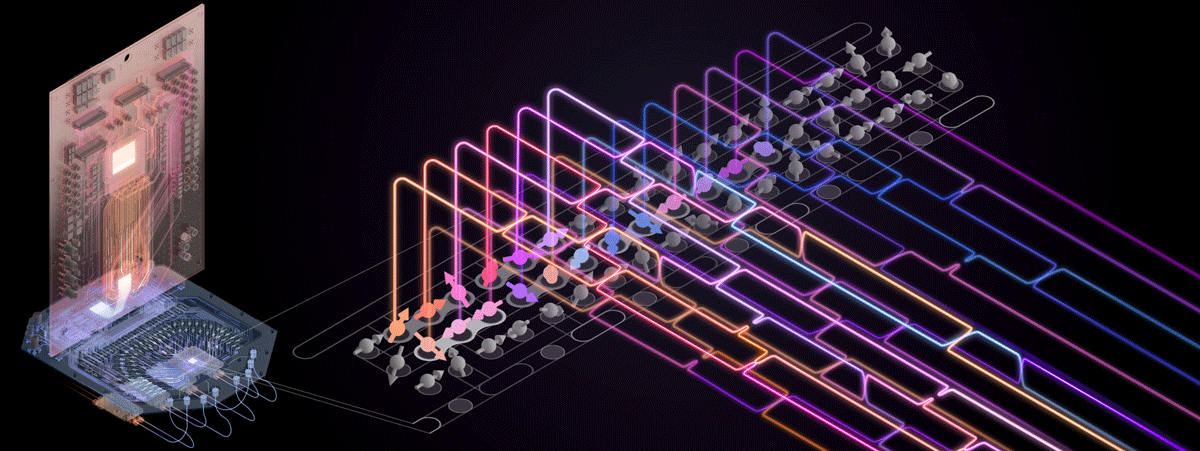
The paper, titled "Order from chaos with adaptive circuits on quantum hardware," has Bibek Pokharel among its authors. The team used a 156-qubit IBM Quantum Heron processor and a connected chain of up to 100 qubits. The circuit alternated between two jobs: a scrambler that mixed information among neighboring qubits, and a control step that measured qubits and reset them when needed.
Overall, the team ran nearly 5,000 two-qubit operations and nearly 5,000 checks and resets. They describe it as the largest successful demonstration of this approach to date. Classical computers could simulate only about two dozen qubits of the problem, so the hardware reached far past what ordinary machines can verify directly.
The key finding came from changing how often each job ran. When scrambling happened more than half the time, the system stayed chaotic. When checking and resetting dominated, the researchers could steer the qubits into a chosen ordered state. At roughly a 50-50 balance, the system underwent a sharp phase transition from chaos to controllable behavior. The transition became sharper as the system grew, and the results closely matched theoretical predictions.
The work matters because fault-tolerant quantum computers must detect and correct errors while they run. Quantum information is fragile: heat, stray electromagnetic signals, imperfect control pulses and hardware flaws can all introduce errors. It also cannot simply be copied, and measuring it can disturb it. The study demonstrates repeated real-time measurement and reset, which the authors describe as a step toward that goal. No fault-tolerant machine has been built yet.
Jedediah Pixley, a Rutgers physics professor, director of the Center for Materials Theory and a member of the Flatiron Institute, is a senior author. Maika Takita, an IBM principal research scientist for quantum error correction and dynamic circuits experiments, is also a senior author. Haining Pan, a Rutgers postdoctoral researcher at the time, is a co-first author. Barbara Jones of IBM and Justin Wilson of Louisiana State University also contributed, along with researchers at City College of New York, the CUNY Graduate Center, Iowa State University, Ames National Laboratory and Pennsylvania State University.
The project began with a bet at a 2021 birthday party for Pixley's wife. Collaborator Sriram Ganeshan wagered that a puzzling quantum effect had a counterpart in ordinary physics. Pixley lost and paid with two scoops of blueberry ice cream, after the group had gathered at the Aspen Center for Physics in Colorado.