Electrons Always Outrun the Wave That Pushes Them
Rochester Built a Laser Focus That Flies at Light Speed Instead.
A specially shaped mirror sweeps a laser's focal point down the beam axis at the vacuum speed of light, defeating the 'dephasing' ceiling that has capped plasma accelerators. Electrons hit 396 MeV where the limit predicted 185.

Physicists at the University of Rochester's Laboratory for Laser Energetics have broken through the ceiling that has constrained laser-plasma particle accelerators for three decades, accelerating electrons to more than twice the energy the governing limit says should be possible over the same distance.
The technique they used solves a problem with an unusually intuitive shape. A laser-plasma accelerator works by firing an intense, ultrashort laser pulse into a plasma. The pulse pushes electrons aside as it travels, and they rush back in behind it, creating a wave of separated charge — a wakefield — with enormous electric fields inside it. An electron caught in the right part of that wave gets accelerated hard. The gradients are roughly a thousand times stronger than in a conventional radiofrequency accelerator, which is why a plasma stage measured in centimeters can do work that takes a machine like SLAC kilometers.
The catch is that the wave cannot keep up. The electrons quickly reach essentially the speed of light in vacuum. The laser pulse driving the wave travels through plasma, where its group velocity is slightly slower. Over enough distance the electrons creep forward relative to the wave, slide out of the accelerating region and into the decelerating one, and stop gaining energy. This is dephasing, and it sets a hard cap on how much energy a single stage can deliver.
"When ultra-relativistic electrons accelerating in a wakefield catch up with the laser pulse driving the wakefield, acceleration ends prematurely," said Dr. Charlie Arrowsmith, describing the constraint.
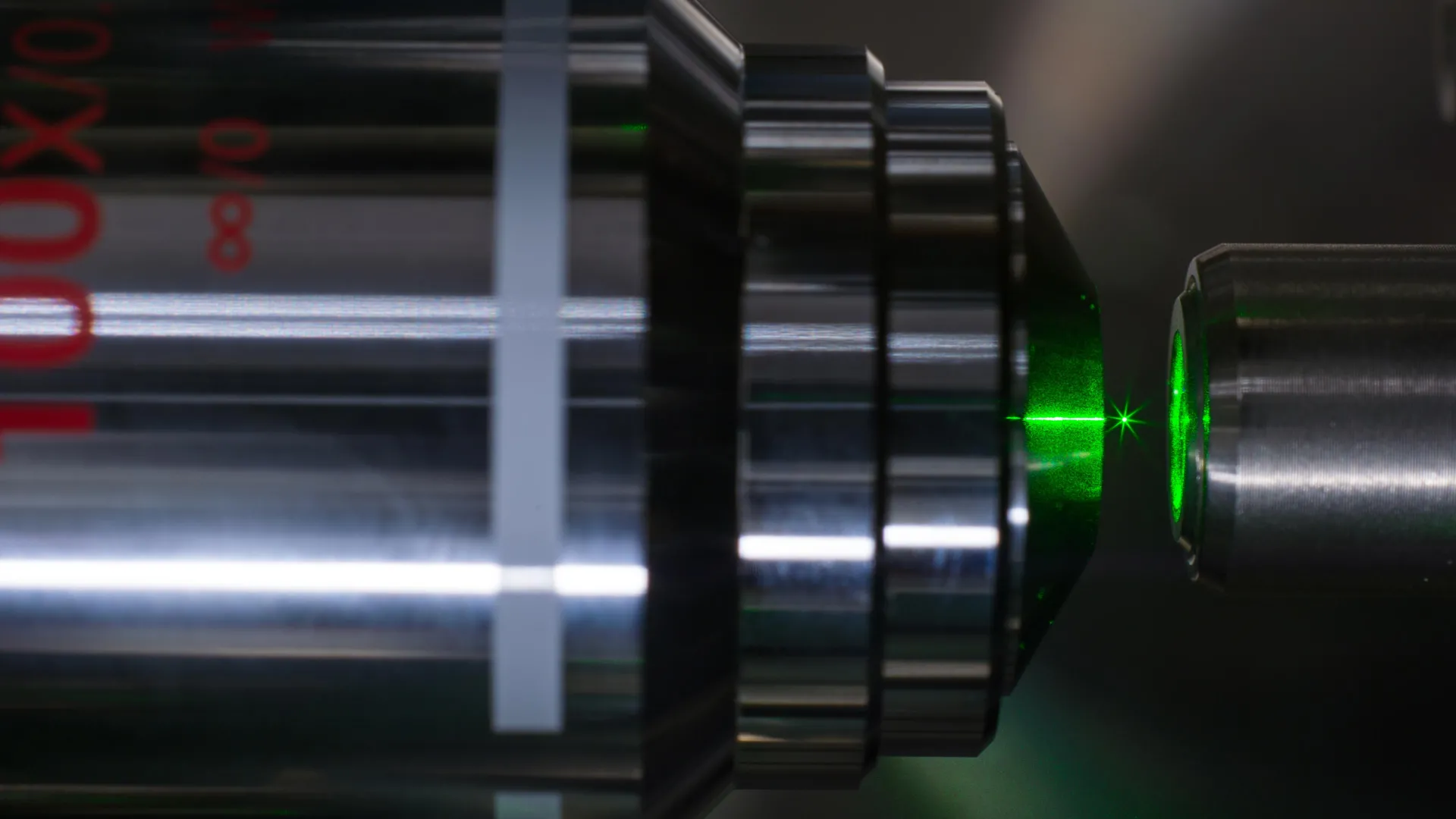
The Rochester approach, called dephasingless laser wakefield acceleration, attacks the premise rather than the symptom. Instead of trying to speed up the pulse, the team stopped requiring the pulse itself to travel with the electrons. They used a specialized mirror called an axiparabola, which does not bring all the incoming light to a single focal point. Light striking near the center focuses at one distance; light striking farther out focuses at another. The result is a peak of intensity that sweeps along the accelerator axis — a "flying focus." Because that peak is a moving interference pattern rather than a physical pulse, its velocity is set by the optics, not by how fast light propagates through the plasma. They tuned it to the vacuum speed of light, the same speed as the electrons.
In the experiment, published in Nature Physics, electrons in a hydrogen-argon gas mixture reached 396 ± 14 MeV. Under identical conditions, the conventional dephasing limit predicts 185 MeV. The plasma density had to be held in a narrow window — between 4.5 and 5.4 × 10¹⁸ per cubic centimeter — and the electrons were introduced by ionization injection, in which the argon's tightly bound inner electrons are stripped inside the wave and immediately captured by it.
The extrapolation is what makes the result significant beyond the specific numbers. Scaling the method suggests that reaching 100 GeV in a single stage could require less than a meter of accelerator, roughly a twentyfold improvement over conventional single-stage designs. That points toward TeV-class electron beams from meter-scale hardware — the long-standing motivation for plasma acceleration research, and the reason it is treated as a candidate technology for a future linear collider. The researchers note that additional optics could give finer control over how the focus moves.